The problems of the UGA prelim, Fall 2016, in exam order.
Negation of uniform convergence and a pointwise but nonuniform example (Tag P-A4JGH)
A sequence \(\{f_n:\mathbb R\to\mathbb R\}_{n=1}^{\infty}\) converges uniformly to \(f:\mathbb R\to\mathbb R\) if, for every \(\varepsilon>0\), there is a positive integer \(N\) such that \[ n>N\quad\Longrightarrow\quad |f_n(x)-f(x)|<\varepsilon \] for all \(x\in\mathbb R\).
What must one check to show that a sequence does not converge uniformly?
Give an example such that \(f_n(x)\) converges to \(f(x)\) for every \(x\in\mathbb R\), but the sequence does not converge uniformly.
Solution
The negation of uniform convergence is \[ \exists\varepsilon_0>0\ \forall N\in\mathbb N\ \exists n>N\ \exists x\in\mathbb R: |f_n(x)-f(x)|\geq\varepsilon_0. \]
For example, let \(f_n(x)=x/n\) and \(f(x)=0\). For each fixed \(x\), one has \(x/n\to0\). The convergence is not uniform. Take \(\varepsilon_0=1\). For every \(N\), choose \(n=N+1\) and \(x=n\). Then \[ |f_n(x)-f(x)|=1. \]
Spectral theorem diagonalization with eigenvalues $1$ and $-2$ (Tag P-VPCLD)
Find an invertible matrix \(A\) and a diagonal matrix \(B\) such that \[ \begin{pmatrix}4&-6\\3&-5\end{pmatrix}=ABA^{-1}. \]
Solution
The eigenvalues are \(1\) and \(-2\). Corresponding eigenvectors are \((2,1)^t\) and \((1,1)^t\). Thus one can take \[ A=\begin{pmatrix}2&1\\1&1\end{pmatrix}, \qquad B=\begin{pmatrix}1&0\\0&-2\end{pmatrix}. \] The columns of \(A\) are linearly independent, and the eigenvector equations give \(MA=AB\) for the given matrix \(M\). Hence \(M=ABA^{-1}\).
Power series at $4$ with radius $1$ converging at one endpoint (Tag P-FB5CY)
Give an example, with proof, of a power series that converges exactly on the interval \([3,5)\).
Solution
We want some power series centered at 4 with convergence radius 1, so something of the form \(\sum_n f(n)(x-4)^n\) with \(L = \lim \frac{a_{n+1}}{a_n} = 1\).
Then, by plugging in \(5\) and \(3\), we find that we want \(\sum (-1)^n f(n)\) to converge but \(\sum f(n)\) to diverge. The canonical example of this is the harmonic series with \(f(n) = \frac 1 n\), so we can just take \[f(x) = \sum_n \frac{(x-4)^n}{n}. \qed\]
$\lim_{x\to 2}\frac{1}{3+x}=\frac{1}{5}$ (Tag P-L3LHW)
Give an \(\varepsilon\)-\(\delta\) proof that \[ \lim_{x\to2}\frac1{3+x}=\frac15. \]
Solution
Let \(\varepsilon>0\) and choose \(\delta=\min\{1,20\varepsilon\}\). If \(|x-2|<\delta\), then \(1<x<3\), so \(|5(3+x)|>20\). Therefore \[ \left|\frac1{3+x}-\frac15\right| =\left|\frac{2-x}{5(3+x)}\right| <\frac1{20}|x-2| <\varepsilon. \]
Line integral of $[2x+y,y]$ from $(2,1)$ to $(3,5)$, and non-conservativeness (Tag P-RPSK2)
Choose a path \(C\) from \((2,1)\) to \((3,5)\) and compute \[ \int_C(2x+y)\,dx+y\,dy. \]
Give and apply a criterion that shows whether this integral is path independent.
Solution
Parametrize the line segment by \[ r(t)=(1-t)(2,1)+t(3,5)=(2+t,1+4t),\qquad 0\leq t\leq1. \] Then \[ \int_C(2x+y)\,dx+y\,dy =\int_0^1(9+22t)\,dt =20. \]
For \(F=(P,Q)=(2x+y,y)\), path independence on \(\mathbb R^2\) would require \(P_y=Q_x\). Here \(P_y=1\) and \(Q_x=0\), so the integral is path dependent.
$\sum_{i=1}^n i^3 = \bigl(\sum_{i=1}^n i\bigr)^2$ (Tag P-IKEPG)
Use induction to prove that, for every positive integer \(n\), \[ 1^3+2^3+\cdots+n^3=(1+2+\cdots+n)^2. \]
Solution
- Use the fact that \(\sum_{i=1}^n i = \frac 1 2 n(n+1)\), so \[\begin{align*} \sum_{i=1}^{n+1} i^3 &= \sum_{i=1}^{n} i^3 + (n+1)^3 \\ &= \left( \sum_{i=1}^{n} i \right)^2 + (n+1)^3 \\ &= \left( \frac 1 2 n(n+1) \right)^2 + (n+1)^3 \\ &= \frac 1 4 n^2(n+1)^2 + (n+1)(n+1)^2 \\ &= \frac 1 4 (n+1)^2 (n^2 + 4(n+1)) \\ &= \frac 1 4 (n+1)^2(n+2)^2 \\ &= \left( \frac 1 2 (n+1)(n+2)\right)^2 \\ &= \left( \sum_{i=1}^{n+1} i \right)^2. \qed \end{align*}\]
$f^{-1}(f(S))=S$ for all $S$ iff $f$ is injective (Tag P-MNR6F)
Let \(f:X\to Y\) be a map of sets. Give, with proof, necessary and sufficient conditions for \[ f^{-1}(f(S))=S \] for every subset \(S\subseteq X\).
Solution
The condition is that \(f\) is injective.
For every map and every \(S\subseteq X\), one has \(S\subseteq f^{-1}(f(S))\). If \(f\) is injective and \(x\in f^{-1}(f(S))\), then \(f(x)=f(s)\) for some \(s\in S\). Injectivity gives \(x=s\), so \(x\in S\). Thus equality holds.
Conversely, suppose the equality holds for every \(S\subseteq X\). If \(f(a)=f(b)\), then \[ b\in f^{-1}(f(\{a\}))=\{a\}, \] so \(b=a\). Hence \(f\) is injective.
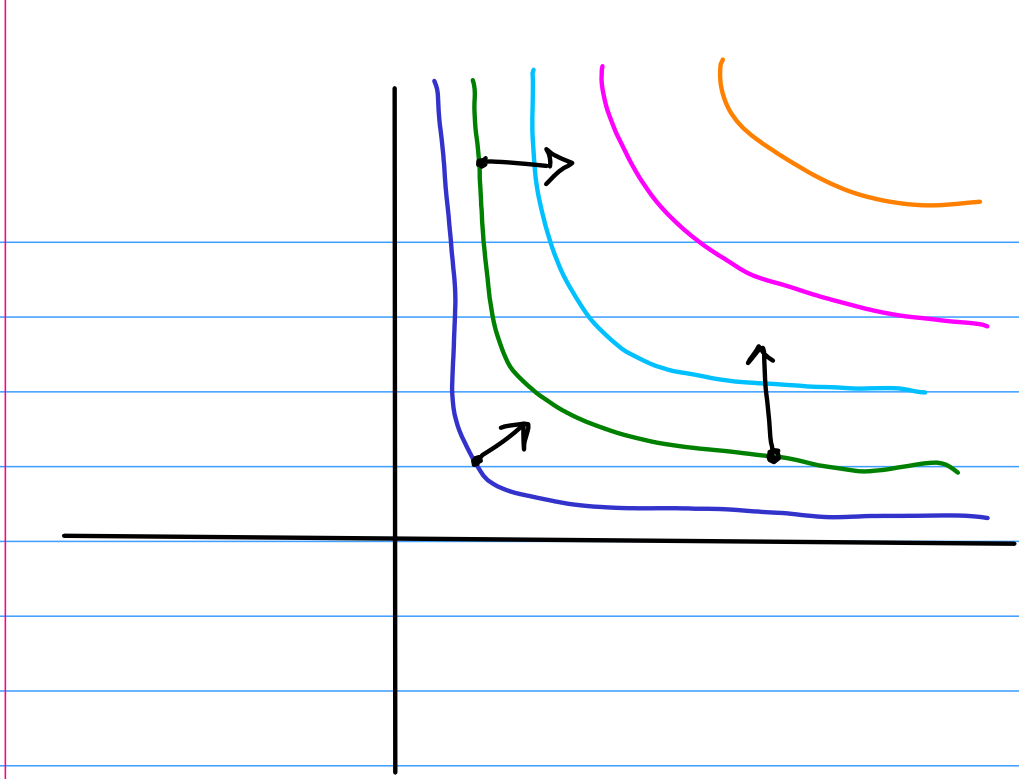
The gradient of $xy$ is orthogonal to its level curves (Tag P-FPMMA)
Let \(f(x,y) = xy\). Show that \(\nabla f\) is orthogonal to the level curves of \(f\).
Solution
\(\nabla f = (y, x)\). Along a level curve \(f(x,y) = c\) one may take a parametrization \(\gamma\) with \(f(\gamma(t)) = c\), so \(\frac{d}{dt}f(\gamma(t)) = 0\). By the chain rule this inner product is \(\langle \nabla f(\gamma(t)), \gamma'(t)\rangle\), hence \(\nabla f\) is orthogonal to every tangent of the level curve.
The nullspace of a given $3\times 3$ matrix is $\mathrm{span}\{(1,3,5)\}$ (Tag P-KBQZ5)
Let \[ A = \begin{pmatrix} 1 & -2 & 1 \\ 0 & 5 & -3 \\ 0 & 0 & 0 \end{pmatrix}. \] Show that \(\ker A = \operatorname{span}\{(1,3,5)\}\).
Solution
Row-reducing \(A\) (already nearly echelon) gives the system \(x-2y+z=0\) and \(5y-3z=0\). Thus \(y=\frac{3}{5}z\) and \(x=2y-z=\frac{1}{5}z\). Taking \(z=5\) yields the basis vector \((1,3,5)\). The kernel is one-dimensional, so \(\ker A = \operatorname{span}\{(1,3,5)\}\).