Point-set
Neighborhoods, limit points, and open and closed sets in a metric space (Tag D-SN2OH)
Let \((X,d)\) be a metric space, let \(p\in X\), and let \(E\subseteq X\).
For \(r>0\), the neighborhood of \(p\) of radius \(r\) is \(N_r(p)\coloneqq\ts{q\in X\st d(p,q)<r}\).
The point \(p\) is a limit point of \(E\) if every neighborhood of \(p\) contains a point \(q\in E\) with \(q\neq p\).
If \(p\in E\) and \(p\) is not a limit point of \(E\), then \(p\) is an isolated point of \(E\).
\(E\) is closed if every limit point of \(E\) belongs to \(E\).
The point \(p\) is an interior point of \(E\) if some neighborhood \(N\) of \(p\) satisfies \(N\subseteq E\).
\(E\) is open if every point of \(E\) is an interior point of \(E\).
The complement of \(E\) is \(E^c\coloneqq\ts{p\in X\st p\notin E}\).
\(E\) is perfect if \(E\) is closed and every point of \(E\) is a limit point of \(E\).
\(E\) is bounded if there are \(M\in\RR\) and \(q\in X\) with \(d(p,q)<M\) for all \(p\in E\).
\(E\) is dense in \(X\) if every point of \(X\) is a limit point of \(E\) or a point of \(E\), or both.
A point \(p\in X\) is a limit point of \(E\) if and only if \((N_r(p)\setminus\ts{p})\cap E\neq\emptyset\) for every \(r>0\). By (c), every point of \(E\) is either a limit point or an isolated point of \(E\), and not both.
(Open and closed subsets of $\RR$)
- \(\QQ \subseteq \RR\) is neither open nor closed. Every neighborhood of a rational number contains an irrational number, and every neighborhood of an irrational number contains a rational number, so neither \(\QQ\) nor \(\RR\sm\QQ\) has an interior point. \(\QQ\) has no isolated points, and every \(r\in \RR\) is a boundary point and an accumulation point of \(\QQ\).
- \(\ZZ \subseteq \RR\) is closed and not open. Its complement \(\RR\sm\ZZ = \bigcup_{n\in \ZZ} (n, n+1)\) is open, and every neighborhood of \(n\in \ZZ\) meets \(\RR\sm \ZZ\), so \(\ZZ\) has no interior points. Every point of \(\ZZ\) is an isolated point and a boundary point, and \(\ZZ\) has no accumulation points.
- Points are closed in \(\RR\), since \(\RR \sm \ts{ p } = (-\infty, p) \union (p, \infty)\) is open. An infinite intersection of open sets need not be open: \(\bigcap_{n\geq 1} (p-1/n, p+1/n) = \ts{ p }\).
- An interval \((a, b)\) is open in \(\RR\), and \((a,b)\cross\ts{0}\) is not open in \(\RR^d\) for \(d\geq 2\).
- \(\ts{1/n \suchthat n\geq 1}\) has no interior points, each of its points is isolated, its boundary is \(\ts{0}\union\ts{1/n \suchthat n\geq 1}\), and its only accumulation point is \(0\).
- The Cantor set has no interior points and no isolated points; every point of it is a boundary point and an accumulation point.
Common spaces and operations
(Standard spaces)
\[ S^n,\ \DD^n,\ T^n,\ \RP^n,\ \CP^n,\ \mathbb{M},\ \mathbb{K},\ \Sigma_{g},\ \RP^\infty,\ \CP^\infty, \] where \(\mathbb M\) is the Möbius band, \(\mathbb K\) the Klein bottle, and \(\Sigma_g\) the closed orientable surface of genus \(g\).
(Spaces that serve as counterexamples)
- A finite set with at least two points and the discrete topology is compact and Hausdorff and not connected.
- \((a, b)\) and \((a,\infty)\) are homeomorphic to \(\RR\) and not compact; \((a,b]\) is neither open nor closed in \(\RR\); \(\ts{0} \union \ts{1/n\suchthat n\geq 1}\) is compact and countable, and \(0\) is not an isolated point.
- \(\QQ\) is totally disconnected, not discrete, and not locally compact.
- The topologist’s sine curve is connected, not path connected, and not locally connected.
- The one-point compactification of a locally compact Hausdorff space is compact Hausdorff; that of \(\QQ\) is compact and not Hausdorff.
- \(\RR^\omega\), the countable product of copies of \(\RR\), is connected and metrizable in the product topology, metrizable and not connected in the uniform topology, and neither connected nor metrizable in the box topology.
- The Hawaiian earring is path connected and locally path connected and not semilocally simply connected, so it has no universal cover.
- The Cantor set is compact, uncountable, and totally disconnected, with no isolated points.
- Quaternionic projective space \(\HP^n\) has a CW structure with one cell in each dimension \(0,4,\ldots,4n\), so \(H_k(\HP^n)\cong\ZZ\) for \(k\in\ts{0,4,\ldots,4n}\) and \(H_k(\HP^n)=0\) otherwise.
- The dunce cap is contractible, and no triangulation of it has a free edge, so it is not collapsible.
- The Alexander horned sphere is an embedding \(S^2\injects S^3\) one of whose complementary components is not simply connected, so the Schoenflies theorem fails in dimension \(3\).
The function $xy/(x^2+y^2)$ is separately continuous but not jointly continuous (Tag FE-BGEZL)
A function \(\RR^2\to\RR\) can be continuous in each variable separately without being continuous. Define \(f\colon\RR^2\to\RR\) by \[ f(x, y) = \begin{cases} \dfrac{xy}{x^2 + y^2}, & (x, y) \neq (0, 0), \\ 0, & (x, y) = (0, 0). \end{cases} \] For each \(b\in\RR\) the map \(x\mapsto f(x, b)\) is continuous on \(\RR\), and for each \(a\in\RR\) the map \(y\mapsto f(a, y)\) is continuous on \(\RR\); on the line \(y = 0\) the function vanishes identically. Along the line \(y = x\), \(f(t, t) = 1/2\) for \(t\neq 0\), so \(f(t,t)\to 1/2\neq f(0,0)\) as \(t\to 0\), and \(f\) is not continuous at the origin.
(Non-Hausdorff spaces)
- An infinite set with the cofinite topology.
- The quotient group \(\RR/\QQ\) with the quotient topology, which is indiscrete.
- The line with two origins.
- An algebraic set \(V(J) \subseteq \AA^n_{k}\) with infinitely many points, for \(k\) a field and \(J\normal \kx{n}\), with the Zariski topology.
(Constructions of spaces)
- Knot complements in \(S^3\)
- Covering spaces
- Lens spaces
- Matrix groups
- Prism manifolds
- The pair of pants
- Seifert surfaces
- Surgery on manifolds
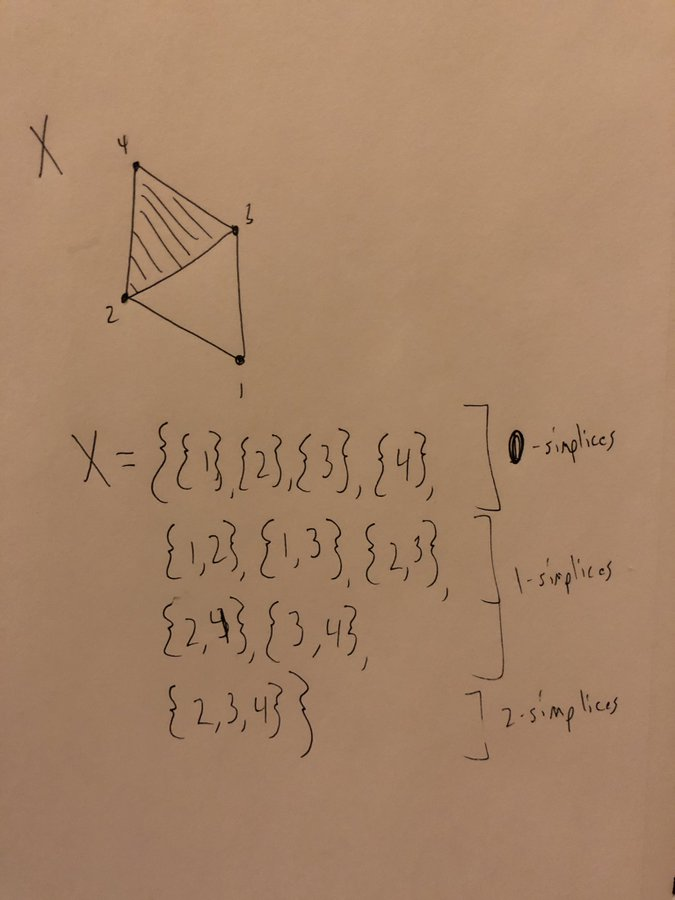
- Simplicial complexes, such as the following:
(Operations on spaces)
- Cartesian product \(A\cross B\)
- Wedge sum \(A \vee B\)
- Connected sum \(A \# B\)
- Quotient \(A/B\) by a subspace
- Puncturing, \(A\sm \theset{a_{1},\ldots,a_k}\)
- Smash product \(A\wedge B\)
- Join \(A\ast B\)
- Cone \(CA\)
- Suspension \(\Sigma A\)
- Loop space \(\Omega A\)
- Identifying finitely many points
Alternative topologies
(The cofinite topology)
Let \(X\) be a set with the cofinite topology. Then \(X\) is compact, and if \(X\) is infinite, then \(X\) is not Hausdorff, since any two nonempty open sets have finite complements and therefore intersect.
Topology is discrete if and only if points are open (Tag PR-NJTN5)
Let \((X, \tau)\) be a topological space. Then \(\tau\) is the discrete topology if and only if \(\theset{x}\in\tau\) for every \(x\in X\).
If the topology is discrete, every singleton is open. Conversely, if \(\ts x\) is open for each \(x \in X\), then every \(U\subseteq X\) is the union \(\bigcup_{x\in U}\ts x\) of open sets, so \(U\) is open.
(The discrete topology)
In the discrete topology on \(X\), every subset is open.
- \(X\) is Hausdorff.
- \(X\) is compact if and only if \(X\) is finite.
- \(X\) is totally disconnected.
- Every map \(f\colon X\to Y\) to a space \(Y\) is continuous, since every preimage \(f^{-1}(V)\) is a subset of \(X\) and hence open.
(The indiscrete topology)
In the indiscrete topology on \(X\), the only open sets are \(\emptyset\) and \(X\).
- If \(X\) has at least two points, then \(X\) is not Hausdorff.
- Every map \(f\colon Y\to X\) from a space \(Y\) is continuous, since the preimages of \(\emptyset\) and \(X\) are \(\emptyset\) and \(Y\).
- \(X\) is compact.
Connectedness
| Space | Connected | Locally connected |
|---|---|---|
| \(\RR\) | \(\checkmark\) | \(\checkmark\) |
| \([0, 1] \union [2, 3]\) | \(\checkmark\) | |
| Topologist’s sine curve | \(\checkmark\) | |
| \(\QQ\) |