By the mean value theorem, a differentiable function with \(\abs{f'}\leq C\) on an interval is \(C\)-Lipschitz there. If each \(f_n\) is differentiable on a bounded interval \(I\), \(\sum_n f_n'\) converges uniformly on \(I\), and \(\sum_n f_n(x_0)\) converges for some \(x_0\in I\), then \(\sum_n f_n\) converges uniformly on \(I\) and \(\qty(\sum_n f_n)' = \sum_n f_n'\).
Mean value theorem and Cauchy's mean value theorem (Tag T-OXNTU)
Let \(a<b\) and let \(f\colon [a, b] \to \RR\) be continuous on \([a,b]\) and differentiable on \((a, b)\).
There exists \(\xi \in (a, b)\) such that \[ f(b) - f(a) = f'(\xi)(b-a). \]
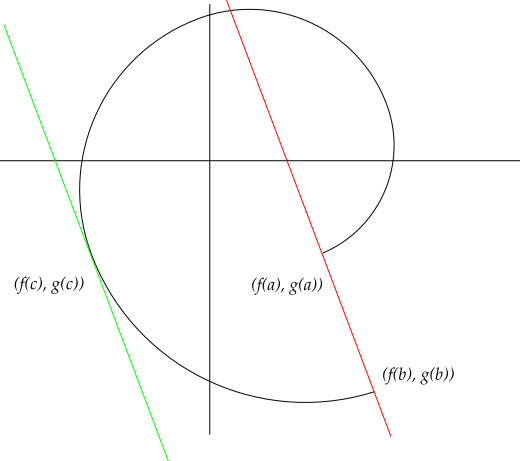
If \(g\colon [a,b]\to \RR\) is also continuous on \([a, b]\) and differentiable on \((a, b)\), then there exists \(\xi\in(a,b)\) such that \[ \qty{ f(b) - f(a) } g'(\xi) = \qty{g(b) - g(a)} f'(\xi). \] [@Rud76].
Geometrically, (2) says that the plane curve \(t\mapsto(f(t),g(t))\), \(t\in[a,b]\), has a tangent vector \((f'(\xi),g'(\xi))\) at some interior parameter \(\xi\) that is parallel to the chord from \((f(a),g(a))\) to \((f(b),g(b))\).
Term-by-term differentiation of a series of functions (Tag T-TR526)
Let \(a<b\), let \(A\coloneqq[a,b]\), and let \(f_n\colon A\to\RR\) for \(n\geq1\) be differentiable on \(A\). Suppose that \(\sum_{n=1}^\infty f_n'\) converges uniformly on \(A\) to a function \(g\colon A\to\RR\), and that \(\sum_{n=1}^\infty f_n(x_0)\) converges for some \(x_0\in A\). Then \(\sum_{n=1}^\infty f_n\) converges uniformly on \(A\) to a function \(f\colon A\to\RR\), \(f\) is differentiable on \(A\), and \(f'=g\) on \(A\) [@Abb16].
A differentiable function on an interval is Lipschitz if and only if its derivative is bounded (Tag PR-LTRLV)
Let \(I\subseteq\RR\) be an interval with nonempty interior and let \(f\colon I\to\RR\) be differentiable. Then \(f\) is Lipschitz, that is, there is \(C\geq0\) with \(\abs{f(x)-f(y)}\leq C\abs{x-y}\) for all \(x,y\in I\), if and only if \(f'\) is bounded on \(I\). In that case the smallest such constant is \(C=\sup_{x\in I}\abs{f'(x)}\).
A Lipschitz function need not be differentiable: \(x\mapsto\abs{x}\) on \((-1,1)\) satisfies \(\abs{\abs x-\abs y}\leq\abs{x-y}\) and is not differentiable at \(0\).
The interval hypothesis is needed: on \(U\coloneqq(0,1)\cup(1,2)\), the function \(f\coloneqq\chi_{(1,2)}\) is differentiable with \(f'=0\), but \(\abs{f(1+\delta)-f(1-\delta)}=1\) for \(0<\delta<1\), so \(f\) is not Lipschitz on \(U\).
Differentiability implies continuity (Tag FR-EDJWQ)
Let \(I\subseteq\RR\) be an open interval, let \(f\colon I\to\RR\), and let \(x_0\in I\). If \(f\) is differentiable at \(x_0\), then \(f\) is continuous at \(x_0\).
For \(x\in I\) with \(x\neq x_0\), \[ f(x)-f(x_0)=(x-x_0)\,\frac{f(x)-f(x_0)}{x-x_0}. \] As \(x\to x_0\), the first factor tends to \(0\) and the second tends to \(f'(x_0)\) by differentiability. Hence \(f(x)-f(x_0)\to0\), so \(f\) is continuous at \(x_0\).
The converse fails. The function \(f\colon\RR\to\RR\), \(f(x)=\abs{x}\), is continuous at \(0\). Its difference quotient \(\frac{f(h)-f(0)}{h}=\frac{\abs{h}}{h}\) equals \(1\) for \(h>0\) and \(-1\) for \(h<0\), so it has no limit as \(h\to0\), and \(f\) is not differentiable at \(0\).
(A bounded differentiable function with unbounded derivative)
On \([-1,1]\) let \[ f(x) \coloneqq \begin{cases} x^2 \sin\qty{1\over x^2}, & x\neq 0, \\ 0, & x=0. \end{cases} \] Then \(\abs f\leq1\), and \(f\) is differentiable at \(0\) since \(\abs{f(h) - f(0)}/\abs h = \abs{ h\sin\qty{h^{-2}}}\leq \abs{h}\to 0\). For \(x\neq0\), \[ f'(x) = 2x\sin\qty{1\over x^2 } - {2\over x}\cos\qty{1\over x^2}. \] For \(x_k \coloneqq 1/\sqrt{k\pi}\), \[ f'(x_k)=-2\sqrt{k\pi}(-1)^k, \qquad \abs{f'(x_k)}=2\sqrt{k\pi}\longrightarrow\infty, \] so \(f'\) is unbounded on \([-1,1]\).