Some interior derivative realizes the secant slope; Cauchy gives the two-function version.Suggest a slogan
Let \(a<b\) and let \(f\colon [a, b] \to \RR\) be continuous on \([a,b]\) and differentiable on \((a, b)\).
There exists \(\xi \in (a, b)\) such that \[ f(b) - f(a) = f'(\xi)(b-a). \]
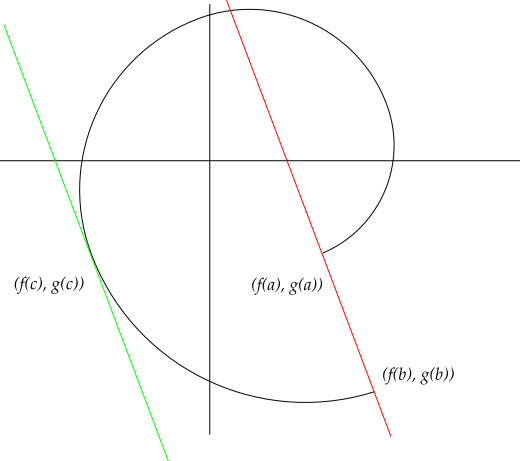
If \(g\colon [a,b]\to \RR\) is also continuous on \([a, b]\) and differentiable on \((a, b)\), then there exists \(\xi\in(a,b)\) such that \[ \qty{ f(b) - f(a) } g'(\xi) = \qty{g(b) - g(a)} f'(\xi). \] [@Rud76].
Geometrically, (2) says that the plane curve \(t\mapsto(f(t),g(t))\), \(t\in[a,b]\), has a tangent vector \((f'(\xi),g'(\xi))\) at some interior parameter \(\xi\) that is parallel to the chord from \((f(a),g(a))\) to \((f(b),g(b))\).