Fermat’s theorem: if \(f\colon(a,b)\to\RR\) has a local extremum at \(c\) and is differentiable at \(c\), then \(f'(c)=0\). The mean value theorem: if \(f\) is continuous on \([a,b]\) and differentiable on \((a,b)\), then \(f(b)-f(a)=f'(c)(b-a)\) for some \(c\in(a,b)\). Taylor’s theorem: if \(f^{(n)}\) is continuous on \([a,b]\) and \(f^{(n+1)}\) exists on \((a,b)\), then \(f(b)=\sum_{k=0}^{n}\frac{f^{(k)}(a)}{k!}(b-a)^k+\frac{f^{(n+1)}(c)}{(n+1)!}(b-a)^{n+1}\) for some \(c\in(a,b)\). A function of bounded variation on \([a,b]\) is the difference of two increasing functions, and is therefore differentiable almost everywhere; functions of bounded variation are the integrators of Riemann–Stieltjes integration.
Fermat's stationary-point theorem (Tag T-RA-WORKSHOP-D5-4-1)
Let \(a<b\), let \(f\colon[a,b]\to\RR\), and let \(c\in(a,b)\). If \(f\) has a local maximum or a local minimum at \(c\) and \(f\) is differentiable at \(c\), then \(f'(c)=0\). [@Rud76].
Mean value theorem (Tag T-RA-WORKSHOP-D5-4-2)
Let \(a<b\) and let \(f\colon[a,b]\to\RR\) be continuous on \([a,b]\) and differentiable on \((a,b)\). Then there exists \(\xi\in(a,b)\) such that \[ \frac{f(b)-f(a)}{b-a}=f'(\xi). \] [@Rud76].
Mean value theorem and Cauchy's mean value theorem (Tag T-OXNTU)
Let \(a<b\) and let \(f\colon [a, b] \to \RR\) be continuous on \([a,b]\) and differentiable on \((a, b)\).
There exists \(\xi \in (a, b)\) such that \[ f(b) - f(a) = f'(\xi)(b-a). \]
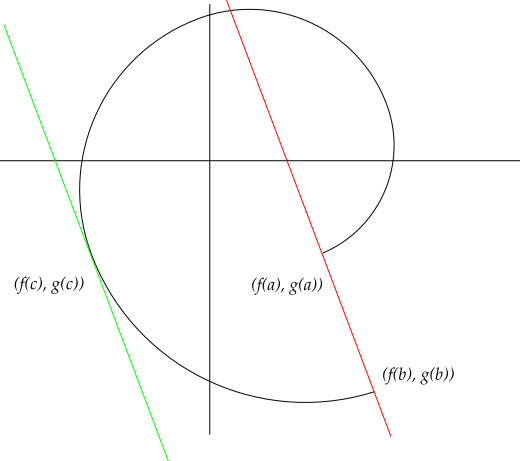
If \(g\colon [a,b]\to \RR\) is also continuous on \([a, b]\) and differentiable on \((a, b)\), then there exists \(\xi\in(a,b)\) such that \[ \qty{ f(b) - f(a) } g'(\xi) = \qty{g(b) - g(a)} f'(\xi). \] [@Rud76].
Geometrically, (2) says that the plane curve \(t\mapsto(f(t),g(t))\), \(t\in[a,b]\), has a tangent vector \((f'(\xi),g'(\xi))\) at some interior parameter \(\xi\) that is parallel to the chord from \((f(a),g(a))\) to \((f(b),g(b))\).
Taylor's theorem with Lagrange remainder (Tag T-RA-WORKSHOP-D5-4-3)
Let \(a<b\), \(n\geq0\), and \(c\in[a,b]\). Suppose \(f\colon[a,b]\to\RR\) is \(n\) times continuously differentiable on \([a,b]\) and \(f^{(n+1)}\) exists on \((a,b)\). Let \[ P_n(x)\coloneqq\sum_{k=0}^{n}\frac{f^{(k)}(c)}{k!}(x-c)^k =f(c)+f'(c)(x-c)+\cdots+\frac{f^{(n)}(c)}{n!}(x-c)^n . \] Then for every \(x\in[a,b]\) with \(x\neq c\) there exists \(\xi\) strictly between \(c\) and \(x\) such that \[ f(x)=P_n(x)+\frac{f^{(n+1)}(\xi)}{(n+1)!}(x-c)^{n+1}. \] In particular, if \(M\geq0\) and \(\abs{f^{(n+1)}(t)}\leq M\) for all \(t\in(a,b)\), then \[ \abs{f(x)-P_n(x)}\leq\frac{M\abs{x-c}^{n+1}}{(n+1)!}\quad\text{for all } x\in[a,b]. \] [@Rud76].
Taylor remainders in Lagrange, Cauchy, and integral form (Tag T-2R7PC)
Let \(n\geq1\), \(p\in\RR\), \(\delta>0\), and let \(f\colon(p-\delta,p+\delta)\to\RR\) be \(n\) times differentiable. For \(x\in(p-\delta,p+\delta)\) put \[ R_n(x)\coloneqq f(x)-\sum_{k=0}^{n-1} \frac{f^{(k)}(p)}{k!}(x-p)^k . \] Let \(x\in(p-\delta,p+\delta)\) with \(x\neq p\).
(Lagrange form) There exists \(\xi\) strictly between \(p\) and \(x\) such that \[ R_n(x)=\frac{f^{(n)}(\xi)}{n!}(x-p)^n . \]
(Cauchy form) There exists \(\eta\) strictly between \(p\) and \(x\) such that \[ R_n(x)=\frac{f^{(n)}(\eta)}{(n-1)!}(x-\eta)^{n-1}(x-p) . \]
(Integral form) If moreover \(f^{(n)}\) is continuous on \((p-\delta,p+\delta)\), then \[ R_n(x)=\int_p^x \frac{f^{(n)}(t)}{(n-1)!}(x-t)^{n-1}\,dt . \]
Part 1 is in [@Rud76].
A differentiable function on an interval is Lipschitz if and only if its derivative is bounded (Tag PR-LTRLV)
Let \(I\subseteq\RR\) be an interval with nonempty interior and let \(f\colon I\to\RR\) be differentiable. Then \(f\) is Lipschitz, that is, there is \(C\geq0\) with \(\abs{f(x)-f(y)}\leq C\abs{x-y}\) for all \(x,y\in I\), if and only if \(f'\) is bounded on \(I\). In that case the smallest such constant is \(C=\sup_{x\in I}\abs{f'(x)}\).
A Lipschitz function need not be differentiable: \(x\mapsto\abs{x}\) on \((-1,1)\) satisfies \(\abs{\abs x-\abs y}\leq\abs{x-y}\) and is not differentiable at \(0\).
The interval hypothesis is needed: on \(U\coloneqq(0,1)\cup(1,2)\), the function \(f\coloneqq\chi_{(1,2)}\) is differentiable with \(f'=0\), but \(\abs{f(1+\delta)-f(1-\delta)}=1\) for \(0<\delta<1\), so \(f\) is not Lipschitz on \(U\).