For measurable \(f\ge0\), \(\int f=\sup\{\int\varphi:\varphi\text{ simple},\ 0\le\varphi\le f\}\). The monotone convergence theorem: if \(0\le f_n\uparrow f\), then \(\int f_n\to\int f\). Fatou’s lemma: for measurable \(f_n\ge0\), \(\int\liminf_nf_n\le\liminf_n\int f_n\). The dominated convergence theorem: if \(f_n\to f\) almost everywhere and \(\abs{f_n}\le g\) with \(g\) integrable, then \(\int\abs{f_n-f}\to0\). The sequence \(n\chi_{(0,1/n)}\) converges to \(0\) at every point while every integral is \(1\), and it has no integrable dominating function. For \(\sigma\)-finite measure spaces, Tonelli’s theorem equates the iterated integrals of a nonnegative measurable function on the product, and Fubini’s theorem does the same for a function integrable on the product. Chebyshev’s inequality: \(m(\{\abs{f}\ge\lambda\})\le\lambda^{-1}\int\abs{f}\) for \(\lambda>0\). For integrable \(f\) and every \(\varepsilon>0\) there is \(\delta>0\) such that \(\int_E\abs{f}<\varepsilon\) whenever \(m(E)<\delta\).
The class $L^+$ of nonnegative measurable functions (Tag D-BF5L2)
Let \((X,\mcm)\) be a measurable space. The class \(L^+\), or \(L^+(X,\mcm)\), is the set of measurable functions \(f\colon X\to[0,\infty]\).
Lebesgue integral of a nonnegative function (Tag D-R4VKE)
Let \((X,\mcm,\mu)\) be a measure space. For a nonnegative simple function \(s = \sum_{j=1}^n c_j \chi_{E_j}\) with \(c_j\in[0,\infty)\) and \(E_j\in\mcm\), put \[ \int_X s \dmu \coloneqq \sum_{j=1}^n c_j \mu(E_j), \] with the convention \(0\cdot\infty=0\). For \(f\in\) $L^+$, the Lebesgue integral of \(f\) is \[ \int_X f \dmu \coloneqq \sup \theset{ \int_X s \dmu \suchthat s \text{ simple and } 0\leq s \leq f }. \]
Monotone convergence theorem (Tag T-5K3IO)
Let \((X,\mcm,\mu)\) be a measure space, and let \(f_n\) for \(n\geq1\) and \(f\) be functions in $L^+(X,\mcm)$ such that, for almost every \(x\in X\), \(f_n(x)\leq f_{n+1}(x)\) for all \(n\) and \(f_n(x)\to f(x)\). Then \[ \lim_{n\to\infty} \int_X f_n\dmu = \int_X f\dmu . \]
Fatou's lemma and reverse Fatou's lemma (Tag T-LDJNS)
Let \((X,\mcm,\mu)\) be a measure space and let \(f_n\colon X\to[0,\infty]\) be measurable for \(n\geq1\).
(Fatou’s lemma [@Fol13]) \[ \liminf_{n\to\infty} \int_X f_n\dmu \geq \int_X \liminf_{n\to\infty} f_n\dmu . \]
(Reverse Fatou’s lemma) If moreover there is an integrable \(g\colon X\to[0,\infty)\) with \(f_n\leq g\) for all \(n\), then \[ \limsup_{n\to\infty} \int_X f_n\dmu \leq \int_X \limsup_{n\to\infty} f_n\dmu . \]
The domination hypothesis in (2) cannot be dropped. On \(\RR\) with Lebesgue measure, \(f_n\coloneqq\chi_{[n,n+1]}\) satisfies \(\int f_n=1\) for all \(n\), while \(\limsup_n f_n=0\) pointwise, so \(\limsup_n\int f_n=1>0=\int\limsup_n f_n\).
Dominated convergence theorem (Tag T-IJQQG)
Let \((X,\mcm,\mu)\) be a measure space, and let \(f_n\colon X\to\CC\) for \(n\geq1\) and \(f\colon X\to\CC\) be measurable with \(f_n\to f\) almost everywhere. Suppose there is an integrable \(g\colon X\to[0,\infty)\) with \(\abs{f_n} \leq g\) almost everywhere for every \(n\). Then \(f\) is integrable and \[ \lim_{n\to\infty}\int_X \abs{f_n - f}\dmu = 0 ; \] consequently \[ \lim_{n\to\infty} \int_X f_n\dmu = \int_X f\dmu . \]
The functions \(f_n\) may be complex-valued and of arbitrary sign; the only sign condition is \(g\geq0\) on the dominating function.
Markov and Chebyshev inequalities (Tag PR-YO7MV)
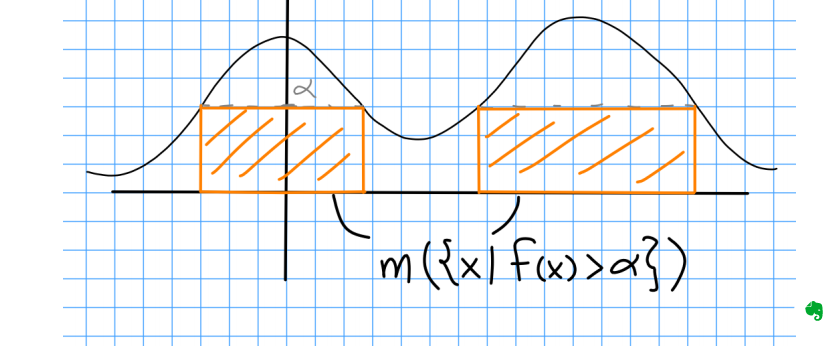
Let \((X,\mcm,\mu)\) be a measure space, let \(f\colon X\to\CC\) be measurable, let \(\alpha>0\), and put \(S_\alpha\coloneqq\theset{x\in X\suchthat\abs{f(x)}>\alpha}\). Then \[ \mu(S_\alpha) \leq \frac{1}{\alpha}\int_X\abs{f}\dmu = \frac{1}{\alpha}\norm{f}_1, \] and more generally, for \(0<p<\infty\), \[ \mu(S_\alpha) \leq \frac{1}{\alpha^p}\int_X\abs{f}^p\dmu = \frac{1}{\alpha^p}\norm{f}_p^p. \]
On \(S_\alpha\) we have \(\abs{f(x)} > \alpha\), hence \(\abs{f(x)}^p > \alpha^p\), so \[ \int_X \abs{f}^p\dmu \geq \int_{S_\alpha} \abs{f}^p\dmu \geq \int_{S_\alpha} \alpha^p\dmu = \alpha^p \mu(S_\alpha). \] Dividing by \(\alpha^p > 0\) gives the second inequality, and \(p=1\) gives the first.
For a probability space \((\Omega,\mathcal F,P)\) and a nonnegative random variable \(Y\) with expectation \(E(Y)\), the case \(p=1\) reads \(P(Y>\alpha)\leq E(Y)/\alpha\).
Small tails of $L^1(\RR^d)$ functions (Tag T-RIY2P)
Let \(d\geq1\), let \(m\) be Lebesgue measure on \(\RR^d\), and let \(f\colon\RR^d\to\CC\) be integrable with respect to \(m\). For \(r>0\), let \(B_r(0)\coloneqq\theset{x\in\RR^d\suchthat\abs{x}<r}\). Then \[ \lim_{r\to\infty}\int_{\RR^d\setminus B_r(0)}\abs{f}\,dm=0. \] Equivalently, for every \(\varepsilon>0\) there exists \(r>0\) such that \[ \int_{\RR^d\setminus B_r(0)}\abs{f}\,dm<\varepsilon. \]
Tonelli's theorem for nonnegative measurable functions (Tag T-6PRW3)
Let \(f\colon\RR^n\times\RR^m\to[0,\infty]\) be Lebesgue measurable on \(\RR^{n+m}\). For \(x\in\RR^n\) let \(f_x\colon\RR^m\to[0,\infty]\) be the slice \(f_x(y)\coloneqq f(x,y)\). Then:
for almost every \(x\in\RR^n\), the slice \(f_x\) is Lebesgue measurable on \(\RR^m\);
the function \(F(x)\coloneqq\int_{\RR^m} f(x,y)\,dy\in[0,\infty]\), defined for almost every \(x\), is Lebesgue measurable on \(\RR^n\);
\[ \int_{\RR^{n+m}} f = \int_{\RR^n} F(x)\,dx = \int_{\RR^n}\qty{\int_{\RR^m} f(x,y)\,dy}dx \in[0,\infty], \] and the same holds with the roles of \(x\) and \(y\) exchanged [@Fol13].
Moreover, if \(E\subseteq\RR^{n}\times\RR^m\) is Lebesgue measurable, then for almost every \(x\in\RR^n\) the slice \(E_x\coloneqq\theset{y\in\RR^m \suchthat (x, y) \in E}\) is Lebesgue measurable.
Fubini's theorem for integrable functions (Tag T-4GPEF)
Let \(f\colon\RR^n\times\RR^m\to\CC\) be integrable with respect to Lebesgue measure on \(\RR^{n+m}\). For \(x\in\RR^n\) let \(f_x\colon\RR^m\to\CC\) be the slice \(f_x(y)\coloneqq f(x,y)\). Then:
for almost every \(x\in\RR^n\), the slice \(f_x\) is integrable on \(\RR^m\);
the function \(F(x)\coloneqq\int_{\RR^m} f(x,y)\,dy\), defined for almost every \(x\), is integrable on \(\RR^n\);
\[ \int_{\RR^{n+m}} f = \int_{\RR^n}\qty{\int_{\RR^m} f(x,y)\,dy}dx , \] and the same holds with the roles of \(x\) and \(y\) exchanged.
Moreover, if \(E\subseteq\RR^{n}\times\RR^m\) is Lebesgue measurable, then for almost every \(x\in\RR^n\) the slice \(E_x\coloneqq\theset{y\in\RR^m \suchthat (x, y) \in E}\) is Lebesgue measurable.
The hypothesis is \(f\) integrable on \(\RR^{n+m}\); \(f\) may take values of both signs. Tonelli's theorem instead assumes \(f\geq0\) measurable, with no integrability hypothesis.
Fubini--Tonelli theorem (Tag T-X7XZX)
Let \((X,\mcm,\mu)\) and \((Y,\mcn,\nu)\) be \(\sigma\)-finite measure spaces, and let \(f\colon X\times Y\to\CC\) be \(\mcm\otimes\mcn\)-measurable. Suppose that one of the iterated integrals of \(\abs{f}\) is finite: \[ \int_X\qty{\int_Y\abs{f(x,y)}\,d\nu(y)}d\mu(x)<\infty\quad\text{or}\quad\int_Y\qty{\int_X\abs{f(x,y)}\,d\mu(x)}d\nu(y)<\infty. \] Then \(f\in L^1(X\times Y,\mu\times\nu)\), and \[ \int_{X\times Y}f\,d(\mu\times\nu)=\int_X\qty{\int_Y f(x,y)\,d\nu(y)}d\mu(x)=\int_Y\qty{\int_X f(x,y)\,d\mu(x)}d\nu(y), \] where the inner integrals exist for almost every value of the outer variable.