For \(f\) holomorphic on a punctured disc about \(z_0\) with Laurent series \(\sum_{k\in\ZZ} a_k(z-z_0)^k\), the residue \(\Res_{z=z_0} f\) is \(a_{-1} = \frac{1}{2\pi i}\oint_{\abs{z-z_0}=r} f(z)\dz\) for small \(r\); at a pole this is the residue of the principal part. At poles it is given by limit formulas, and at essential singularities it is read from the series.
A simple pole
Residue formula for simple poles (Tag PR-L4Y5F)
Let \(f\) be holomorphic on a punctured disc about \(z_0\) with a simple pole at \(z_0\). Then its residue at \(z_0\) is \[ \Res_{z=z_0}f = \lim_{z\to z_0} (z-z_0) f(z). \]
Near \(z_0\), \(f(z)=\frac{a_{-1}}{z-z_0}+G(z)\) with \(G\) holomorphic at \(z_0\), so \((z-z_0)f(z)=a_{-1}+(z-z_0)G(z)\to a_{-1}=\Res_{z=z_0}f\).
Residue of $g/h$ at a simple zero of $h$ (Tag C-Q6BSL)
Let \(g\) and \(h\) be holomorphic near \(z_0\), with \(h(z_0)=0\) and \(h'(z_0)\neq0\). Then \[ \Res_{z=z_0}\frac{g(z)}{h(z)}=\frac{g(z_0)}{h'(z_0)}. \]
Since \(h(z_0)=0\) and \(h'(z_0)\neq 0\), \(z_0\) is at most a simple pole of \(g/h\), and by L’Hôpital’s rule \[ (z-z_0) {g(z) \over h(z)} = {(z-z_0) g(z) \over h(z)} \to {g(z_0) \over h'(z_0)} \quad\text{as } z\to z_0 ,\] because \(\frac{d}{dz}\bigl((z-z_0)g(z)\bigr) = g(z) + (z-z_0)g'(z)\) equals \(g(z_0)\) at \(z_0\).
(Residue of a simple pole)
Let \(f(z) = \frac{1}{1+z^2}\), so \(g(z) = 1\) and \(h(z) = 1+z^2\) with \(h'(z) = 2z\) and \(h'(i) = 2i \neq 0\). Thus \[ \Res_{z=i}{1\over 1+z^2} = \frac{1}{2i} .\]
A pole of higher order
Residue at a pole of order $n$ (Tag FF-VOO4Q)
Let \(n\ge1\), and let \(f\) be holomorphic on a punctured disc about \(z_0\) with a pole of order at most \(n\) at \(z_0\). Then the residue of \(f\) at \(z_0\) is \[ \Res_{z=z_0} f = \lim_{z\to z_0} {1 \over (n-1)!} \frac{d^{n-1}}{dz^{n-1}}\qty{(z-z_0)^n f(z)}. \]
By the Laurent series
At an essential singularity the residue is the coefficient \(a_{-1}\) of the Laurent series.
(Residue at an essential singularity)
Since \(e^{1/z} = \sum_{k\geq 0} z^{-k}/k!\) for \(z\neq 0\), the coefficient of \(\inverseof{z}\) is \(1\), so \(\Res_{z=0} e^{1/z} = 1\).
The residue at infinity
Residue at infinity (Tag PR-D3CDJ)
Let \(R\ge0\), let \(f\) be holomorphic on \(\theset{z : \abs{z}>R}\) with Laurent expansion \(f(z)=\sum_{k\in\ZZ}a_kz^k\) there, and let \[ \Res_{z=\infty}f(z) \coloneqq -\frac{1}{2\pi i}\int_{\abs{z}=r}f(z)\dz = -a_{-1} \] for any \(r>R\), with the circle oriented counterclockwise. Then, with \(g(z) \coloneqq -{1 \over z^2}f\qty{1\over z}\) for \(0<\abs{z}<1/R\), \[ \Res_{z=\infty}f(z) = \Res_{z=0} g(z). \]
For \(0<\abs{w}<1/R\), \(g(w)=-w^{-2}\sum_{k\in\ZZ}a_kw^{-k}=-\sum_{k\in\ZZ}a_kw^{-k-2}\). The coefficient of \(w^{-1}\) comes from \(k=-1\) and equals \(-a_{-1}\), so \(\Res_{w=0}g(w)=-a_{-1}=\Res_{z=\infty}f(z)\).
(Sum of residues)
If \(f\) is holomorphic on \(\CC\) except for finitely many isolated singularities \(z_1,\ldots,z_N\), then \[ \sum_{j=1}^N \Res_{z=z_j} f + \Res_{z=\infty} f = 0 ,\] because for \(\rho\) larger than every \(\abs{z_j}\) the residue theorem gives \(\frac{1}{2\pi i}\oint_{\abs z=\rho} f = \sum_j\Res_{z=z_j} f\), and the definition gives \(-\Res_{z=\infty} f\) for the same integral.
Exercises
Doing it without a formula:
Integrating $z^k$ around $S^1$ is the source of residue theory (Tag E-S6663)
Show that \[ \int_{S^1}z^k \dz = \begin{cases} 2\pi i & k=-1 \\ 0 & \text{else}. \end{cases} ,\] and thus \[ \int \sum_{k\geq -M} c_k z^k = \sum_{k\geq -M} \int c_k z^k = 2\pi i c_{-1} ,\] i.e. the integral picks out the \(c_{-1}\) coefficient in a Laurent series expansion.
Solution
\[ \int_\gamma z^k \dz = \int_0^{2\pi} e^{ik\theta} ie^{i\theta } \dtheta = i\int_0^{2\pi} e^{i(k+1)\theta \dtheta } = \begin{cases} 2\pi i & k=-1 \\ 0 & \text{else}. \end{cases} \]
Primitive in the complement of a branch cut (Tag E-M5MWL)
Compute the following integrals: \[ \int_{\abs{z-1} = 1} {1\over z^2-1} \dz \\ \int_{\abs{z-0} = 2} {1\over z^2-1} \dz \\ .\] Compute the 2nd integral by finding a primitive.
Solution
For the first integral: \[ \int_\gamma{1\over z^2-1}\dz &= {1\over 2}\int_\gamma {1\over z-1} + {1\over z+1}\dz \\ &= {1\over 2}\int_\gamma {1\over z-1} \\ &= {1\over 2}\cdot 2\pi i \Res_{z=1}f(z) \\ &= {1\over 2}\cdot 2\pi i \cdot 1 \\ &= \pi i ,\] using that \(f(z) = {1\over z-1}\) is already an expansion of \(f\) about \(z=1\) since it is a Laurent series in \((z-1)^k\), so the residue is \(1\).
For the second integral: attempt to define a primitive \[ F(z) \da {1\over 2}\log\qty{z-1\over z+1} \implies F'(z) = {1\over z^2-1} .\] If this primitive is well-defined on \(\gamma\), the integral will vanish because this is a closed curve. Choose the branch cut \(\CC\sm(-\infty, 0]\) and define \(g(z) = {z-1\over z+1}\), so that \(F(z) = {1\over 2}\log(g(z))\). Then then \(g(z)\in (-\infty, 0] \iff z\in [-1, 1]\), and this is well-defined on \(\gamma\) since \([-1, 1]\) does not intersect \(\gamma\).
Thus for \(\gamma\) any parameterization of \(\abs{z} = 2\), \[ \int_{\abs{z} = 2} f(z) \dz = \int_{\abs{z} = 2} F'(z)\dz = F(\gamma(0)) - F(\gamma(1)) = 0 .\]
Cauchy formula and $\sinh$ (Tag E-RGDJ7)
Compute \[ \int_{S^1} {2 \sinh(z) \over z^n}\dz .\]
Solution
Write \(f(z) = 2\sinh(z) = e^{z} - e^{-z}\) and apply the generalized Cauchy formula: \[ f^{(n-1)}(0) &= {(n-1)! \over 2\pi i} \int_{S^1} {f(z) \over (z-0)^n}\dz \\ \\ \implies \int_{S^1}{f(z)\over z^n}\dz &= {2\pi i \over (n-1)!} f^{(n-1)}(0) \\ &= {2\pi i\over (n-1)!} 2\cdot \qty{e^z - (-1)^{n-1} e^z \over 2}\evalfrom_{z=0} \\ &= {2\pi i\over (n-1)!} 2\cdot \qty{1 + (-1)^{n} \over 2} \\ &= \begin{cases} {4\pi i \over (n-1)!} & n \text{ even } \\ 0 & n \text{ odd }. \end{cases} .\]
Cauchy formula and principal parts (Tag E-M7K4C)
Compute \[ \int_\gamma {z^2+1 \over z(z^2 + 4)}\dz \] for
- A circle of radius \(1\),
- A circle of radius \(2+\eps\),
Solution
For the smaller circle, use Cauchy’s formula \[ \int_{\abs{z} = 1} f(z) \dz &= \int_{\abs{z} = 1} { {z^2 + 1 \over z^2 + 4} \over z} \dz \\ &= 2\pi i \qty{z^2 + 1 \over z^2 + 4} \evalfrom_{z=0} \\ &= {i\pi \over 2} .\].
For the larger circle, break into principal parts. Write \[ {z^2 + 1 \over z(z^2+4)} = {a\over z} + {b\over z+2i} + {c\over z-2i} ,\] and use PFD/cover-up method/finding residues:
- \(a = \qty{z^2+1\over z^2+4}\evalfrom_{z=0} = {1\over 4}\)
- \(b= \qty{z^2 + 1 \over z(z-2i)}\evalfrom_{z=-2i} = {-4+1\over -2i(-4i)} = {3\over 8}\)
- \(c = \qty{z^2 + 1 \over z(z+2i)}\evalfrom_{z=2i} = {-4+1 \over 2i(4i)} = {3\over 8}\)
Thus \[ \int_\gamma f(z) \dz &= \int_\gamma \qty{ {1/4\over z} + {3/8\over z+2i} + {3/8 \over z-2i} } \dz \\ &= 2\pi i\qty{ {1\over 4} + {3\over 8} + {3\over 8}} .\]
Residues of $z^3/(z^2+1)$ from its principal parts (Tag E-AOQLK)
Find all residues of the following function by writing it as a sum of principal parts at its poles: \[ f(z) = {z^3 \over z^2 + 1} .\]
Solution
Use polynomial long division to write \[ z^3 = z(z^2+1) - z \implies {z^3 \over z^2 + 1} = z - {z\over z^2 + 1} .\] Factor the latter part: \[ {z\over z^2 + 1} = {a\over z+i} + {b\over z-i} \implies a(z-i) + b(z+i) = z ,\] evaluate at \(z=i\) to get \(b=1/2\), and at \(z=-i\) to get \(a=1/2\). Thus \[ f(z) = z - {1/2 \over z+i} - {1/2 \over z-i} = P_\infty + P_{-i} + P_{i} ,\] yielding poles at \(\pm i\) with residues \[ \Res_{z=\infty} f(z) &= 1 \\ \Res_{z = i} f(z) &= -1/2 \\ \Res_{z = -i} f(z) &= -1/2 \\ .\]
Indeed, \[ f(z)=z-{1\over z}+O(z^{-3}) \qquad(z\to\infty), \] so the coefficient of \(z^{-1}\) is \(-1\) and therefore \(\Res_\infty f=-(-1)=1\). Equivalently, it is the negative of the sum of the finite residues.
Residue from Laurent expansion: $1/(z - \sin(z))$ (Tag E-TOZQJ)
Use a direct Laurent expansion to show \[ \Res_{z=0} {1\over z-\sin(z)} = {3! \over 5\cdot 4} .\]
Note the necessity: one doesn’t know the order of the pole at zero, so it’s unclear how many derivatives to take.
Solution
Expand: \[ {1\over z - \sin(z)} &= \inverseof{z} \inverseof{\qty{1 - \inverseof{z} \sin(z) }} \\ &= \inverseof{z} \inverseof{\qty{1 - \inverseof{z}\qty{ z - {1\over 3!}z^3 + {1\over 5!} z^5 - \cdots}}}\\ &= \inverseof{z} \inverseof{\qty{1 - \qty{ 1 - {1\over 3!}z^2 + {1\over 5!} z^4 - \cdots}}} \\ &= \inverseof{z} \inverseof{\qty{{1\over 3!}z^2 - {1\over 5!}z^4 + \cdots}} \\ &= \inverseof{z} \cdot 3! z^{-2} \inverseof{\qty{1 - {1\over 5!/3!}z^2 + \cdots}} \\ &= {3!\over z^3} \qty{1 \over 1 - \qty{ {1\over 5\cdot 4}z^2 + \cdots}} \\ &= {3!\over z^3}\qty{1 + \qty{{1\over 5\cdot 4}z^2} + \qty{{1\over 5\cdot 4}z^2}^2 + \cdots} \\ &= 3! z^{-3} + {3!\over 5\cdot 4}\inverseof{z} + O(z) \\ .\]
$\Res_{z=0}\frac{1}{z^2\sin z}$ (Tag E-FCYUM)
Compute \[ \Res_{z=0} {1\over z^2 \sin(z)} .\]
Solution
First expand \(\inverseof{(\sin(z))}\): \[ {1\over \sin(z)} &= \inverseof{\qty{z - {1\over 3!}z^3 + {1\over 5!}z^5 -\cdots }} \\ &= \inverseof{z} \inverseof{\qty{1 - {1\over 3!}z^2 + {1\over 5!}z^4 - \cdots }} \\ &= \inverseof{z} \qty{1 + \qty{{1\over 3!}z^2 - {1\over 5!} z^4 + \cdots} + \qty{{1\over 3!}z^2 - \cdots}^2 + \cdots } \\ &= \inverseof{z}\qty{1 + {1\over 3!}z^2 + O(z^4) } ,\] using that \(\inverseof{(1-x)} = 1 + x + x^2 + \cdots\) with \(x={1\over 3!}z^2 - {1\over 5!} z^4 + \cdots\).
Thus \[ z^{-2}\inverseof{\qty{\sin(z)}} &= z^{-2} \cdot \inverseof{z}\qty{1 + {1\over 3!}z^2 + O(z^4) } \\ &= z^{-3} + {1\over 3!}\inverseof{z} + O(z) ,\] and the residue is the coefficient of \(\inverseof{z}\): \[ \Res_{z=0} {1\over z^2 \sin(z)}=\boxed{1\over 6} .\]
Applying the formulas:
Residue of $1/z^2 + 1$ (Tag E-YNZYA)
Use the rational function formula to compute the residues at \(z=\pm i\) of \[ f(z) \da {1\over z^2 + 1} .\]
Solution
Applying the rational function formula: \[ \Res_{z=z_0}{1\over 1+z^2} &= {1\over 2z}\evalfrom_{z= z_0} \implies\\ \Res_{z=i}f(z) &= {1\over 2i} = -{i\over 2} \\ \Res_{z=-i}f(z) &= -{1\over 2i} = {i\over 2} .\]
The residue of $1/(z^n+1)$ at a root of unity (Tag E-ITVTT)
Find the residue at \(\omega_n \da e^{\pi i \over n}\) of \[ f(z) = {1\over z^n + 1} .\]
Solution
Check that \(\dd{}{z} z^n+1 = nz^{n-1}\neq 0\) for \(z\neq 0\), so this has no repeated roots since \(z=0\) is not a root. Thus all of the poles are simple, and the residue of \(1/q\) at a simple zero \(z_0\) of \(q\) is \(1/q'(z_0)\): \[ \Res_{z=\omega_n} {1\over z^n + 1} &= {1 \over nz^{n-1}}\evalfrom_{z=\omega_n} \\ &= {1\over n\omega_n^{n-1}} \\ &= {\omega_n^{1-n}\over n} \\ &= -{\omega_n \over n} ,\] which follows from expanding \[ \omega_n^{1-n} = e^{i\pi (1-n) \over n} = e^{i\pi\over n}e^{-i\pi n \over n} = e^{i\pi \over n}\cdot (-1) = -\omega_n .\].
Residues at $\infty$ (Tag E-U2A4C)
Compute \[ \Res_{z=\infty}e^z, \qquad \Res_{z=\infty}{z-1\over z+1}. \]
Solution
Recall \[ \Res_{z=\infty}f(z) =-\Res_{w=0}\frac{f(1/w)}{w^2}. \]
For \(f(z)=e^z\), \[ \frac{e^{1/w}}{w^2} =\sum_{k=0}^\infty {w^{-k-2}\over k!}. \] There is no \(w^{-1}\) term, hence \[ \Res_{z=\infty}e^z=0. \]
For \[ f(z)={z-1\over z+1}, \] we have \[ \frac{f(1/w)}{w^2} ={1\over w^2}{1-w\over1+w} ={1\over w^2}\qty{1-2w+2w^2-2w^3+\cdots}. \] Thus \[ \Res_{w=0}\frac{f(1/w)}{w^2}=-2, \] so \[ \Res_{z=\infty}{z-1\over z+1}=2. \] Equivalently, the only finite pole is at \(z=-1\) with residue \(-2\), and the sum of all residues on \(\CP^1\) is zero.
Simple zeros of $\sin(\pi z)$ at the integers, and residues of $1/\sin(\pi z)$ (Tag E-V2VS5)
Show that the complex zeros of \(f(z) \da \sin(\pi z)\) are exactly \(\ZZ\), and each is order 1. Calculate the residue of \(1/\sin(\pi x)\) at \(z=n\in \ZZ\).




Solution
Goal: Show that the complex zeros of \(f(z) = \sin(\pi z)\) are exactly \(\ZZ\), each of order 1, and compute the residue of \(1/\sin(\pi z)\) at \(z = n \in \ZZ\).
<1>1. The zeros of \(\sin(\pi z)\) in \(\CC\) are exactly the integers.
\(\sin(\pi z) = (e^{i\pi z} - e^{-i\pi z})/2i\), so \(\sin(\pi z) = 0\) iff \(e^{2i\pi z} = 1\) iff \(2i\pi z = 2\pi i k\) for some \(k \in \ZZ\) iff \(z = k \in \ZZ\).
<1>2. Each zero \(z = n\) is simple.
\(\ddd{z}\sin(\pi z) = \pi \cos(\pi z)\), and \(\cos(\pi n) = (-1)^n \neq 0\) for \(n \in \ZZ\).
<1>3. \(1/\sin(\pi z)\) has a simple pole at each \(z = n \in \ZZ\).
The denominator vanishes to order exactly 1 at each integer (<1>2) and the numerator is the nonzero constant 1.
<1>4. The residue of \(1/\sin(\pi z)\) at \(z = n\) is \((-1)^n/\pi\).
For a simple pole, \(\Res_{z = n} \frac{1}{\sin(\pi z)} = \lim_{z \to n} (z - n)\frac{1}{\sin(\pi z)} = \frac{1}{\sin'(\pi n)} = \frac{1}{\pi \cos(\pi n)} = \frac{1}{\pi (-1)^n} = \frac{(-1)^n}{\pi}\).
<1>5. Q.E.D.
<1>1–<1>2 identify the zeros and their orders; <1>3–<1>4 give the residues.
The integral of $1/(1+x^2)^2$ over $\mathbb{R}$ (Tag E-SNRS5)
\[ \int_\RR {1 \over (1+x^2)^2} \dx .\]
Solution
- Factor \((1+z^2)^2 = ((z-i)(z+i))^2\), so \(f\) has poles at \(\pm i\) of order 2.
- Take a semicircular contour \(\gamma \da I_R \union D_R\), then \(f(z) \approx 1/z^4 \to 0\) for large \(R\) and \(\int_{D_R} f \to 0\).
- Note \(\int_{I_R} f \to \int_\RR f\), so \(\int_\gamma f \to \int_\RR f\).
- \(\int_\gamma f = 2\pi i \sum_{z_0} \Res_{z=z_0} f\), and \(z_0 = i\) is the only pole in this region.
- Compute \[ \Res_{z=i} f &= \lim_{z\to i} {1\over (2-1)!} \dd{}{z} (z-i)^2 f(z) \\ &= \lim_{z\to i} \dd{}{z} {1\over (z+i)^2 } \\ &= \lim_{z\to i} {-2 \over (z+i)^3 } \\ &= -{2 \over (2i)^3 } \\ &= {1\over 4i} \\ \\ \implies \int_\gamma f &= {2\pi i \over 4i} = \pi/2 ,\]
$\int_0^\infty\frac{\log x}{(1+x^2)^2}\,dx$ by a keyhole contour (Tag E-ENWYG)
Evaluate \[ I\da \int_0^\infty {\log x\over(1+x^2)^2}\,dx. \]
Solution
Let \(\log\) be the branch with \(0<\arg z<2\pi\) on \(\CC\setminus[0,\infty)\), and let \[ f(z)={\log^2 z\over(1+z^2)^2},\qquad (1+z^2)^2 = (z+i)^2(z-i)^2 .\] Integrate \(f\) over a keyhole contour with outer radius \(R\) and inner radius \(\rho\), slit along \([0,\infty)\):
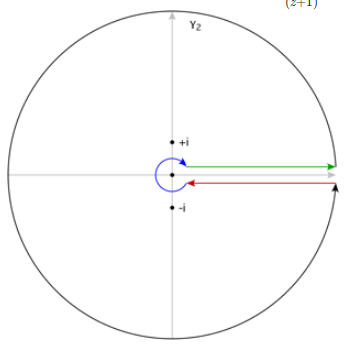
Write \(I\) for the requested integral and \(A\coloneqq\int_0^\infty{dx\over(1+x^2)^2}={\pi\over4}\).
<1>1. The circles of radii \(R\) and \(\rho\) contribute \(0\) in the limit.
By the ML estimate, the outer circle contributes \(O\qty{R(\log R+2\pi)^2/R^4}\to0\) and the inner circle contributes \(O\qty{\rho(\abs{\log\rho}+2\pi)^2}\to0\).
<1>2. The two edges of the slit contribute \(-4\pi i I+4\pi^2A\).
On the upper edge \(\log z=\log x\), and on the lower edge, traversed from \(\infty\) to \(0\), \(\log z=\log x+2\pi i\). So the edges contribute \[ \int_0^\infty{\log^2x-(\log x+2\pi i)^2\over(1+x^2)^2}\,dx=-4\pi i I+4\pi^2A .\]
<1>3. \(\Res_{z=i}f=-{\pi\over4}+{i\pi^2\over16}\) and \(\Res_{z=-i}f={3\pi\over4}-{9i\pi^2\over16}\).
With \(h(z)=\log^2z\), \(h'(z)=2\log z/z\), and on this branch \(\log i=i\pi/2\), \(\log(-i)=3\pi i/2\). At the double poles, \[ \Res_{z=i}f=\dd{}{z}{h(z)\over(z+i)^2}\bigg|_{z=i}={h'(i)\over(2i)^2}-{2h(i)\over(2i)^3}={\pi\over-4}-{-\pi^2/2\over-8i}=-{\pi\over4}+{i\pi^2\over16} ,\] \[ \Res_{z=-i}f=\dd{}{z}{h(z)\over(z-i)^2}\bigg|_{z=-i}={h'(-i)\over(-2i)^2}-{2h(-i)\over(-2i)^3}={-3\pi\over-4}-{-9\pi^2/2\over8i}={3\pi\over4}-{9i\pi^2\over16} .\]
<1>4. \(I=\boxed{-\pi/4}\).
By steps <1>1 to <1>3 and the residue theorem, \[ -4\pi iI+4\pi^2A=2\pi i\qty{{\pi\over2}-{i\pi^2\over2}}=\pi^3+i\pi^2 .\] The real parts agree since \(A=\pi/4\), and the imaginary parts give \(-4\pi I=\pi^2\).
A contour with one logarithm also works: with the branch \(-\pi/2<\arg z<3\pi/2\), integrate \(\log z/(1+z^2)^2\) over the upper semicircle indented at \(0\). The negative real axis contributes \(I+i\pi A\), and the residue at the double pole \(i\) is \(\frac i4+\frac\pi8\), so \(2I+i\pi A=-\frac\pi2+\frac{i\pi^2}4\) and again \(I=-\pi/4\).
Sinc Function (Tag E-PMURO)
Show \[ \int_{(0, \infty)} {\sin(x) \over x }\dx = {\pi \over 2} .\]
Solution
Take an indented semicircle. Let \(I\) be the original integral, then \[ I = {1\over 2i} \int_\RR {e^{iz} - 1 \over z } \dz .\]
Residues at infinity (Tag E-QF7KI)
Use residues at infinity to evaluate \[ \int_{|z|=1} \frac{1}{(z-2)(1+2 z)^{4}(1-3 z)^{7}} \dz .\]
Solution
Goal. Evaluate \(\oint_{|z|=1} \frac{1}{(z-2)(1+2z)^4(1-3z)^7}\,dz\) using residues at infinity.
<1>1. The integrand \(f(z) = \frac{1}{(z-2)(1+2z)^4(1-3z)^7}\) has poles inside \(|z| = 1\) at \(z = -1/2\) (order \(4\)) and \(z = 1/3\) (order \(7\)), and a simple pole at \(z = 2\) outside.
\(1 + 2z = 0\) at \(z = -1/2\) and \(1 - 3z = 0\) at \(z = 1/3\), both inside the unit circle; \(z = 2\) is outside.
<1>2. The sum of all residues over the extended plane is \(0\).
for a rational function, \(\sum_{\text{finite poles}} \operatorname{Res}(f, z_j) + \operatorname{Res}(f, \infty) = 0\).
<1>3. Compute \(\operatorname{Res}(f, \infty)\). <2>1. \(\operatorname{Res}(f, \infty) = -\operatorname{Res}\qty(\frac{1}{z^2} f(1/z), 0)\).
definition of the residue at infinity.
<2>2. \(\frac{1}{z^2} f(1/z) = \frac{1}{z^2} \cdot \frac{1}{(1/z - 2)(1 + 2/z)^4(1 - 3/z)^7} = \frac{z^{10}}{(1-2z)(z+2)^4(z-3)^7}\).
substitute \(z \mapsto 1/z\) and simplify (multiply numerator and denominator by \(z^{12}\)).
<2>3. This is analytic at \(z = 0\) (numerator has \(z^{10}\)), so \(\operatorname{Res}\qty(\frac{1}{z^2}f(1/z), 0) = 0\).
no \(1/z\) term in the Laurent expansion at \(0\).
<2>4. Hence \(\operatorname{Res}(f, \infty) = 0\).
<1>3.1 and <1>3.3.
<1>4. Compute \(\operatorname{Res}(f, 2)\). <2>1. \(z = 2\) is a simple pole, so \(\operatorname{Res}(f, 2) = \lim_{z \to 2} (z-2) f(z) = \frac{1}{(1+2\cdot 2)^4 (1 - 3\cdot 2)^7} = \frac{1}{5^4 \cdot (-5)^7} = -\frac{1}{5^{11}}\).
the residue at a simple pole is the limit of \((z-2)f(z)\).
<1>5. Sum of residues inside \(|z| = 1\). <2>1. \(\sum_{\text{inside}} \operatorname{Res} = -(\operatorname{Res}(f, 2) + \operatorname{Res}(f, \infty))\).
by <1>2, the total is zero, and the poles outside are \(z = 2\) and \(\infty\).
<2>2. \(= -\qty(-\frac{1}{5^{11}} + 0) = \frac{1}{5^{11}}\).
substitute <1>3.4 and <1>4.1.
<1>6. \(\oint_{|z|=1} f(z)\,dz = 2\pi i \cdot \frac{1}{5^{11}}\).
the residue theorem.
<1>7. Q.E.D.
the integral equals \(\frac{2\pi i}{5^{11}}\).