Evaluate \[ I\da \int_0^\infty {\log x\over(1+x^2)^2}\,dx. \]
A contour with one logarithm also works: with the branch \(-\pi/2<\arg z<3\pi/2\), integrate \(\log z/(1+z^2)^2\) over the upper semicircle indented at \(0\). The negative real axis contributes \(I+i\pi A\), and the residue at the double pole \(i\) is \(\frac i4+\frac\pi8\), so \(2I+i\pi A=-\frac\pi2+\frac{i\pi^2}4\) and again \(I=-\pi/4\).
Solution
Let \(\log\) be the branch with \(0<\arg z<2\pi\) on \(\CC\setminus[0,\infty)\), and let \[ f(z)={\log^2 z\over(1+z^2)^2},\qquad (1+z^2)^2 = (z+i)^2(z-i)^2 .\] Integrate \(f\) over a keyhole contour with outer radius \(R\) and inner radius \(\rho\), slit along \([0,\infty)\):
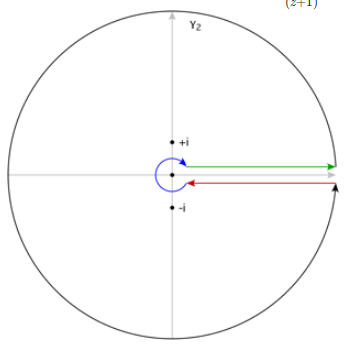
Write \(I\) for the requested integral and \(A\coloneqq\int_0^\infty{dx\over(1+x^2)^2}={\pi\over4}\).
1. The circles of radii \(R\) and \(\rho\) contribute \(0\) in the limit.
By the ML estimate, the outer circle contributes \(O\qty{R(\log R+2\pi)^2/R^4}\to0\) and the inner circle contributes \(O\qty{\rho(\abs{\log\rho}+2\pi)^2}\to0\).
2. The two edges of the slit contribute \(-4\pi i I+4\pi^2A\).
On the upper edge \(\log z=\log x\), and on the lower edge, traversed from \(\infty\) to \(0\), \(\log z=\log x+2\pi i\). So the edges contribute \[ \int_0^\infty{\log^2x-(\log x+2\pi i)^2\over(1+x^2)^2}\,dx=-4\pi i I+4\pi^2A .\]
3. \(\Res_{z=i}f=-{\pi\over4}+{i\pi^2\over16}\) and \(\Res_{z=-i}f={3\pi\over4}-{9i\pi^2\over16}\).
With \(h(z)=\log^2z\), \(h'(z)=2\log z/z\), and on this branch \(\log i=i\pi/2\), \(\log(-i)=3\pi i/2\). At the double poles, \[ \Res_{z=i}f=\dd{}{z}{h(z)\over(z+i)^2}\bigg|_{z=i}={h'(i)\over(2i)^2}-{2h(i)\over(2i)^3}={\pi\over-4}-{-\pi^2/2\over-8i}=-{\pi\over4}+{i\pi^2\over16} ,\] \[ \Res_{z=-i}f=\dd{}{z}{h(z)\over(z-i)^2}\bigg|_{z=-i}={h'(-i)\over(-2i)^2}-{2h(-i)\over(-2i)^3}={-3\pi\over-4}-{-9\pi^2/2\over8i}={3\pi\over4}-{9i\pi^2\over16} .\]
4. \(I=\boxed{-\pi/4}\).
By steps 1 to 3 and the residue theorem, \[ -4\pi iI+4\pi^2A=2\pi i\qty{{\pi\over2}-{i\pi^2\over2}}=\pi^3+i\pi^2 .\] The real parts agree since \(A=\pi/4\), and the imaginary parts give \(-4\pi I=\pi^2\).