(Determinants)
For an \(n\times n\) matrix \(A=(a_{ij})\), \[ \det A = \sum_{\sigma \in S_n} \sgn(\sigma) \prod_{i=1}^n a_{i, \sigma(i)}. \] For \(n=3\), \[ \det\left(\begin{array}{ccc} a_{11} & a_{12} & a_{13} \\ a_{21} & a_{22} & a_{23} \\ a_{31} & a_{32} & a_{33} \end{array}\right)=\begin{gathered} a_{11} a_{22} a_{33}+a_{12} a_{23} a_{31}+a_{13} a_{21} a_{32} \\ -a_{13} a_{22} a_{31}-a_{12} a_{21} a_{33}-a_{11} a_{23} a_{32} \end{gathered}. \]
Let \(\minor_A(i, j)\) denote the matrix obtained from \(A\) by deleting row \(i\) and column \(j\). Expansion along row \(i\) gives \[ \det(A) = \sum_{j=1}^n (-1)^{i+j} a_{ij} \det \minor_A(i, j), \] and if \(\det A\) is invertible, the adjugate gives the inverse: \[ \inverseof{A} = {1\over \det A} \operatorname{adj}(A), \qquad \operatorname{adj}(A)_{ij} \da (-1)^{i+j} \det \minor_A(j, i). \]
(Eigenvalues, trace, and determinant)
The eigenvalues of an upper-triangular matrix are its diagonal entries, and its determinant is their product. If the characteristic polynomial of \(A\) splits, with eigenvalues \(\lambda_1,\ldots,\lambda_n\) listed with multiplicity, then \(\tr(A) = \sum_i \lambda_i\) and \(\det(A) = \prod_i \lambda_i\), and more generally \[ \chi_A(t) = t^n - \qty{\sum_i \lambda_i }t^{n-1} + \qty{\sum_{i < j} \lambda_i \lambda_j }t^{n-2} - \cdots + (-1)^n\qty{\prod_i \lambda_i}. \] Since \(\tr(AB) = \tr(BA)\), similar matrices have equal traces: \(\tr(PJ\inverseof{P}) = \tr(\inverseof{P} PJ) = \tr(J)\).
(Block multiplication)
For block matrices whose block sizes make the products \(AE\), \(BG\), \(AF\), \(BH\), \(CE\), \(DG\), \(CF\), \(DH\) defined, \[ \begin{bmatrix} A & B \\ C & D \end{bmatrix} \begin{bmatrix} E & F \\ G & H \end{bmatrix} = \matt{AE + BG}{AF + BH}{CE + DG}{ CF + DH}. \]
(Powers of an upper-triangular matrix)
If \(A\) is upper triangular, the diagonal entries of \(A^k\) are the \(k\)th powers of the diagonal entries of \(A\): \[ A\da\left(\begin{array}{ccc} a_1 & & * \\ & \ddots & \\ 0 & & a_n \end{array}\right) \implies A^k = \left(\begin{array}{ccc} a_1^k & & * \\ & \ddots & \\ 0 & & a_n^k \end{array}\right). \] By induction on \(k\): a product of upper-triangular matrices is upper triangular, and its \(i\)th diagonal entry is the product of the \(i\)th diagonal entries of the factors.
(Polynomial long division)
For \(f(x) \da x^3-6x^2+12x-8\), every rational root lies in \(\ts{\pm 8, \pm 4, \pm 2, \pm 1}\). Since \(f(2) = 0\), divide by \(x-2\):
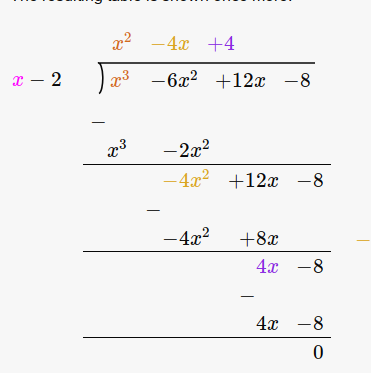
The quotient is \(x^2-4x+4 = (x-2)^2\), so \[ f(x) = (x-2)(x^2-4x+4) = (x-2)^3. \]