Homework 1
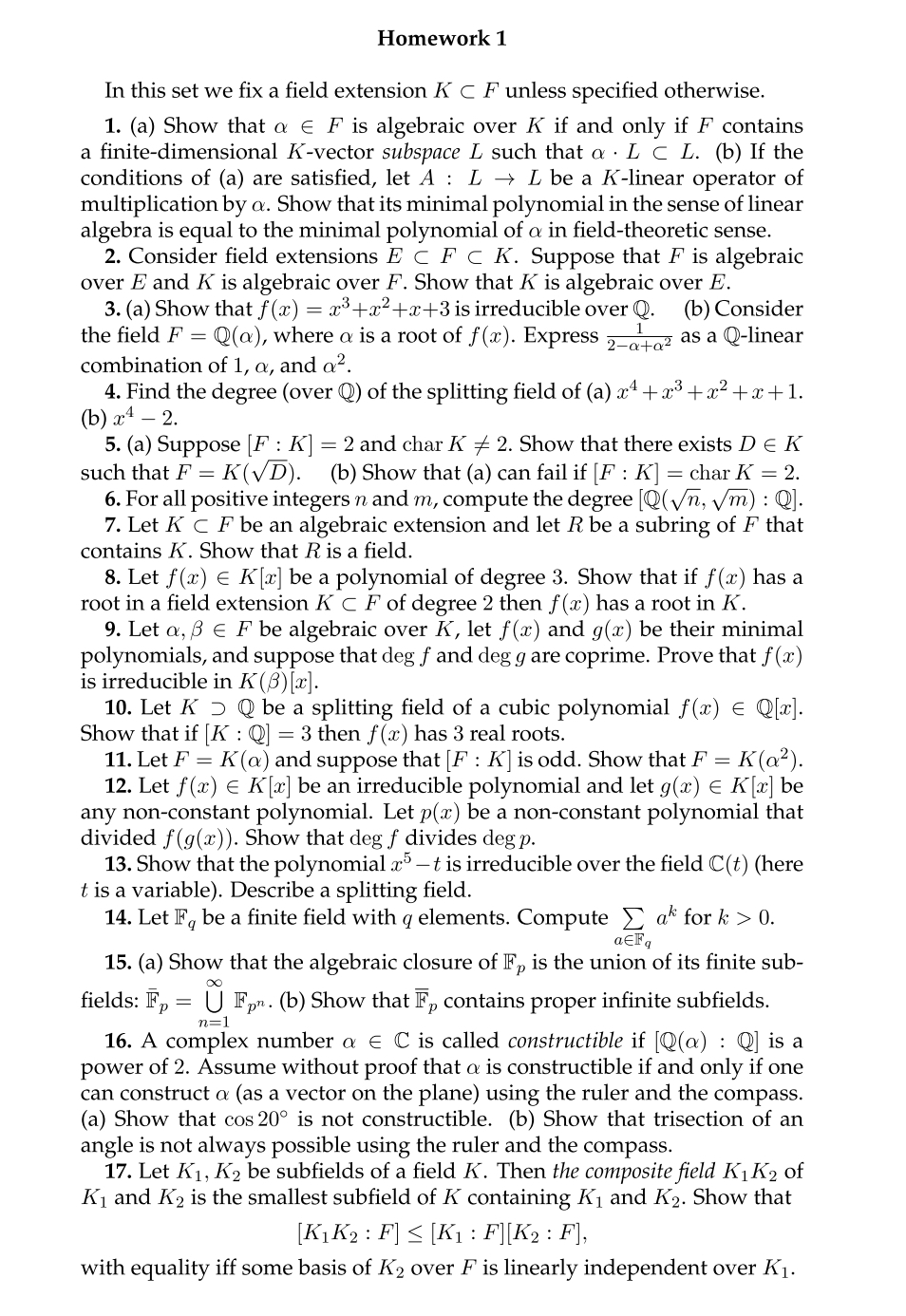
Problems
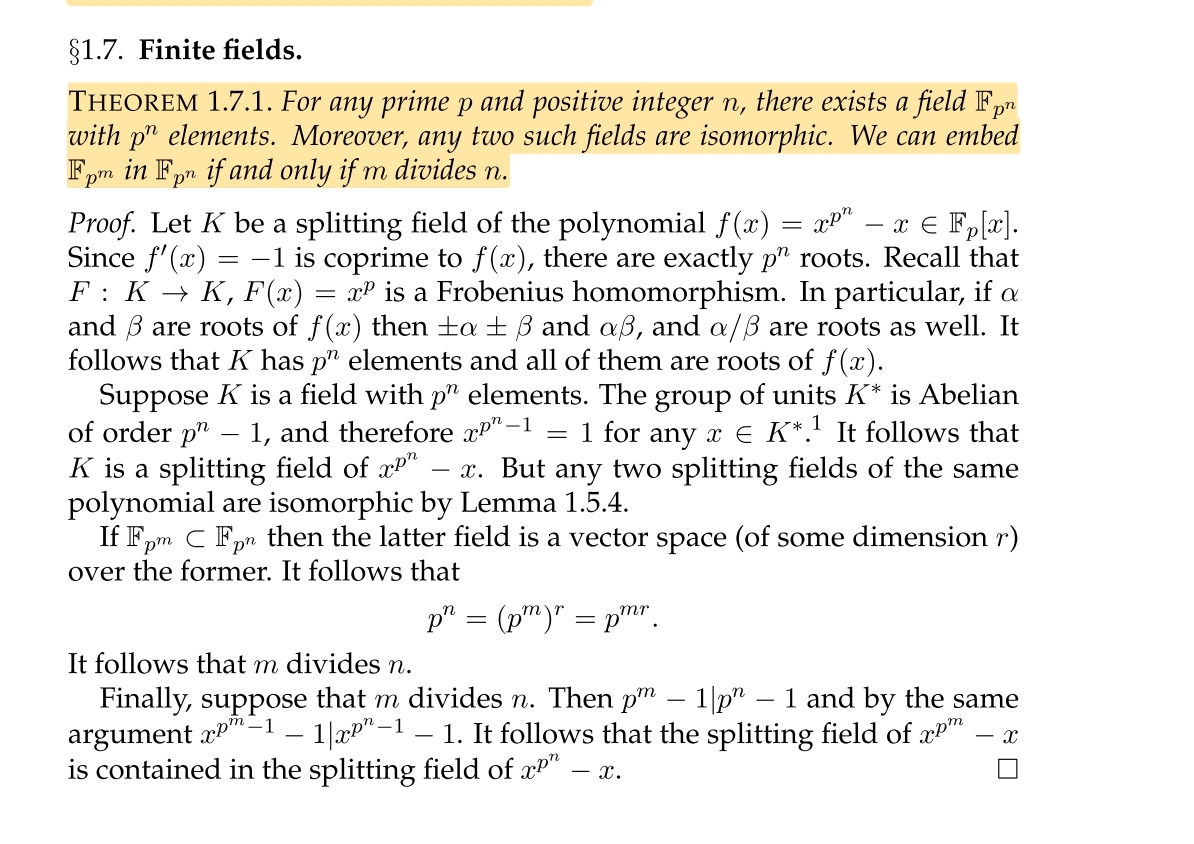
Finite fields with $p^n$ elements (Tag P-TTUVH)
How do you construct finite fields with \(p^n\) elements?
Solution
Isomorphic but unequal fields (Tag P-4FVOI)
What is an example of isomorphic but not equal fields?
Solution
Let \(\omega\) be a primitive cube root of unity. The fields \(\QQ(\sqrt[3]2)\) and \(\QQ(\omega\sqrt[3]2)\) are isomorphic, because \(\sqrt[3]2\) and \(\omega\sqrt[3]2\) have the same minimal polynomial \(x^3-2\) over \(\QQ\), so both fields are isomorphic to \(\QQ[x]/(x^3-2)\). They are not equal inside \(\CC\): \(\QQ(\sqrt[3]2)\subset\RR\), while \(\omega\sqrt[3]2\notin\RR\). See P-3VHPO for the full argument.
Finite extensions are algebraic (Tag P-UZDCX)
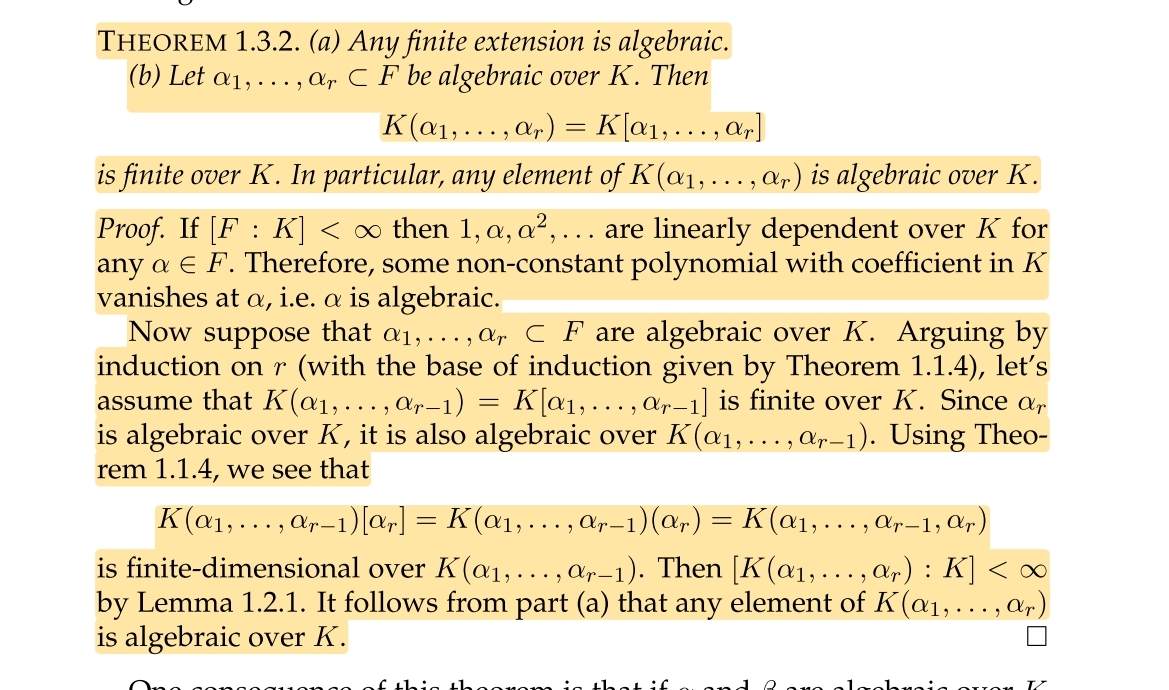
Why is every finite extension algebraic? Why is the degree of an extension given by joining algebraic elements always finite?
Solution
$[K(\alpha):K]$ equals the degree of the minimal polynomial of algebraic $\alpha$ (Tag P-CDUB4)
Why is \([K(\alpha): K]\) equal to the degree of the minimal polynomial of \(\alpha\) when it is algebraic?
Solution
Let \(m\in K[x]\) be the minimal polynomial of \(\alpha\), of degree \(d\).
<1>1. \(K(\alpha)=K[\alpha]\cong K[x]/(m)\).
Evaluation \(K[x]\to K[\alpha]\), \(f\mapsto f(\alpha)\), is surjective with kernel \((m)\), since \(m\) generates the ideal of polynomials vanishing at \(\alpha\). Since \(m\) is irreducible, \((m)\) is maximal, so \(K[\alpha]\) is a field and equals \(K(\alpha)\).
<1>2. \(1,\alpha,\dots,\alpha^{d-1}\) is a \(K\)-basis of \(K(\alpha)\).
They span: for \(f\in K[x]\), division gives \(f=qm+r\) with \(\deg r<d\), so \(f(\alpha)=r(\alpha)\). They are independent: a relation \(\sum_{i<d}c_i\alpha^i=0\) is a polynomial of degree less than \(d\) vanishing at \(\alpha\), hence zero by minimality of \(m\).
<1>3. Q.E.D.
By step <1>2, \([K(\alpha):K]=d=\deg m\).
The rings and fields $K[x]$, $K(x)$, $K[\alpha]$, and $K(\alpha)$ (Tag P-HI4U2)
What are the following objects?
\(K(x)\)
\(K[x]\)
\(K( \alpha)\)
\(K[ \alpha]\)
Solution
For a field \(K\) and a variable \(x\), \(K[x]\) is the ring of polynomials in \(x\) with coefficients in \(K\), and \(K(x)=\operatorname{Frac}(K[x])\) is the field of rational functions \(p/q\) with \(p,q\in K[x]\), \(q\neq0\).
For a field extension \(K\subseteq F\) and \(\alpha\in F\), \(K[\alpha]\) is the smallest subring of \(F\) containing \(K\) and \(\alpha\), and \(K(\alpha)\) is the smallest subfield of \(F\) containing \(K\) and \(\alpha\). Evaluation \(x\mapsto\alpha\) is the unique \(K\)-algebra homomorphism \(K[x]\to K[\alpha]\) sending \(x\) to \(\alpha\), and it is surjective. If \(\alpha\) is transcendental over \(K\), it is injective, so \(K[\alpha]\cong K[x]\) and \(K(\alpha)\cong K(x)\). If \(\alpha\) is algebraic with minimal polynomial \(m\), its kernel is \((m)\), and \(K[\alpha]\cong K[x]/(m)\) is already a field, so \(K[\alpha]=K(\alpha)\).
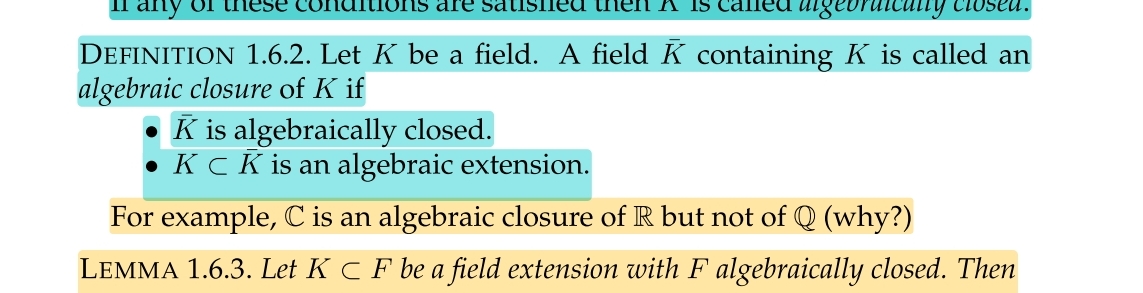
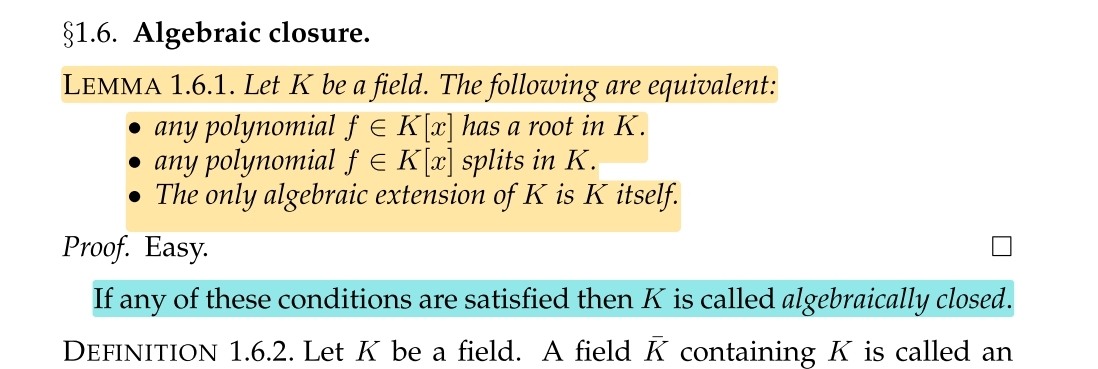
Algebraic and transcendental elements (Tag P-IEZIG)
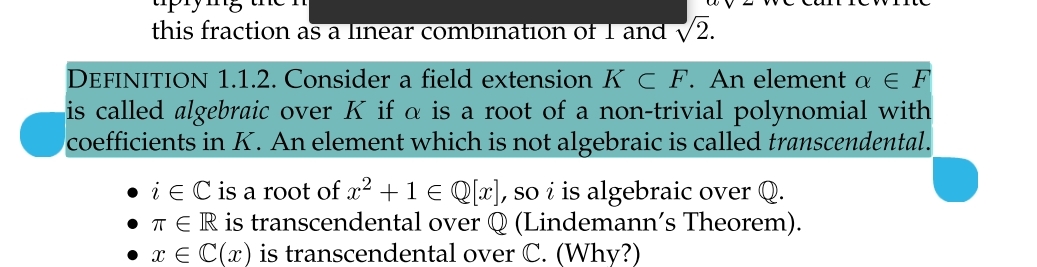
What does it mean for an element to be algebraic or transcendental? Which is \(x\in \CC(x)\)? What is an example of a clearly non-algebraic element of a field?
Solution
Degree of a field extension (Tag P-DUXVY)
What is the degree of a field extension? What does it mean to be a finite extension?
Solution
For a field extension \(F/K\), addition in \(F\) and multiplication by elements of \(K\) make \(F\) a vector space over \(K\). The degree of \(F\) over \(K\) is \([F:K]\coloneqq\dim_KF\), and \(F/K\) is a finite extension if \([F:K]<\infty\). For example, \([\CC:\RR]=2\), with basis \(1,i\).