The logarithmic derivative
Logarithmic derivative (Tag D-WHYOA)
Let \(\Omega\subseteq\CC\) be open and let \(f\) be meromorphic on \(\Omega\) and not identically zero on any connected component of \(\Omega\). The logarithmic derivative of \(f\) is the meromorphic function \[ \logd f\coloneqq\frac{f'}{f} \] on \(\Omega\).
Every zero of a meromorphic \(f\) is a simple pole of \(\logd f\) whose residue is its multiplicity. If \(z_0\) is a root of multiplicity \(m\), write \(f(z) = (z-z_0)^m g(z)\) with \(g\) holomorphic and nonvanishing near \(z_0\), and take logarithmic derivatives: \[ \begin{aligned} \logd f(z) &= \logd (z-z_0)^m + \logd g(z) \\ &= {m\over (z-z_0)} + {g'(z) \over g(z)} \end{aligned}.\] Since \(g\) is holomorphic and nonvanishing there, so is \(g'/g\), and the only contribution at \(z_0\) is \(m\).
For a nonzero rational function \(f\in\CC(x)\) and \(p\in\CC\), the residue of the logarithmic derivative at \(p\) is the valuation \(v_p(f)\) of \(f\) at the prime ideal \(\gens{x-p} \subseteq \CC[x]\): \[ d \qty{ \log(f) } = {f'\over f}\dz \implies \Res_{z=p}(d \log(f) ) = v_p(f) .\]
The statement
Winding number (Tag D-PJ7JM)
Let \(\gamma\) be a closed piecewise \(C^1\) curve in \(\CC\) and let \(z_0\in\CC\) be a point not on \(\gamma\). The winding number, or index, of \(\gamma\) about \(z_0\) is \[ n(\gamma, z_0)\coloneqq\frac{1}{2\pi i}\int_\gamma\frac{1}{\xi-z_0}\dxi. \]
Argument principle counting zeros and poles (Tag T-JXDQT)
Let \(\Omega\subseteq\CC\) be a bounded open set whose boundary \(\gamma\coloneqq\partial\Omega\) consists of finitely many piecewise smooth closed curves, oriented positively with respect to \(\Omega\). Let \(f\) be meromorphic on an open set containing \(\overline{\Omega}\), with no zeros or poles on \(\gamma\). Let \(Z_f\) and \(P_f\) be the numbers of zeros and poles of \(f\) in \(\Omega\), counted with multiplicity. Then \[ \frac{1}{2\pi i}\int_\gamma\frac{f'(z)}{f(z)}\dz=Z_f-P_f. \] If moreover \(f\) is holomorphic with zeros \(z_1,\ldots,z_m\) in \(\Omega\), listed with multiplicity, then \[ \frac{1}{2\pi i}\int_\gamma\frac{f'(z)}{f(z)}\dz=m \quad\text{and}\quad \frac{1}{2\pi i}\int_\gamma\frac{zf'(z)}{f(z)}\dz=\sum_{k=1}^mz_k. \]
If \(z_0\) is a zero of \(f\) of order \(m\), write \(f(z) = (z-z_0)^m g(z)\) with \(g\) holomorphic and nonvanishing on a neighborhood of \(z_0\), and compute \[ \begin{aligned} \logd f(z) &= \frac{m\left(z-z_{0}\right)^{m-1} g(z)+\left(z-z_{0}\right)^{m} g^{\prime}(z)}{\left(z-z_{0}\right)^{m} g(z)} \\ &= {m \over z-z_0} + \logd g(z) \end{aligned},\] so \(z_0\) is a simple pole of \(\logd f\) with \(\res_{z=z_0} \logd f = m\).
If \(z_0\) is a pole of \(f\) of order \(m\), write \(f(z) = (z-z_0)^{-m} g(z)\), so that \[ \logd f = {-m \over z-z_0} + \logd g ,\] and \(z_0\) is again a simple pole, now with residue \(-m\).
Apply the residue theorem and group the residues by sign: \[ \begin{aligned} {1\over 2\pi i } \int_{\gamma} \logd f(z) \dz &= \sum_{z_i \in P_{\logd f}} \Res_{z=z_i} \logd f(z)\\ &= \sum_{z_k \text{ a zero of } f} \operatorname{ord}_{z_k} f - \sum_{z_j \text{ a pole of } f} \operatorname{ord}_{z_j} (1/f) \\ &= Z_f - P_f \end{aligned}.\]
The index version
Argument principle as a winding number (Tag T-52HK6)
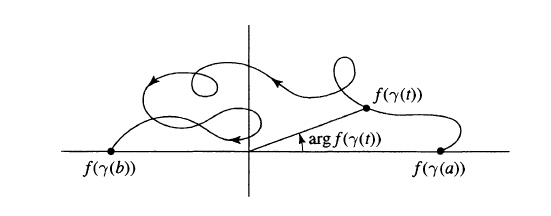
Let \(\Omega\subseteq\CC\) be open, let \(f\) be meromorphic on \(\Omega\), and let \(\gamma\colon[a,b]\to\Omega\) be a closed piecewise \(C^1\) curve that meets no zero and no pole of \(f\). Then the integral of the logarithmic derivative of \(f\) along \(\gamma\) is the winding number of the closed curve \(f\circ\gamma\) about \(0\): \[ \frac{1}{2\pi i}\int_\gamma\frac{f'(z)}{f(z)}\dz=\Index_{w=0}(f\circ\gamma)=\frac{1}{2\pi i}\int_{f\circ\gamma}\frac{dw}{w}. \]
The curve \(f\circ\gamma\) is closed, piecewise \(C^1\), and avoids \(0\). Substituting \(w=f(\gamma(t))\), \(dw=f'(\gamma(t))\gamma'(t)\dt\), \[ \int_\gamma\frac{f'(z)}{f(z)}\dz=\int_a^b\frac{f'(\gamma(t))\gamma'(t)}{f(\gamma(t))}\dt=\int_{f\circ\gamma}\frac{dw}{w}. \]
Change variables by \(w = f(z)\), so that \(z=\gamma(t) \mapsto w = (f\circ \gamma)(t)\) and \(\dw = f'(z) \dz\): \[ {1\over 2\pi i }\int_{\gamma} \logd f(z) \dz = {1\over 2\pi i} \int_{f\circ \gamma} {1\over w} \dw = \Index_{w=0} (f\circ \gamma) .\]
(Using the index version)
Let \(f(z) = z^2 + z = z(z+1)\).
- \(\gamma_1 \coloneqq \ts{\abs z = 2}\) encloses 2 zeros and no poles, so \(f\circ \gamma_1\) winds twice about the origin counterclockwise.
- \(\gamma_2 \coloneqq \ts{\abs z = {1\over 2}}\) encloses 1 zero and no poles, so \(f\circ \gamma_2\) winds once.
(Tracking the argument by hand)
The winding number is the total change of a continuous branch of \(\arg\) along the image curve, divided by \(2\pi\), and it is additive over sub-curves. For a curve in \(\HH\) from a point of \((0,\infty)\) to a point of \((-\infty,0)\), a continuous branch of \(\arg\) with values in \([0,\pi]\) changes by \(\pi\).
Counting solutions of \(f(z) = w\)
The integral \[ F(w) \coloneqq {1\over 2\pi i} \oint_{\bd \Omega} {f'(z) \over f(z) - w} \dz \] is \(\frac{1}{2\pi i}\oint_{\bd\Omega} \logd g_w(z)\dz\) for \(g_w(z) \coloneqq f(z) - w\), so for holomorphic \(f\) it counts the solutions of \(f(z) = w\) in \(\Omega\) with multiplicity. It is a continuous function of \(w\) on each connected component of \(\CC\sm f(\bd\Omega)\) and takes values in \(\ZZ\), hence is constant on each component.
A solution of \(f(z) = a\) of multiplicity \(m \geq 2\) is a zero of \(f'\).
Exercises
The logarithmic derivative of a product: $\frac{(fg)'}{fg}=\frac{f'}{f}+\frac{g'}{g}$ (Tag E-VI5ZS)
Show that \(\del_{\log}(fg) = \del_{\log} f + \del_{\log} g\), i.e. \[ { (fg)' \over fg} = {f'\over f} + {g' \over g} .\]
Solution
Goal: Show that \(\del_{\log}(fg) = \del_{\log} f + \del_{\log} g\), i.e. \((fg)'/(fg) = f'/f + g'/g\), wherever \(f, g\) are nonzero holomorphic functions.
<1>1. Differentiate \(fg\) by the product rule.
\((fg)' = f'g + fg'\).
<1>2. Divide both sides by \(fg \neq 0\).
\(\frac{(fg)'}{fg} = \frac{f'g + fg'}{fg} = \frac{f'g}{fg} + \frac{fg'}{fg} = \frac{f'}{f} + \frac{g'}{g}\).
<1>3. Q.E.D.
<1>1 and <1>2 establish the identity, valid on any region where \(f, g\) are holomorphic and \(fg \neq 0\).
The logarithmic derivative of a product: $\frac{(fg)'}{fg}=\frac{f'}{f}+\frac{g'}{g}$ (Tag E-PWVJS)
Show that \(\logd(fg) = \logd f + \logd g\), i.e. \[ { (fg)' \over fg} = {f'\over f} + {g' \over g} .\]
Solution
\[ {(fg)' \over fg} = { f'g + fg' \over fg} = {f'g \over fg} + {fg' \over fg} = {f'\over f} + {g' \over g} .\]
Detecting injectivity using derivatives (Tag E-WTCTP)
Show that if \(z_0\) is a zero of \(f'\) of order \(n-1\), then \(f\) is \(n\)-to-one in a neighborhood of \(z_0\).
Solution
Wlog, assume \(z_0 = 0\). We want to show that there exists discs \(U = \DD_r(0)\) and \(W = \DD_R(0)\) such that the fiber of \(f:U\to W\) has exactly \(n\) distinct points. Since \(0\) is a zero of order \(n\), expand \(f\) as \(\sum_{k\geq n} c_k z^k = z^n\sum_{k\geq 0} c_{k+n}z^k\). By dividing coefficients through, we may assume \(c_n = 1\), so \[ f(z) = z^n + \qty{ c_{n+1} z^{n+1} + c_{n+2}z^{n+2} + \cdots} = z^n + z^{n+1} \sum_{k\geq 0} c_{k+n+1}z^k \da z^n + g(z) .\]
By Rouché, \(f(z)\) and \(z^n\) have the same number of zeros in a small disc \(\DD_\rho(0)\).
(of claim)
Write \(m(z) = \sum_{k\geq 0}c_{k+n}z^k\) and \(M(z) = z^n\); then if \(\abs{m(z)} < \abs{M(z)}\) for any circle \(\abs{z} = \rho\) with \(\rho< 1\) then \(M\) and \(m+M = f\) will have the same number of zeros (\(n\) with multiplicity).
Bounding \(m\), the tail of the Laurent series of \(f\): by Cauchy’s integral formula, on a disc of radius \(R\), \[ c_k = {f^{(n)}(z_0) \over n!} = {1\over 2\pi i} \oint_{\abs{\xi} = R} { f(\xi) \over (\xi - z_0)^{n+1} } \dxi ,\] so \[ \abs{c_k} \leq \max_{\abs{\xi} = R}\abs{f(\xi)} R^{-k} \da {M_R \over R^{k}} .\]
We can now estimate \(g\): \[ \abs{g(z)} &= \abs{z^n \sum_{k\geq 0} c_{k+n+1} z^k} \\ &\leq \abs{z}^n \sum_{k\geq 0} \abs{ c_{k+n+1}} \abs{z}^k \\ &\leq \sum_{k\geq 0} {M_R \over R^{k+n+1}} \rho^k \\ &= \abs{z}^n {M_R \over R^{n+1}} \sum_{k\geq 0} \qty{\rho\over R}^k \\ &= \abs{z}^n {M_R \over R^{n+1}} \qty{1\over 1- {\rho \over R}} \\ &= \abs{z}^n {M_R \over R^{n+1}} {R\over R-\rho} \\ &= \abs{z}^n \qty{ {M_R\over R^n( R-\rho)} } \\ &\da \abs{z}^n C_{R, \rho} ,\] and \(R, \rho\) can be chosen such that \(C_{R, \rho} < 1\).
Thus on \(\abs{z} = \rho\), \[ \abs{m(z)} = \abs{g(z) } \leq C_{R, \rho} \abs{z} < \abs{z} = \abs{M(z)} .\]
So the fiber above \(z=0\) is of size \(n\), the claim is that this is also true in a neighborhood of zero. The above estimate also shows that for \(0 < \abs{z}\leq \rho\), \(\abs{g(z)} \leq \abs{z^n}\), and so \[ \abs{g(z)} = \abs{g(z) - z^n + z^n} \geq \abs{ \abs{g(z) - z^n} - \abs{z^n} } > 0 ,\] so \(g\) is nonzero on \(\DD_\rho(0)\smz\). For the zero-counting function \[ F(w) \da {1\over 2\pi i} \oint_{\abs{\xi} = \rho'} {f'(\xi) \over f(\xi) - w }\dxi .\] Taking \(\rho ' < \min_{\abs{\xi} = \rho} \abs{f(z)}\) makes this a holomorphic function of \(w\) on \(\DD_{\rho'}(0)\), and as a continuous \(\ZZ\dash\)valued function it is constant. Since \(F(0) = n\), this forces \(F(w) = n\) for all \(\abs{w} < \rho'\), so there are \(n\) solutions to \(f(z) = w\) in these discs. After shrinking these discs if necessary, \(f'\neq 0\) is nonvanishing on a punctured disc, so \(f\) is injective there and these solutions are distinct.