For a cone \(\sigma\subseteq N_\RR\), \(U_\sigma=\Spec k[S_\sigma]\) with \(S_\sigma=\sigma^\vee\cap M\). A Hilbert basis \(m_1,\ldots,m_r\) of \(S_\sigma\) gives a closed embedding \(U_\sigma\hookrightarrow\AA^r\), and the ideal of the image is generated by the binomials \(x^a-x^b\) for the relations \(\sum a_im_i=\sum b_im_i\).
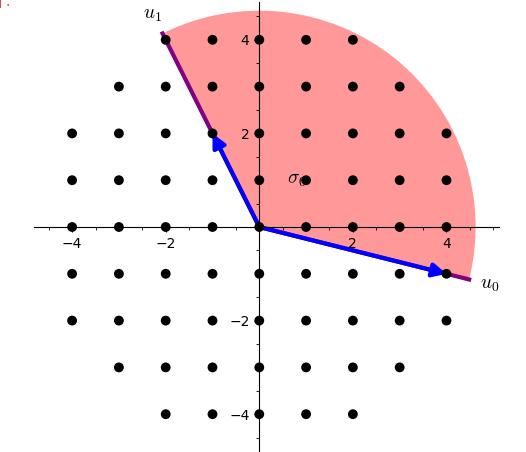
The affine toric variety of the cone on (2,1) and (1,4) (Tag FE-TORDUAL)
In the plane the dual of \(\sigma = \Cone(v_1, v_2)\) is found by rotating each generator a quarter turn and orienting the result inwards. Rotation by \(\pi/2\) is \[ e_1 \mapsto e_2, \quad e_2 \mapsto -e_1, \qquad R = \begin{bmatrix} 0 & -1 \\ 1 & 0 \end{bmatrix} . \] For \(v_1 = (2,1)\) and \(v_2 = (1,4)\) this gives \(R v_1 = (-1,2)\) and \(R v_2 = (-4,1)\). The second normal points out of the cone, so flip it to \((4,-1)\), and \[ \dualof{\sigma} = \Cone\big( (4,-1),\ (-1,2) \big) . \] Check the two pairings that must vanish: \(\inp{(4,-1)}{(1,4)} = 4 - 4 = 0\) and \(\inp{(-1,2)}{(2,1)} = -2 + 2 = 0\), so each of these is the inward normal to one wall.
(The semigroup and its equations)
The Hilbert basis of \(S_\sigma = \dualof{\sigma} \intersect M\) is \[ (4,-1), \quad (1,0), \quad (0,1), \quad (-1,2) , \] found by walking from one extremal ray to the other and keeping the lattice points that are not sums of earlier ones. Write \(u = x^4 \inverseof{y}\), \(v = x\), \(w = y\), \(t = \inverseof{x} y^2\) for the corresponding characters.
Now read the additive relations straight off the exponent vectors: \[ (4,-1) + (0,1) = (4,0) , \qquad (1,0) + (-1,2) = (0,2) , \qquad (4,-1) + (-1,2) = (3,1) , \] that is \(uw = v^4\), \(vt = w^2\), and \(ut = v^3 w\). Hence \[ X_\sigma = \Spec k[x^4 \inverseof{y}, x, y, \inverseof{x} y^2] = \Spec \frac{k[u,v,w,t]}{(uw - v^4,\ vt - w^2,\ ut - v^3 w)} , \] a surface in \(\AA^4\). The three equations are the \(2 \times 2\) minors of \[ \begin{bmatrix} v & w & u \\ w & t & v^3 \end{bmatrix} , \] so the singularity is determinantal, as every two-dimensional toric singularity is.
The index \(\abs{\det \begin{bmatrix} 2 & 1 \\ 1 & 4 \end{bmatrix}} = 7\) is the whole story: \(v_1, v_2\) generate a sublattice of index \(7\) in \(N\), so \(X_\sigma\) is the cyclic quotient singularity \(\AA^2 / \mu_7\) and \(\Cl(X_\sigma) = \ZZ/7\). The computation has two steps: rotate to obtain \(\dualof{\sigma}\), then list its lattice points and read the additive relations among them.
For a full-dimensional cone \(\sigma\), the number of elements of the Hilbert basis of \(S_\sigma\) is the embedding dimension of \(U_\sigma\) at its torus-fixed point; a two-dimensional cone whose Hilbert basis has four elements gives a surface in \(\AA^4\) that does not embed in \(\AA^3\). For the cone over the rational normal curve of degree \(d\), the relations are the \(2\times2\) minors of \(\begin{pmatrix}x_0&x_1&\cdots&x_{d-1}\\x_1&x_2&\cdots&x_d\end{pmatrix}\).
Smooth affine toric varieties
Smooth affine toric varieties and why toric varieties are normal (Tag PR-TORSMAFF)
If \(\sigma\) is a smooth cone of dimension \(k\) inside \(N \cong \ZZ^n\), then \[ U_\sigma \cong \AA^k \times \GG_m^{n-k} . \] Every smooth affine toric variety is of this form.
Extend the minimal generators of \(\sigma\) to a \(\ZZ\)-basis of \(N\), which is possible exactly because \(\sigma\) is smooth. In the dual basis \(\dualof{\sigma}\) is the cone spanned by \(e_1, \ldots, e_k\) and \(\pm e_{k+1}, \ldots, \pm e_n\), so \[ S_\sigma = \NN^k \oplus \ZZ^{n-k}, \qquad k[S_\sigma] = k[x_1, \ldots, x_k, x_{k+1}^{\pm 1}, \ldots, x_n^{\pm 1}] . \]
(Simplicial cones)
If \(\sigma\) is simplicial of dimension \(k\) inside \(N \cong \ZZ^n\), then \(U_\sigma\) is the quotient of \(\AA^k \times \GG_m^{n-k}\) by a finite abelian group, so a toric variety whose fan is simplicial has at worst finite quotient singularities. [@Ful93]
(Normality)
\(X_\Sigma\) is normal.
The reason is that \(S_\sigma\) is a saturated semigroup: if \(\ell m \in S_\sigma\) for some \(\ell > 0\) then \(m \in S_\sigma\), since the defining inequalities \(\inp{m}{u} \geq 0\) are homogeneous. Concretely, \(k[S_\sigma]\) is the intersection of the rings \(k[S_\tau]\) over the rays \(\tau \leq \sigma\), each of which is a Laurent polynomial ring \(k[x_1, x_2^{\pm 1}, \ldots, x_n^{\pm 1}]\) and so integrally closed, and an intersection of integrally closed domains with the same fraction field is integrally closed.
This is the standing caveat on the whole dictionary: fans produce normal toric varieties only. The nodal cubic has a torus acting with a dense orbit and is not on the list.
The cotangent space at a fixed point is the Hilbert basis of the semigroup (Tag PR-FULCOTAN)
Let \(\sigma\) span \(N_\RR\), so \(\sigma^\perp = 0\) and the distinguished point \(x_\sigma \in U_\sigma\) is the torus-fixed point. Its maximal ideal and square are \[ \mfm = \gens{ \chi^u \st u \in S_\sigma \smz } , \qquad \mfm^2 = \gens{ \chi^u \st u \in (S_\sigma \smz) + (S_\sigma \smz) } , \] so \[ \dualof{T}_{x_\sigma} U_\sigma = \mfm/\mfm^2 = \bigoplus_{u \text{ irreducible}} k \cdot \chi^u , \] where \(u \in S_\sigma \smz\) is irreducible, or indecomposable, if it is not a sum of two nonzero elements of \(S_\sigma\). The irreducible elements are exactly the Hilbert basis of \(S_\sigma\), so \[ \dim T_{x_\sigma} U_\sigma = \size\ts{\text{Hilbert basis of } S_\sigma} . \]
(What this forces)
\(U_\sigma\) is smooth at \(x_\sigma\) exactly when the Hilbert basis has \(n = \dim N_\RR\) elements, and then \(\sigma\) is generated by a \(\ZZ\)-basis of \(N\).
Each extremal ray of \(\dualof{\sigma}\) contributes its primitive generator as an irreducible element, and distinct rays contribute distinct ones. So if \(U_\sigma\) is smooth at \(x_\sigma\) then \[ \size\ts{\text{rays of } \dualof{\sigma}} \leq \size\ts{\text{Hilbert basis}} = \dim T_{x_\sigma} U_\sigma = n . \] A pointed full-dimensional cone in \(\RR^n\) has at least \(n\) rays, so \(\dualof{\sigma}\) has exactly \(n\) of them, and the Hilbert basis is exactly those \(n\) primitive generators. They generate \(S_\sigma\), hence generate \(M\) as a group, and \(n\) generators of a rank-\(n\) lattice form a \(\ZZ\)-basis. Dualising, \(\sigma\) is generated by the dual basis, which is a \(\ZZ\)-basis of \(N\).
(Why the converse holds)
If the cone is generated by a lattice basis, the corresponding affine toric variety is visibly smooth. The converse is the substantive direction: smoothness forces the Hilbert basis to have exactly \(n\) elements. The mechanism is a count: the embedding dimension at the fixed point is the size of the Hilbert basis, smoothness caps that count at \(n\), and the cap squeezes the dual cone down to exactly \(n\) rays with no room left for a non-basis.
The count is also the practical statement. For \(\sigma = \Cone\big( (0,1), (2,-1) \big)\) the Hilbert basis of \(S_\sigma\) is \((1,0), (1,1), (1,2)\), three elements in dimension two, so \(U_\sigma\) embeds in \(\AA^3\) and not in \(\AA^2\): it is the quadric cone, singular at the fixed point and smooth everywhere else.
\(U_\sigma\) is smooth exactly when the minimal ray generators of \(\sigma\) are part of a basis of \(N\). For full-dimensional \(\sigma\), the Zariski cotangent space at the torus-fixed point has dimension equal to the size of the Hilbert basis of \(S_\sigma\), which equals \(\dim U_\sigma\) exactly in the smooth case.
For a two-dimensional cone with primitive ray generators \(u_1,u_2\), \(\abs{\det(u_1,u_2)}=1\) exactly when \(U_\sigma\) is smooth, and \(\Cl(U_\sigma)\) is cyclic of order \(\abs{\det(u_1,u_2)}\).
Saturation and normality
Saturated semigroups and the normalisation of an affine toric variety (Tag D-FULSAT)
An affine semigroup \(S \subseteq M\) is saturated if \[ k \in \ZZ_{>0}, \quad m \in M, \quad km \in S \implies m \in S . \] \(\Spec k[S]\) is normal exactly when \(S\) is saturated in the lattice \(\ZZ S\) it generates, and \(S_\sigma = \dualof{\sigma} \intersect M\) is saturated for every cone, since its defining inequalities are homogeneous.
(A semigroup that is not saturated)
Let \(S\) be generated by \((4,0), (3,1), (1,3), (0,4)\) inside \(M = \ZZ^2\). Then \(2 \cdot (2,2) = (4,4) = (4,0) + (0,4) \in S\), but \((2,2) \notin S\), so \(S\) is not saturated and \(\Spec k[S]\) is not normal.
(Normalization of an affine toric variety)
Given a non-normal affine toric variety \(X = \Spec k[S]\), set \(M = \ZZ S\), take any finite generating set \(S'\) of \(S\), and put \[ \sigma \da \dualof{\Cone(S')} \subseteq N_\RR . \] Then \(\dualof{\sigma} \intersect M\) is the saturation of \(S\), and \[ \Spec k[\dualof{\sigma} \intersect M] \longrightarrow X \] is the normalisation. It is finite and birational, and it is an isomorphism if and only if \(S\) is saturated.
(Non-normal toric varieties)
The toric variety \(X_\Sigma\) of a fan \(\Sigma\) is normal. A variety \(X\) containing a torus \(T\) as a dense open subset, with the action of \(T\) on itself extending to \(X\), need not be normal; if \(X\) is affine, its normalization is \(X_\sigma\) for \(\sigma=\dualof{\Cone(S')}\), with \(S'\) a finite generating set of its semigroup \(S\). The cuspidal cubic \(V(x^3 - y^2)\) contains the torus \(\ts{(t^2, t^3) \st t \in \GG_m}\), so \(S = \gens{2,3} \subseteq \ZZ\), which is not saturated because \(2 \cdot 1 \in S\) while \(1 \notin S\). The saturation is \(\NN \subseteq \ZZ\), and the normalisation is \(\AA^1 \to V(x^3 - y^2)\), \(t \mapsto (t^2, t^3)\).
For a finitely generated semigroup \(S\subseteq M\), \(k[S]\) is normal exactly when \(S\) is saturated, and the saturation of \(S\) gives the normalization of \(\Spec k[S]\). The semigroup \(\langle2,3\rangle\subseteq\ZZ\) gives the cusp \(\Spec k[t^2,t^3]\); its saturation is \(\NN\), giving the normalization \(\AA^1\).
The quadric cone
The cone over the rational normal curve, and a class group with torsion (Tag FE-TORCD)
Take \(\sigma = \Cone(e_2,\ d e_1 - e_2) \subseteq N_\RR = \RR^2\) for \(d \geq 2\). Rotating as usual, \(\dualof{\sigma} = \Cone\big( (1,0),\ (1,d) \big)\), whose lattice points are generated by \[ (1,0), (1,1), \ldots, (1,d) \rightsquigarrow x, xy, \ldots, xy^d , \] so \(X_\sigma = \hat C_d\) is the affine cone over the rational normal curve of degree \(d\), cut out by the \(2 \times 2\) minors of \[ \begin{bmatrix} z_0 & z_1 & \cdots & z_{d-1} \\ z_1 & z_2 & \cdots & z_d \end{bmatrix} . \] For \(d = 2\) this is the quadric cone \(V(z_0 z_2 - z_1^2)\).
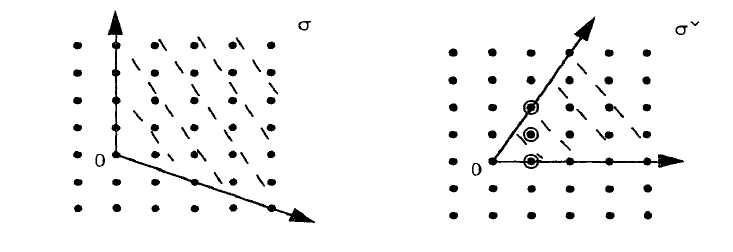
(The class group)
The two rays give \(D_1, D_2\), and the sequence \[ M \to \Div_T(U_\sigma) = \ZZ D_1 \oplus \ZZ D_2 \to \Cl(U_\sigma) \to 0 \] sends \(m \mapsto \sum_\rho \inp{m}{u_\rho} D_\rho\). On the basis \(e_1, e_2\) of \(M\) the matrix against the ray generators \(u_1 = e_2\), \(u_2 = d e_1 - e_2\) is \[ \begin{bmatrix} 0 & d \\ 1 & -1 \end{bmatrix} , \] that is \(\operatorname{div}(\chi^{e_1}) = d D_2\) and \(\operatorname{div}(\chi^{e_2}) = D_1 - D_2\). The second relation kills \(D_1\) in favour of \(D_2\), and the first says \(d D_2 = 0\): \[ \Cl(\hat C_d) = \ZZ/d\ZZ . \]
\(U_\sigma\) is affine, so \(\Pic(U_\sigma) = 0\) while \(\Cl(U_\sigma) = \ZZ/d\). Therefore \(D_2\) is a Weil divisor that is not Cartier — no case analysis needed, the two groups simply differ. This is the standard counterexample to “Weil implies Cartier” and, at \(d = 2\), the standard example of a normal surface singularity, \(V(xy - z^2)\) with its two rulings.
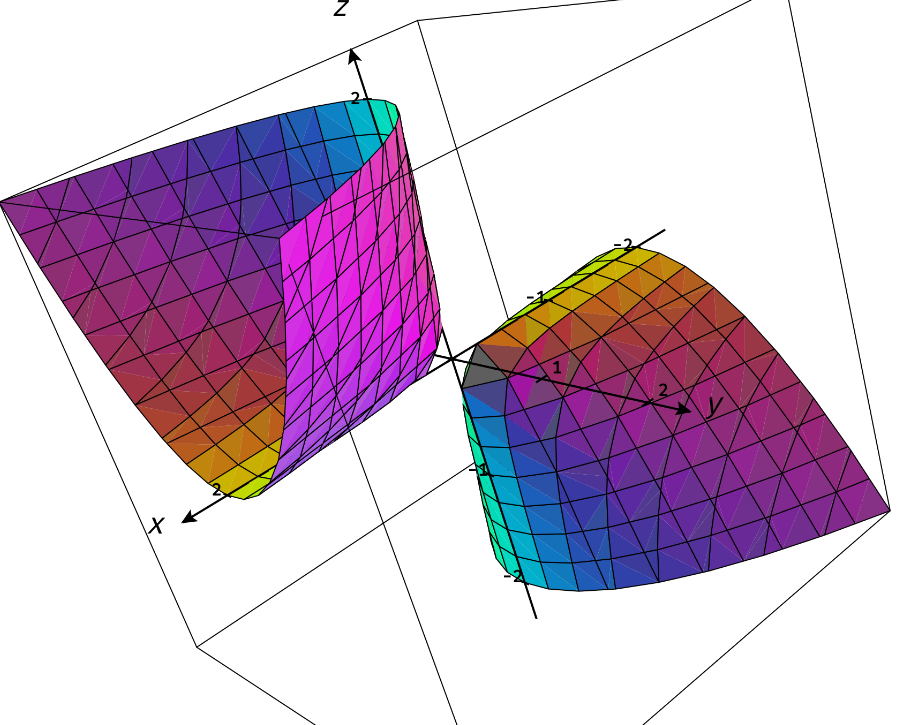
The quadric cone \(V(y^2-xz)\) is normal and not smooth, the line \(x=y=0\) is a Weil divisor on it that is not Cartier, and its class group is \(\ZZ/2\).
The cone over the rational normal curve as a cyclic quotient singularity (Tag FE-FULQUOT)
Take \(\sigma = \Cone\big( m e_1 - e_2,\ e_2 \big) \subseteq N_\RR = \RR^2\) with \(m \geq 2\). Solving \(\inp{u}{m e_1 - e_2} \geq 0\) and \(\inp{u}{e_2} \geq 0\) gives \(\dualof{\sigma} = \Cone\big( (1,0), (1,m) \big)\), whose lattice points have Hilbert basis \((1,0), (1,1), \ldots, (1,m)\), so with \(x = \chi^{e_1}\) and \(y = \chi^{e_2}\), \[ A_\sigma = k[S_\sigma] = k\big[ x,\ xy,\ \ldots,\ xy^m \big] . \] Substituting \(x = u^m\) and \(y = v/u\) turns the generators into the degree-\(m\) monomials: \[ A_\sigma = k\big[ u^m,\ u^{m-1} v,\ \ldots,\ u v^{m-1},\ v^m \big] . \]
(The group)
Let \(\mu_m\) act diagonally on \(\AA^2\) by \[ \zeta \cdot (u,v) = (\zeta u,\ \zeta v), \qquad \zeta^m = 1 . \] A monomial \(u^i v^j\) is invariant exactly when \(i + j \equiv 0 \pmod m\), so the invariant ring is generated by the degree-\(m\) monomials, and \[ A_\sigma = k[u,v]^{\mu_m} , \qquad U_\sigma \cong \AA^2 / \mu_m . \] In the standard notation this is the cyclic quotient singularity \(\tfrac{1}{m}(1,1)\).
(The lattice reading of the same fact)
The two generators of \(\sigma\) span a sublattice of index \[ \abs{\det \begin{bmatrix} m & -1 \\ 0 & 1 \end{bmatrix}} = m \] inside \(N\), and that index is the order of the group. This is the general statement: a simplicial cone whose generators span a sublattice of index \(d\) gives the quotient of \(\AA^n\) by a group of order \(d\), and the group is \(N/N'\) for \(N'\) the sublattice. Thus the same determinant that detects non-smoothness gives the order of the finite quotient group.
For \(m = 2\) this is the quadric cone \(V(z_0 z_2 - z_1^2) = \AA^2/\pm 1\), the \(A_1\) surface singularity, and the same variety appears as the singular chart of \(\PP(1,1,2)\). The quotient description is the one that generalises: it survives to higher dimension and to non-diagonal weights, where the determinantal presentation by \(2 \times 2\) minors does not.
As \(V(y^2-xz)\subseteq\AA^3\) it is cut out by the \(2\times2\) minor of \(\begin{pmatrix}x&y\\y&z\end{pmatrix}\); as \(\AA^2/\{\pm1\}\) it is the \(A_1\) quotient singularity, and \(\Cl\cong\ZZ/2\) is the character group of \(\{\pm1\}\).
Resolving it
The minimal resolution of a toric surface singularity (Tag FE-TORMINRES)
Let \(\sigma \subseteq \RR^2\) be a two-dimensional cone. Take the convex hull of \((\sigma \intersect N) \sm \ts{0}\). Its compact boundary is a broken line through finitely many lattice points; the rays through those points are exactly the rays of the minimal resolution. Every cone of the refined fan is then smooth, and the resolution is minimal because no exceptional curve has self-intersection \(-1\).
(Degree three)
Take \(\sigma = \Cone\big( (0,1),\ (3,-1) \big)\), whose affine toric variety is the cone over the rational normal cubic and has \(\Cl = \ZZ/3\). The determinant is \(\abs{0 \cdot (-1) - 1 \cdot 3} = 3\), so \(\sigma\) is singular. The only lattice point on the compact boundary of the hull is \((1,0)\), so insert that ray. Check both new cones: \[ \det\begin{bmatrix} 0 & 1 \\ 1 & 0 \end{bmatrix} = -1 , \qquad \det\begin{bmatrix} 1 & 0 \\ 3 & -1 \end{bmatrix} = -1 , \] both smooth, so a single blowup resolves. The exceptional curve \(E = D_{(1,0)}\) has self-intersection read from \[ (0,1) + (3,-1) = (3,0) = 3 \cdot (1,0) \rightsquigarrow E^2 = -3 . \]
The same computation for \(\Cone\big( (0,1), (d,-1) \big)\) gives one exceptional curve with \(E^2 = -d\), which is the standard model of the cone over the rational normal curve of degree \(d\): contract the negative section of \(\FF_d\).
For a general cone the boundary lattice points give a chain of rational curves with self-intersections \(-b_1, \ldots, -b_r\), all \(b_i \geq 2\), and the \(b_i\) are the Hirzebruch–Jung continued fraction of the singularity. The \(b_i \geq 2\) is exactly the statement that the resolution is minimal.
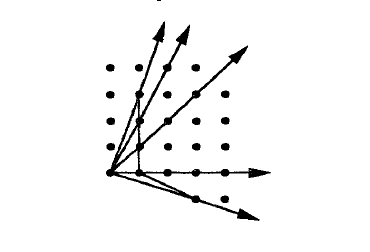
The minimal resolution of a toric surface \(U_\sigma\) subdivides \(\sigma\) by the rays through the lattice points on the compact edges of the convex hull of \((\sigma\cap N)\setminus\{0\}\).