Problems on complex arithmetic
Geometrically describe the following subsets of $\CC$: $\abs{z-1} = 1$ $\abs{z-1} = 2\abs{z-2}$ $1/z = \bar z$ $\Re(z) = 3$ $\Im(z) = a$ with $a\in \RR$. (Tag P-TWN5M)
Geometrically describe the following subsets of \(\CC\):
- \(\abs{z-1} = 1\)
- \(\abs{z-1} = 2\abs{z-2}\)
- \(1/z = \bar z\)
- \(\Re(z) = 3\)
- \(\Im(z) = a\) with \(a\in \RR\).
- \(\Re(z) > a\) with \(a\in \RR\).
- \(\abs{z-1} < 2\abs{z-2}\)
Solution
A circle of radius 1 about \(z=1\).
A circle, using that Apollonius circles are characterized as the locus of distances whose ratios to some fixed points \(A, B\) are constant. To actually compute this: \[ \abs{z-1}^2 &= 4\abs{z-2}^2 \\ \implies (x-1)^2 + y^2 - 4\qty{(x-2)^2 + y^2 } &=0 \\ -3x^2 + 14x - 3y^2 - 15 &= 0 && \star\\ \implies x^2 - {14\over 3}x + y^2 + 5 &= 0 \\ \implies (x- {14\over 2\cdot 3})^2 - {14\over 2\cdot 3}^2 + y^2 + 5 &= 0 \\ \implies (x-{14\over 6})^2 + y^2 = \qty{2\over 3}^2 ,\] which is a circle of radius \(2/3\) with center \(\qty{{14\over 6}, 0}\). To avoid the calculation, use \[ Ax^2 + Bxy + Cy + \cdots = 0,\quad A=1, B=0, C=1 \implies \Delta \da B^2 - 4AC < 0 ,\] which is an ellipse, and since \(A=C\) it is in fact a circle.
\(S^1\), using that \({1\over z} = {\bar{z} \over z\bar{z}} = {\bar z\over \abs{z}^2}\) and if this equals \(\bar{z}\), then \(\abs{z}^2=1\). Alternatively, \(1 = \bar{z}z = \abs{z}^2\).
Vertical line through \(z=3\).
Horizontal line through \(z=ia\).
Region to the right of the vertical line through \(z=a\).
Exterior of a circle: same calculation is (2), replacing \(=0\) with \(<0\). Note that the line marked \(\star\) involves dividing by a negative, so this flips the sign, and we get \(\cdots > \qty{2\over 3}^2\) at the end.
Reverse triangle inequality $|z+w|\ge\bigl||z|-|w|\bigr|$ (Tag P-3HHKX)
Prove the following inequality, and explain when equality holds: \[ \abs{z+w} \geq \abs{ \abs{z} - \abs{w} } .\]
Solution
Goal: Prove \(\abs{z + w} \ge \abs{\abs{z} - \abs{w}}\) and explain when equality holds.
<1>1. \(\abs{z} \le \abs{z + w} + \abs{w}\).
Triangle inequality applied to \(z = (z + w) + (-w)\): \(\abs{z} \le \abs{z + w} + \abs{-w} = \abs{z+w} + \abs{w}\), hence \(\abs{z} - \abs{w} \le \abs{z + w}\).
<1>2. \(\abs{w} \le \abs{z + w} + \abs{z}\).
Same argument with roles swapped: \(\abs{w} \le \abs{z + w} + \abs{z}\), hence \(\abs{w} - \abs{z} \le \abs{z + w}\).
<1>3. \(\abs{\abs{z} - \abs{w}} \le \abs{z + w}\).
\(\abs{\abs{z} - \abs{w}} = \max(\abs{z} - \abs{w}, \abs{w} - \abs{z}) \le \abs{z + w}\) by <1>1 and <1>2.
<1>4. Equality characterization.
Equality holds iff \(\abs{z} - \abs{w} = \abs{z+w}\) with \(\abs{z} \ge \abs{w}\) (or the symmetric case). By the equality case of the triangle inequality, \(\abs{z + w} = \abs{z} + \abs{w}\) iff \(z\) and \(w\) are nonnegative real multiples of each other. Here \(z = (z+w) + (-w)\): equality in <1>1 requires \(z + w\) and \(-w\) to be nonnegatively aligned, i.e. \(z + w = \lambda(-w)\) with \(\lambda \ge 0\), i.e. \(z = -(\lambda + 1)w\), i.e. \(z/w \le 0\) (real, nonpositive). Symmetrically for <1>2. Conclusion: equality holds iff \(z\) and \(w\) are collinear with opposite directions: \(z/w \in (-\infty, 0]\), i.e. \(\arg z = \arg w + \pi \pmod{2\pi}\) (or one of them is \(0\)).
<1>5. Q.E.D.
<1>3 proves the inequality; <1>4 characterizes equality.
Roots of $z^3+2z+4$ lie outside the unit circle (Tag P-43AXY)
Prove that the following polynomial has its roots outside of the unit circle: \[ p(z) = z^3 + 2z + 4 .\]
Hint: What is the maximum value of the modulus of the first two terms if \(\abs{z} \leq 1\)?
Solution
Goal: Prove that all roots of \(p(z) = z^3 + 2z + 4\) lie outside the unit circle.
<1>1. On \(\abs{z} = 1\), the modulus of the first two terms is at most \(3\).
\(\abs{z^3 + 2z} \leq \abs{z}^3 + 2\abs{z} = 1 + 2 = 3\) by the triangle inequality.
<1>2. On \(\abs{z} = 1\), \(\abs{z^3 + 2z} < \abs{4}\).
By <1>1, \(\abs{z^3 + 2z} \leq 3 < 4 = \abs{4}\).
<1>3. \(p(z) = z^3 + 2z + 4\) has the same number of zeros in \(\abs{z} < 1\) as the constant \(4\).
Apply Rouch'e’s theorem to \(f(z) = 4\) and \(g(z) = z^3 + 2z\) on the circle \(\abs{z} = 1\); the strict inequality \(\abs{g(z)} < \abs{f(z)}\) from <1>2 holds on the whole circle, so \(f\) and \(f + g = p\) have equally many zeros inside.
<1>4. \(p\) has no zeros in \(\abs{z} < 1\) and none on \(\abs{z} = 1\).
The constant \(4\) has no zeros, so by <1>3 neither does \(p\) inside the circle; and <1>2 rules out zeros on the circle itself (there \(\abs{p(z)} \geq \abs{4} - \abs{z^3 + 2z} \geq 4 - 3 = 1 > 0\)).
<1>5. Q.E.D.
<1>4 shows every root of \(p\) satisfies \(\abs{z} > 1\), i.e. lies strictly outside the unit circle.
$|z-z_1|/|z-z_2|=c$ is a circle (Tag P-CZ3R7)
Prove that if \(c>0\), \[ \abs{w_1} = c\abs{w_2} \implies \abs{w_1 - c^2 w_2} = c\abs{w_1 - w_2} .\]
Prove that if \(c>0\) and \(c\neq 1\), with \(z_1\neq z_2\), then the following equation represents a circle: \[ \abs{z-z_1 \over z-z_2} = c .\] Find its center and radius.
Hint: use part (a)
Solution: part 1
\[ \abs{w_1 - c^2 w_2}^2 &= (w_1 - c^2 w_2) ( \bar{w_1} - c^2 \bar{w_2} ) \\ &= \abs{w_1}^2 + c^4 \abs{w_2}^2 - 2c^2 \Re(w_1 \bar{w_2}) \\ &= {\color{green} c^2 \abs{w_2}^2 } + c^4 \abs{w_2}^2 - 2c^2 \Re(w_1 \bar{w_2}) \\ &= c^2 \abs{w_2}^2 + {\color{green} c^2 \abs{w_1}^2 } - 2c^2 \Re(w_1 \bar{w_2}) \\ &= c^2 \abs{w_1 - w_2} ,\] where we’ve applied the assumption \(\abs{w_1} = c\abs{w_2}\) twice.
Solution: part 2
Using part 1: \[ w_1\da z-z_1, w_2 \da z-z_2 \implies \abs{w_1} &= c\abs{w_2} \\ \implies \abs{w_1 - c^2 w_2} &= c \abs{w_1 - w_2} \\ \implies \abs{ z-z_1 - c^2 (z-z_2) } &= \abs{(z-z_1) - (z-z_2)} \\ \implies \abs{(1-c^2) z - z_3} &= \abs{ z_2 - z_1 } \\ \implies \abs{z-z_4} &= r ,\] where the \(z_i\) and \(r\) are all constant, so this is the equation of a circle.
The disk automorphism $z\mapsto\frac{w-z}{1-\bar{w}z}$ (Tag P-FOXHV)
Let \(z, w \in \CC\) with \(\bar z w \neq 1\). Prove that \[ \abs{w-z \over 1 - \bar w z} < 1 \quad\text{ if } \abs{z}<1,~ \abs{w} < 1 \] with equality when \(\abs{z} = 1\) or \(\abs{w} = 1\).
Prove that for a fixed \(w\in \DD\), the mapping \(F: z\mapsto {w-z \over 1 - \bar w z}\) satisfies
\(F\) maps \(\DD\) to itself and is holomorphic.
\(F(0) = w\) and \(F(w) = 0\).
\(\abs{z} = 1\) implies \(\abs{F(z)} = 1\).
\(F: \DD \to \DD\) is bijective.
Hint: Calculate \(F \circ F\).
Solution
Goal: (a) Show \(\abs{\frac{w - z}{1 - \bar w z}} < 1\) for \(\abs z, \abs w < 1\) (with equality when \(\abs z = 1\) or \(\abs w = 1\)), for \(\bar z w \neq 1\); (b) show \(F(z) = \frac{w - z}{1 - \bar w z}\) maps \(\DD\) to itself, is holomorphic, sends \(0 \mapsto w\), \(w \mapsto 0\), the circle to the circle, and is bijective.
<1>1. Compute \(\abs{w - z}^2 - \abs{1 - \bar w z}^2 = (\abs w^2 - 1)(1 - \abs z^2)\).
\(\abs{w - z}^2 = \abs w^2 + \abs z^2 - w\bar z - \bar w z\) and \(\abs{1 - \bar w z}^2 = 1 + \abs w^2 \abs z^2 - \bar w z - w \bar z\); subtracting gives \(\abs w^2 + \abs z^2 - 1 - \abs w^2\abs z^2 = (\abs w^2 - 1)(1 - \abs z^2)\).
<1>2. (a): For \(\abs z, \abs w < 1\), \(\abs{\frac{w - z}{1 - \bar w z}} < 1\).
By <1>1, \(\abs{w - z}^2 - \abs{1 - \bar w z}^2 = (\abs w^2 - 1)(1 - \abs z^2) < 0\) (both factors negative), so \(\abs{w - z} < \abs{1 - \bar w z}\); dividing by the positive \(\abs{1 - \bar w z}\) (nonzero because \(\abs{\bar w z} = \abs w \abs z < 1\)) gives the claim.
<1>3. (a): If \(\abs z = 1\) or \(\abs w = 1\), then \(\abs{\frac{w - z}{1 - \bar w z}} = 1\).
If \(\abs z = 1\), then \(\abs{1 - \bar w z} = \abs z \abs{1 - \bar w z} = \abs{z - \bar w z^2}\)… more directly: \(\abs{1 - \bar w z} = \abs{\bar z - \bar w} = \abs{z - w}\) since \(\bar z = 1/z\); indeed \(\abs{1 - \bar w z} = \abs{\overline{1 - \bar w z}} = \abs{1 - w\bar z}\), and \(\abs{1 - w\bar z} = \abs{z - w}\) because \(\abs z = 1\) (multiply by \(\abs z\): \(\abs{z - w\abs z^2} = \abs{z - w}\)). So numerator and denominator have equal modulus.
The case \(\abs w = 1\) is symmetric: \(\abs{1 - \bar w z} = \abs{w - z\abs w^2} = \abs{w - z}\).
<1>4. (b): \(F\) is holomorphic on \(\DD\).
\(F\) is a rational function whose denominator \(1 - \bar w z\) does not vanish on \(\DD\) (as \(\abs{\bar w z} \leq \abs w \abs z < 1\) for \(\abs w < 1\), \(\abs z < 1\)); hence it is holomorphic there.
<1>5. (b): \(F(0) = w\) and \(F(w) = 0\).
\(F(0) = \frac{w - 0}{1 - 0} = w\), and \(F(w) = \frac{w - w}{1 - \bar w w} = \frac{0}{1 - \abs w^2} = 0\) (valid since \(\abs w < 1\)).
<1>6. (b): \(F\) maps \(\DD\) into itself and \(\abs z = 1 \implies \abs{F(z)} = 1\).
By <1>2, \(\abs{F(z)} < 1\) for \(\abs z < 1\); by <1>3 with the roles as given, \(\abs{F(z)} = 1\) for \(\abs z = 1\) (equality case \(\abs z = 1\)).
<1>7. (b): \(F: \DD \to \DD\) is bijective.
\(F(F(z)) = \frac{w - F(z)}{1 - \bar w F(z)}\).
Clearing the inner denominator \(1 - \bar w z\) gives \[ F(F(z)) = \frac{w(1 - \bar w z) - (w - z)}{(1 - \bar w z) - \bar w(w - z)} = \frac{z(1 - \abs w^2)}{1 - \abs w^2} = z \] for \(\abs w < 1\). Thus \(F \circ F = \mathrm{id}_{\DD}\), so \(F\) is a bijection.
<1>8. Q.E.D.
<1>2–<1>3 prove (a) and <1>4–<1>7 prove (b).
$2^{n-1}\prod_{k=1}^{n-1}\sin(k\pi/n)=n$ (Tag P-37Z7J)
Use \(n\)th roots of unity to show that \[ 2^{n-1} \sin\qty{\pi \over n} \sin\qty{2\pi \over n} \cdots \sin\qty{(n-1)\pi \over n} = n .\]
Hint: \[ 1 - \cos(2\theta) &= 2\sin^2(\theta) \\ 2 \sin(2\theta) &= 2\sin(\theta) \cos(\theta) .\]
- \(\zeta_n \da e^{2\pi i \over n}\)
- \(\Phi_n(z) \da \prod_{1\leq j \leq n-1}(z-\zeta_n^j)\)
- \(\Phi_n(1) = n\), since \(\Phi_n(z) = {z^n-1\over z-1} = \sum_{0\leq j\leq n-1} z^j\).
- \(\sin(z) = \qty{e^{iz} - e^{-iz} \over 2i}\).
- \(\prod_k \exp(c_k) = \exp\qty{\sum_k c_k}\).
Solution: Newer
\[ \prod_{1\leq k \leq n-1} \sin\qty{k\pi\over n} &= \prod_{1\leq k \leq n-1} {\omega_n^k - \omega_n^{-k} \over 2i} \\ &= \qty{1\over 2i}^{n-1} \prod_{1\leq k \leq n-1} \omega_n^{k} \qty{1 - \zeta_n^{-k}} \\ &= \qty{1\over 2i}^{n-1} \prod_{1\leq k \leq n-1} \exp\qty{i\pi k\over n} \prod_{1\leq k \leq n-1} \qty{1 - \zeta_n^{-k}} \\ &= \qty{1\over 2i}^{n-1} \exp\qty{ {i\pi\over n} \displaystyle\sum_{1\leq k \leq n-1} k } \prod_{1\leq k \leq n-1} \qty{1 - \zeta_n^{-k}} \\ &= \qty{1\over 2i}^{n-1} e^{i\pi n(n-1)\over 2n} \prod_{1\leq k \leq n-1} \qty{1 - \zeta_n^{-k}} \\ &= \qty{1\over 2}^{n-1}\qty{1\over i}^{n-1} \qty{ e^{i\pi \over 2} }^{n-1} \prod_{1\leq k \leq n-1} \qty{1 - \zeta_n^{-k}} \\ &= 2^{1-n} \prod_{1\leq k \leq n-1} \qty{1 - \zeta_n^{-k}} \\ &= 2^{1-n} \prod_{1\leq k \leq n-1} \qty{1 - \zeta_n^{k}} \\ &= 2^{1-n} { \Phi_n(z) \over z-1}\evalfrom_{z=1} \\ &= 2^{1-n} \qty{ \sum_{0\leq k \leq n-1} z^k}\evalfrom_{z=1} \\ &= n2^{1-n} .\]
Solution: Older
\[ \prod_{1\leq j\leq n-1} \sin \left(\frac{j \pi}{n}\right) &=\prod_{1\leq j\leq n-1} \frac{1}{2 i} \qty{\zeta_n^{j\over 2} - \zeta_n^{- {j \over 2} }} \\ &=\left(\frac{1}{2 i}\right)^{n-1} \prod_{1\leq j\leq n-1} \zeta_n^{j\over 2} \prod_{1\leq j \leq n-1} \qty{1 - \zeta_n^{-j}} \\ &=\left(\frac{1}{2 i}\right)^{n-1} \prod_{1\leq j\leq n-1} \exp\qty{ij\pi \over n} \prod_{1\leq j \leq n-1} \qty{1 - \zeta_n^{-j}} \\ &=\left(\frac{1}{2 i}\right)^{n-1} \exp \left(\sum_{1\leq j\leq n-1} \frac{i j \pi}{n}\right) \Phi_{n}(1)\\ &=\left(\frac{1}{2 i}\right)^{n-1} \exp \left(\frac{(n-1) i \pi}{2}\right) \Phi_{n}(1)\\ &=\left(\frac{1}{2 i}\right)^{n-1}\left(e^{i \pi / 2}\right)^{n-1} \Phi_{n}(1)\\ &=\left(\frac{1}{2 i}\right)^{n-1} i^{n-1} \Phi_{n}(1)\\ &=\left(\frac{1}{2}\right)^{n-1} \Phi_{n}(1)\\ &=\frac{n}{2^{n-1}} .\]
Equilateral triangles as $z_1^2+z_2^2+z_3^2=z_1z_2+z_2z_3+z_3z_1$ (Tag P-UYWZ5)
Prove that the distinct complex numbers \(z_1, z_2, z_3\) are the vertices of an equilateral triangle if and only if \[ z_{1}^{2}+z_{2}^{2}+z_{3}^{2}=z_{1} z_{2}+z_{2} z_{3}+z_{3} z_{1} .\]
Solution
Translate so that \(z_1=0\), and put \[ a=z_2-z_1,\qquad b=z_3-z_1. \] The displayed equation is translation-invariant and becomes \[ a^2+b^2=ab. \] Since the three points are distinct, \(a\ne0\). Dividing by \(a^2\) and writing \(t=b/a\) gives \[ t^2-t+1=0, \] so \[ t=e^{i\pi/3}\quad\text{or}\quad t=e^{-i\pi/3}. \] Thus \(|b|=|a|\) and the angle between \(a\) and \(b\) is \(\pi/3\). Consequently \[ |a-b|=|a|=|b|, \] so the three vertices form an equilateral triangle.
Conversely, if the triangle is equilateral, after the same translation and division by \(a\ne0\) we have \(b/a=e^{\pm i\pi/3}\), which satisfies \(t^2-t+1=0\). Reversing the algebra gives the displayed identity.
Problems on holomorphy and power series
$|z|^2$ is complex-differentiable only at $0$ (Tag P-CV2MR)
Prove that \(f(z) = \abs{z}^2\) has a derivative at \(z=0\) and nowhere else.
Solution
The easy check: \(f\) is differentiable iff \(\delbar_z f = 0\), but \[ \delbar_z \abs{z}^2 = \delbar_z z\bar{z} = z \neq 0 ,\] unless of course \(z=0\).
A more explicit check: check the limits. \[ {f(z) - f(0) \over z-0} = { \abs{z}^2 \over z } = {z\bar z \over z} = \bar{z} \converges{z\to 0}\too 0 ,\] so \(f\) is differentiable at \(w=0\). Now taking \(w = Re^{i\theta} \neq 0\), \[ {f(z) -f(w) \over z-w} = {\abs{z}^2 - \abs{w}^2 \over z - w} = {\qty{\abs{z} + \abs{w} } \qty{\abs{z} - \abs{w}} \over z-w } = {\abs z - \abs w \over z-w}\cdot \qty{\abs{z} + \abs{w}} .\] First let \(z\to w\) along \(\bd \DD_{R'}(0)\) where \(R' \da \abs{w}\), so that the numerator vanishes and the limit is zero. Then let \(z\to w\) along the curve \(\ts{tw\st t\in [0, 1]}\), then \(\abs{z} = t \abs{w}\), so the ratio becomes \[ {\abs z - \abs w \over z-w}\cdot \qty{\abs{z} + \abs{w}} &= {t\abs{w} - \abs w \over tw-w}\cdot \qty{t\abs{w} + \abs{w}} \\ &= {\abs{w}\qty{t-1 } \over w(t-1)} \cdot \abs{w}(t+1) \\ &= { \abs{w}^2(t+1) \over w} \\ &= \bar{w}(t+1) \\ &\converges{t\to 1}\to 2\bar{w} ,\] which is nonzero is \(w\neq 0\).
Constancy of holomorphic functions of constant modulus, real part, argument, or conjugate (Tag P-7UTDI)
Let \(f(z)\) be analytic in a domain, and prove that \(f\) is constant if it satisfies any of the following conditions:
- \(|f(z)|\) is constant.
- \(\Re(f(z))\) is constant.
- \(\arg(f(z))\) is constant.
- \(\overline{f(z)}\) is analytic.
Solution
Write \(f=u+iv\) on the connected domain.
<1>1. If \(|f|\) is constant, then either \(f\equiv0\), or \(f\) is nonzero and its image lies in a circle. A nonconstant holomorphic map is open, but a circle has empty interior. Hence \(f\) is constant.
<1>2. If \(\Re f=u\) is constant, then \(u_x=u_y=0\). By the Cauchy–Riemann equations, \[ v_y=u_x=0,\qquad v_x=-u_y=0, \] so \(v\) is constant and therefore \(f\) is constant.
<1>3. If \(\arg f\equiv\theta_0\), then \(f\) never vanishes and \[ e^{-i\theta_0}f \] is real-valued. It is holomorphic, so by part (2) it is constant. Hence \(f\) is constant.
<1>4. If \(\overline f=u-iv\) is also holomorphic, then applying the Cauchy–Riemann equations to both \(u+iv\) and \(u-iv\) gives \[ u_x=v_y=-v_y, \qquad u_y=-v_x=v_x. \] Thus \(u_x=u_y=v_x=v_y=0\), so \(f\) is constant.
$z\mapsto\overline{f(\bar z)}$ is analytic if $f$ is (Tag P-TFO34)
Prove that if \(z\mapsto f(z)\) is analytic, then \(z \mapsto \bar{f(\bar z)}\) is analytic.
Solution
Goal: Prove that if \(z \mapsto f(z)\) is analytic on a domain \(\Omega\), then \(z \mapsto \overline{f(\bar z)}\) is analytic on \(\overline{\Omega} \definedas \theset{\bar z \suchthat z \in \Omega}\).
<1>1. Fix \(z_0 \in \Omega\); near \(z_0\), \(f\) has a convergent power series \(f(z) = \sum_{n=0}^{\infty} a_n (z - z_0)^n\).
Analytic functions are locally representable by power series (Taylor expansion).
<1>2. Compute \(\overline{f(\bar z)}\) for \(z\) near \(\bar z_0\). <2>1. \(\overline{f(\bar z)} = \sum_{n=0}^{\infty} \bar a_n (z - \bar z_0)^n\).
Substitute \(\bar z\) for \(z\) in <1>1 and conjugate termwise: \(\overline{a_n(\bar z - z_0)^n} = \bar a_n \overline{(\bar z - z_0)}^n = \bar a_n (z - \bar z_0)^n\).
<2>2. The series \(\sum \bar a_n (z - \bar z_0)^n\) converges for \(\abs{z - \bar z_0} < r\), where \(r\) is the radius of convergence of <1>1.
\(\abs{z - \bar z_0} = \abs{\bar z - z_0}\), so the set of convergence is the mirror image of that of <1>1.
<1>3. \(g(z) := \overline{f(\bar z)}\) is analytic at \(\bar z_0\).
<1>2.1 gives a power series representation of \(g\) centered at \(\bar z_0\) with positive radius of convergence, which characterizes analyticity.
<1>4. Q.E.D.
\(\bar z_0\) was an arbitrary point of \(\overline{\Omega}\), so \(g\) is analytic throughout \(\overline{\Omega}\).
Polynomials in $z$ are not uniformly dense in $C(\overline{\mathbb{D}})$ (Tag P-U2ZP6)
Can every continuous function on \(\bar \DD\) be uniformly approximated by polynomials in the variable \(z\)?
Hint: compare to Weierstrass for the real interval.
Solution
No: polynomials are holomorphic and the uniform limit of holomorphic functions is holomorphic. However, \(f(z) \da \bar{z}\) is continuous on \(\bar\DD\) but not holomorphic.
An entire function with a vanishing Taylor coefficient at every point is a polynomial (Tag P-4YOJC)
Suppose \(f\) is analytic, defined on all of \(\CC\), and for each \(z_0 \in \CC\) there is at least one coefficient in the expansion \(f(z) = \sum_{n=0}^\infty c_n(z-z_0)^n\) is zero. Prove that \(f\) is a polynomial.
Hint: use the fact that \(c_n n! = f^{(n)}(z_0)\) and use a countability argument.
Solution
The claim is that there is some \(N\) such that \(\dd{^N f}{z^N} \equiv 0\), making \(f\) a polynomial. If no derivative is identically zero, the following set is countable: \[ \Union_{n\in \NN} \inverseof{\dd{^n f}{z^n}}(0) .\] This is because each derivative is analytic and the zeros of an analytic function are countable. But by hypothesis this set is uncountable.
$\lim a_n/a_{n+1}=z_0$ for the power series of a function with a pole at $z_0\in\partial\DD$ (Tag P-YEZTR)
Suppose that \(f\) is holomorphic on an open set containing the closed unit disk \(\overline{\mathbb{D}} = \{z \in \mathbb{C} \mid |z| \le 1\}\) except for a single pole at \(z_0 \in \partial\mathbb{D}\) (\(|z_0| = 1\)). Let \(\sum_{n=0}^\infty a_n z^n\) be the Maclaurin series expansion of \(f\) in \(\mathbb{D}\). Prove that: \[\lim_{n \to \infty} \frac{a_n}{a_{n+1}} = z_0.\]
Solution
Let the pole at \(z_0\) have order \(m\). Its principal part can be written \[ Q(z)=\sum_{j=1}^m\frac{c_j}{(z_0-z)^j}, \qquad c_m\ne0. \] After subtracting \(Q\), the function \(g=f-Q\) is holomorphic on a neighborhood of the closed unit disk. Hence there is some \(R>1\) such that \(g\) is holomorphic on \(D_R(0)\).
<1>1. For \(|z|<1\), \[ \frac1{(z_0-z)^j} =\sum_{n=0}^\infty \binom{n+j-1}{j-1}z_0^{-(n+j)}z^n. \] Thus, if \(q_n\) denotes the \(n\)th Taylor coefficient of \(Q\), \[ q_n=\sum_{j=1}^m c_j \binom{n+j-1}{j-1}z_0^{-(n+j)}. \] The term \(j=m\) has highest polynomial degree in \(n\), so \[ q_n= \frac{c_m}{(m-1)!}n^{m-1}z_0^{-(n+m)} \left(1+O(n^{-1})\right). \]
<1>2. Write \(g(z)=\sum b_nz^n\). Cauchy’s estimates on any circle of radius \(r\) with \(1<r<R\) give \(b_n=O(r^{-n})\). Hence the Taylor coefficients \(a_n=q_n+b_n\) of \(f\) satisfy \[ a_n= \frac{c_m}{(m-1)!}n^{m-1}z_0^{-(n+m)} \left(1+O(n^{-1})\right), \] because the exponentially decaying \(b_n\) is negligible compared with the nonzero polynomial-size leading term.
Therefore, for all sufficiently large \(n\), \(a_{n+1}\ne0\), and \[ \frac{a_n}{a_{n+1}} =z_0\left(\frac{n}{n+1}\right)^{m-1} \frac{1+O(n^{-1})}{1+O((n+1)^{-1})} \longrightarrow z_0. \]
$\lim|a_{n+1}/a_n|=L$ implies $\lim|a_n|^{1/n}=L$, and the ratio test for the radius of convergence (Tag P-7UIYI)
Let \(a_n\neq 0\) and show that \[ \lim_{n\to \infty} {\abs{a_{n+1}} \over \abs{a_n}} = L \implies \lim_{n\to\infty} \abs{a_n}^{1\over n} = L .\] In particular, this shows that when applicable, the ratio test can be used to calculate the radius of convergence of a power series.
Solution
<1>1. Put \(r_n = \abs{a_{n+1}}/\abs{a_n}\). Then \(r_n>0\) and \(r_n \to L\).
The quotient is defined and positive because every \(a_n\neq0\); its limit is \(L\) by hypothesis.
<1>2. For any \(\varepsilon > 0\), put \(\ell=\max\{L-\varepsilon,0\}\). There is \(N\) such that \(\ell \le r_n < L + \varepsilon\) for all \(n \ge N\).
Since \(r_n\to L\), there is \(N\) with \(L-\varepsilon<r_n<L+\varepsilon\) for \(n\ge N\). Together with \(r_n>0\) from step <1>1, this gives \(\ell\le r_n\).
<1>3. For \(n > N\), \[\abs{a_N}\,\ell^{n-N} \le \abs{a_n} < \abs{a_N}(L + \varepsilon)^{n-N}.\]
The product telescopes: \(\abs{a_n} = \abs{a_N} \prod_{k=N}^{n-1} r_k\). Bound each factor \(r_k\) by step <1>2.
<1>4. One has \[L - \varepsilon \le \ell \le \liminf_{n\to\infty} \abs{a_n}^{1/n} \le \limsup_{n\to\infty} \abs{a_n}^{1/n} \le L + \varepsilon.\]
Take \(n\)th roots in step <1>3 and let \(n\to\infty\). Since \(a_N\neq0\), \(\abs{a_N}^{1/n} \to 1\), and \(c^{(n-N)/n} \to c\) for every \(c>0\). If \(\ell=0\), the lower bound is \(0\le\liminf\abs{a_n}^{1/n}\).
<1>5. One has \(\lim_{n\to\infty} \abs{a_n}^{1/n} = \boxed{L}\).
Step <1>4 holds for every \(\varepsilon > 0\). Letting \(\varepsilon\to0\) gives \(L\le\liminf\abs{a_n}^{1/n}\le\limsup\abs{a_n}^{1/n}\le L\).
<1>6. Q.E.D.
Step <1>5 is the required limit.
A power series may be re-expanded about any point of its disk of convergence (Tag P-FOYTY)
Let \(f\) be a power series centered at the origin. Prove that \(f\) has a power series expansion about any point in its disc of convergence.
Solution
Suppose \[ f(z)=\sum_{n=0}^\infty a_nz^n \] has radius of convergence \(R>0\), and let \(z_0\) satisfy \(|z_0|<R\). Then the sum \(f\) is holomorphic on \(D(0,R)\). Choose \[ 0<\rho<R-|z_0|. \] By Cauchy’s formula, for \(|z-z_0|<\rho\), \[ f(z)=\sum_{k=0}^\infty \frac{f^{(k)}(z_0)}{k!}(z-z_0)^k. \] Indeed, taking any circle \(|\zeta-z_0|=s\) with \(|z-z_0|<s<R-|z_0|\), expand \[ \frac1{\zeta-z} =\frac1{\zeta-z_0} \sum_{k=0}^\infty \left(\frac{z-z_0}{\zeta-z_0}\right)^k \] uniformly on the circle and insert this into Cauchy’s integral formula. Thus \(f\) has a power-series expansion about every point of its original disk of convergence.
Convergence of $\sum nz^n$, $\sum z^n/n^2$, and $\sum z^n/n$ on the unit circle (Tag P-F7HCN)
Prove the following:
\(\sum_{n} nz^n\) does not converge at any point of \(S^1\)
\(\sum_n {z^n \over n^2}\) converges at every point of \(S^1\).
\(\sum_n {z^n \over n}\) converges at every point of \(S^1\) except \(z=1\).
Solution
Goal: Prove: (a) \(\sum_{n} nz^n\) does not converge at any point of \(S^1\); (b) \(\sum_n z^n/n^2\) converges at every point of \(S^1\); (c) \(\sum_n z^n/n\) converges at every point of \(S^1\) except \(z = 1\).
<1>1. Part (a): for \(\abs z = 1\), the terms do not tend to \(0\).
\(\abs{n z^n} = n \cdot \abs z^n = n \to \infty\) as \(n \to \infty\); a necessary condition for convergence of a series is that its terms tend to \(0\).
<1>2. Part (b): \(\sum_n \frac{z^n}{n^2}\) converges absolutely at every point of \(S^1\). <2>1. \(\abs{\frac{z^n}{n^2}} = \frac{1}{n^2}\) for \(\abs z = 1\).
\(\abs{z^n} = 1\).
<2>2. \(\sum_n \frac{1}{n^2}\) converges.
\(p\)-series with \(p = 2 > 1\).
<2>3. Hence the series converges absolutely, in particular converges, at every \(z \in S^1\).
Absolute convergence (comparison test, <2>1–<2>2) implies convergence.
<1>3. Part (c) at \(z = 1\): \(\sum_n \frac{1}{n}\) diverges.
Harmonic series.
<1>4. Part (c) at \(z \in S^1 \setminus \theset{1}\): \(\sum_n \frac{z^n}{n}\) converges. <2>1. The partial sums \(A_N := \sum_{n=1}^{N} z^n\) are bounded.
Geometric series: \(A_N = \frac{z - z^{N+1}}{1 - z}\), so \(\abs{A_N} \leq \frac{2}{\abs{1 - z}}\), a constant independent of \(N\), since \(z \neq 1\).
<2>2. The sequence \(\frac{1}{n}\) decreases to \(0\).
Monotone and bounded below by \(0\).
<2>3. Dirichlet’s test applies: \(\sum \frac{z^n}{n}\) converges.
Dirichlet’s test: a series \(\sum a_n b_n\) converges if the partial sums of \(\sum a_n\) are bounded and \(b_n \downarrow 0\); take \(a_n = z^n\), \(b_n = 1/n\), using <2>1 and <2>2.
<1>5. Q.E.D.
<1>1 proves (a); <1>2 proves (b); <1>3 and <1>4 prove (c).
Integral of $f$ over a receding vertical segment equals $iAb$ (Tag P-LLNJ7)
Assume \(f\) is continuous in the region \(\theset{x+iy \suchthat x\geq x_0, ~ 0\leq y \leq b}\), and the following limit exists uniformly with respect to \(y\) (and is independent of \(y\)): \[ \lim_{x\to +\infty}f(x+iy) = A .\]
Show that if \(\gamma_x \definedas \theset{z = x+it \suchthat 0 \leq t \leq b}\), then \[ \lim_{x\to +\infty} \int_{\gamma_x} f(z) \,dz = iAb .\]
Solution
Parametrize the vertical segment by \[ z=x+it, \qquad 0\le t\le b, \qquad dz=i\,dt. \] Then \[ \int_{\gamma_x}f(z)\,dz =i\int_0^b f(x+it)\,dt. \] Since \(f(x+iy)\to A\) uniformly for \(0\le y\le b\), \[ \sup_{0\le t\le b}|f(x+it)-A|\longrightarrow0. \] Therefore \[ \begin{aligned} \left|\int_{\gamma_x}f(z)\,dz-iAb\right| &=\left|i\int_0^b\bigl(f(x+it)-A\bigr)\,dt\right|\\ &\le b\sup_{0\le t\le b}|f(x+it)-A|\longrightarrow0. \end{aligned} \] Hence \[ \lim_{x\to\infty}\int_{\gamma_x}f(z)\,dz=iAb. \]
Identities
(Sums of two exponentials)
For real \(a, b, \omega\), \[ \begin{aligned} e^{a i \omega}+e^{b i \omega} &=2 \cos \qty{\frac{a-b}{2} \omega} e^{\frac{a+b}{2} i \omega}, \\ e^{a i \omega}-e^{b i \omega} &=2 i \sin \qty{\frac{a-b}{2} \omega} e^{\frac{a+b}{2} i \omega}. \end{aligned} \] So a sum or difference of two exponentials is a unimodular complex scalar times a real trigonometric function.
Put \(\ell \coloneqq \frac{a+b}{2}\) and \(k \coloneqq \frac{a-b}{2}\), so that \(a - \ell = k\) and \(b - \ell = -k\). Then \[ e^{aiw} \pm e^{biw} = e^{\ell iw} \qty{ e^{(a-\ell)iw} \pm e^{(b - \ell)iw} } = e^{\ell i w} \qty{ e^{kiw} \pm e^{-kiw}}, \] which is \(e^{\ell i w}\cdot 2\cos(kw)\) for the sum and \(e^{\ell i w}\cdot 2i\sin(kw)\) for the difference.
With \(w \coloneqq \pi/2\), \(a=-1\), \(b=-3\), \[ \begin{aligned} e^{-i\pi / 2}+ e^{-3i\pi / 2} &= e^{-iw} + e^{-3iw} \\ &= e^{-2iw} \qty{e^{iw} + e^{-iw}}\\ &= e^{-2iw}\cdot 2\cos(w) \\ &= e^{-i\pi}\cdot 2\cos\qty{\pi / 2} \\ &= 0. \end{aligned} \]
(Complex algebra)
For \(z, w\in\CC\), \[ \begin{aligned} z + \bar{z} &= 2\Re(z), & z - \bar{z} &= 2i\Im(z), \\ z\bar z &= \abs{z}^2, & \arg(z/w) &\equiv \arg(z) - \arg(w) \pmod{2\pi} \quad (z,w\neq 0), \\ {1\over i} &= -i = i^3, & {1\over i^3} &= i. \end{aligned} \]
With \(w\coloneqq e^{iz}\), \[ \begin{aligned} \cos(z) &= \frac 1 2 \qty{e^{iz} + e^{-iz}} = {1\over 2}(w+ \inverseof{w}),\\ \sin(z) &= \frac{1}{2i}\qty{e^{iz} - e^{-iz}} = {1\over 2i}(w-\inverseof{w}). \end{aligned} \]
The hyperbolic functions are \[ \begin{aligned} \cosh(z) &= \cos(iz) = {1\over 2}\qty{e^z + e^{-z}}, \\ \sinh(z) &= -i \sin(iz) = {1\over 2}\qty{e^z - e^{-z}}. \end{aligned} \]
(Hyperbolic functions)
\(\cosh\) and \(\sinh\) are periodic with period \(2\pi i\).
\(\frac{d}{dz}\cosh(z) = \sinh(z)\) and \(\frac{d}{dz}\sinh(z) = \cosh(z)\); more generally \[ \cosh^{(n)}(z) = {e^z + (-1)^n e^{-z}\over 2}, \qquad \sinh^{(n)}(z) = {e^z - (-1)^{n} e^{-z}\over 2}. \]
\(\sinh\) is odd and \(\cosh\) is even.
\(\cosh(z + i\pi) = -\cosh(z)\) and \(\sinh(z + i\pi) = -\sinh(z)\).
The zeros of \(\cosh\) are the points \(i\qty{\pi/2 + k\pi}\) with \(k\in\ZZ\).
The zeros of \(\sinh\) are the points \(i\pi k\) with \(k\in\ZZ\).
For \(z, w\in\CC\) and real \(a,b,c,d\), \[ \begin{aligned} \abs{z \pm w}^2 &= \abs{z}^2 + \abs{w}^2 \pm 2\Re(\bar{w}z), \\ (a+bi)(c+di) &= (ac - bd) + (ad + bc)i, \\ {1\over \abs{z+w}} &\leq {1 \over \abs z - \abs w} \quad \text{if } \abs z > \abs w, \\ \abs{e^{z}} &= e^{\Re(z)}, \qquad \arg(e^z) \equiv \Im(z) \pmod{2\pi}. \end{aligned} \]
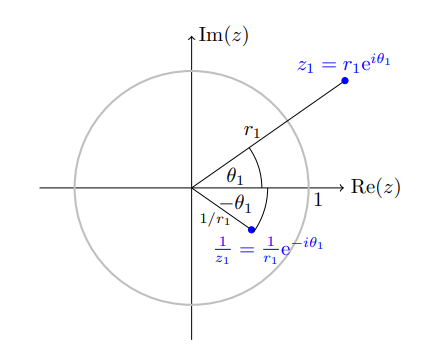
In polar coordinates the inversion \(z\mapsto 1/z\) is \(Re^{i\theta}\mapsto {1\over R}e^{-i\theta}\): it inverts the modulus and reflects the argument.
Exercises
Finding complex roots (Tag E-X4MBB)
Solve \(z^4=i\).
Solution
First find a principal root: \(z^4=i = e^{i\pi\over 2} \implies z_0 = e^{i\pi \over 8}\). Now all of the roots are \(\ts{z_k = z_0 \zeta_4^k \st k=0,1,2,3}\) where \(\zeta_4=e^{2\pi i \over 4} = e^{i\pi \over 2}\), so
\(z_0 = e^{i\pi \over 8} e^{0i\pi \over 4} = e^{i\pi \over 8}\) corresponding to \({1\over 8} + {0\over 4}\),
\(z_1 = e^{i\pi \over 8} e^{1i\pi \over 4} = e^{3i\pi \over 8}\) corresponding to \({1\over 8} + {1\over 4} = {3\over 8}\),
\(z_2 = e^{i\pi \over 8} e^{2i\pi \over 4} = e^{5i\pi \over 8}\) corresponding to \({1\over 8} + {2\over 4} = {5\over 8}\),
\(z_3 = e^{i\pi \over 8} e^{3i\pi \over 4} = e^{7i\pi \over 8}\) corresponding to \({1\over 8} + {3\over 4} = {7\over 8}\).
Working with conjugates (Tag E-WNNSK)
Find \(\Re\qty{z+2\over z-1}\).
Solution
\[ {z+2\over z-1}\cdot{\bar{z-1} \over \bar{z-1}} &= {(z+2)\bar{z-1} \over \abs{z-1}^2} \\ &= {((z-1) + 3)\bar{z-1} \over \abs{z-1}^2} \\ &= {\abs{z-1}^2 + 3\bar{z} -3 \over \abs{z-1}^2} \\ &= {(x-1)^2 + y^2 + 3(x-iy) - 3 \over (x-1)^2 + y^2} \\ &= {(x-1)^2 + 3x - 3 + y^2\over (x-1)^2 + y^2} + i{-3y\over (x-1)^2 + y^2} \\ &= {(x-1)(x+2) + y^2\over (x-1)^2 + y^2} + i{-3y\over (x-1)^2 + y^2} .\]
Trig identities (Tag E-P7SIB)
Find an identity for \(\cos(4\theta)\) in terms of \(\sin(\theta)\) and \(\cos(\theta)\).
Solution
Write \(x=\cos(\theta), y= \sin(\theta)\), so \(e^{i\theta} = x+iy\). Then \[ \cos(4\theta) + i\sin(4\theta) &= e^{4i\theta } \\ &= (x+iy)^4 \\ &= \sum_{0\leq k \leq 4} {4\choose k} x^k (iy)^{4-k} \\ &= x^4 + 4ix^3y - 6x^2y^2 - 4ixy^3 + y^4 \\ &= (x^4 - 6x^2y^2 + y^4) + i(4x^3y - 4xy^3) .\] So \[ \cos(4\theta) &= \cos^4(\theta) - 6\cos^2(\theta)\sin^2(\theta) + \sin^4(\theta)\\ \sin(4\theta) &= 4\cos^3(\theta)\sin(\theta) - 4\cos(\theta)\sin^3(\theta) .\]
$\abs{e^z}=e^{\Re z}$ (Tag E-JWO2G)
Show that \(\abs{e^z} = e^{\Re(z)}\).
Solution
Write \(z=x+iy\), so \(\Re(z) = x\). Then \[ \abs{e^z} = \abs{e^{x+iy}} = \abs{e^x}\abs{e^{iy}} = e^x ,\] using that \(\abs{e^{iy}}=\abs{\cos y+i\sin y}=1\) and \(e^x>0\) for all \(x\in \RR\).
Purely imaginary if on circle (Tag E-ZCPKK)
For \(z\in\CC\smts{-1}\), show that \[ \frac{z-1}{z+1}\in i\RR \iff \abs z=1. \]
Hint: \(z\) is real iff \(\bar{z} = z\) and purely imaginary iff \(\bar{z} = -z\).
Solution
Write \(w=(z-1)/(z+1)\). Then \[ w\in i\RR &\iff w=-\overline w \\ &\iff \frac{z-1}{z+1}=\frac{1-\bar z}{1+\bar z} \\ &\iff (z-1)(1+\bar z)=(1-\bar z)(1+z) \\ &\iff 2\abs z^2-2=0 \\ &\iff \abs z=1. \]