Let \(S\coloneqq\theset{z\in\CC : -\pi/2<\Re z<\pi/2,\ \Im z>0}\) and \(H\coloneqq\DD \intersect \ts{\Re(w) > 0}\). Then \[ \begin{aligned} F\colon S &\to H, \\ z &\mapsto e^{iz} \end{aligned} \] is a biholomorphism with inverse \(w\mapsto -i\Log(w)\), where \(\Log\) is the principal branch of the logarithm.
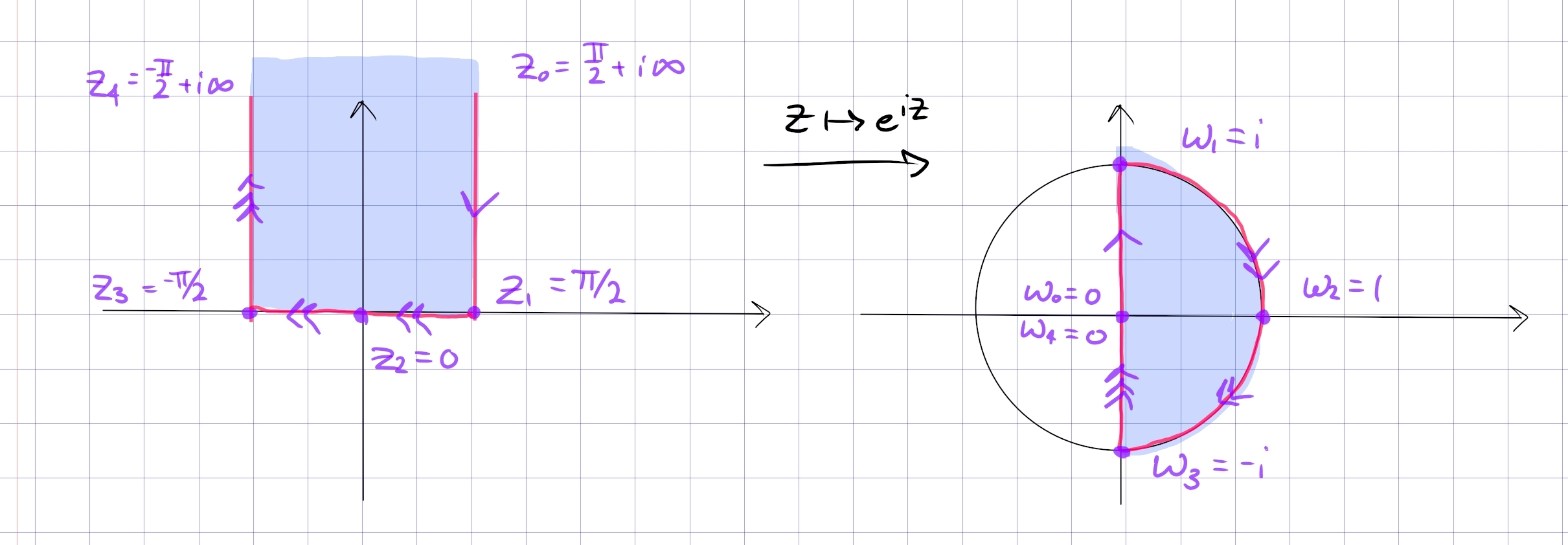
For \(z=x+iy\in S\), \(e^{iz}=e^{-y}e^{ix}\) has modulus \(e^{-y}\in(0,1)\) and argument \(x\in(-\pi/2,\pi/2)\), so \(e^{iz}\in H\), and \(-i\Log(e^{iz})=-i(-y+ix)=x+iy=z\). Conversely, every \(w\in H\) is \(w=re^{i\theta}\) with \(r\in(0,1)\) and \(\theta\in(-\pi/2,\pi/2)\), and \(-i\Log(w)=\theta-i\log r\) has real part \(\theta\in(-\pi/2,\pi/2)\) and imaginary part \(-\log r>0\), so it lies in \(S\), and \(e^{i(-i\Log w)}=e^{\Log w}=w\). Both maps are holomorphic and mutually inverse.