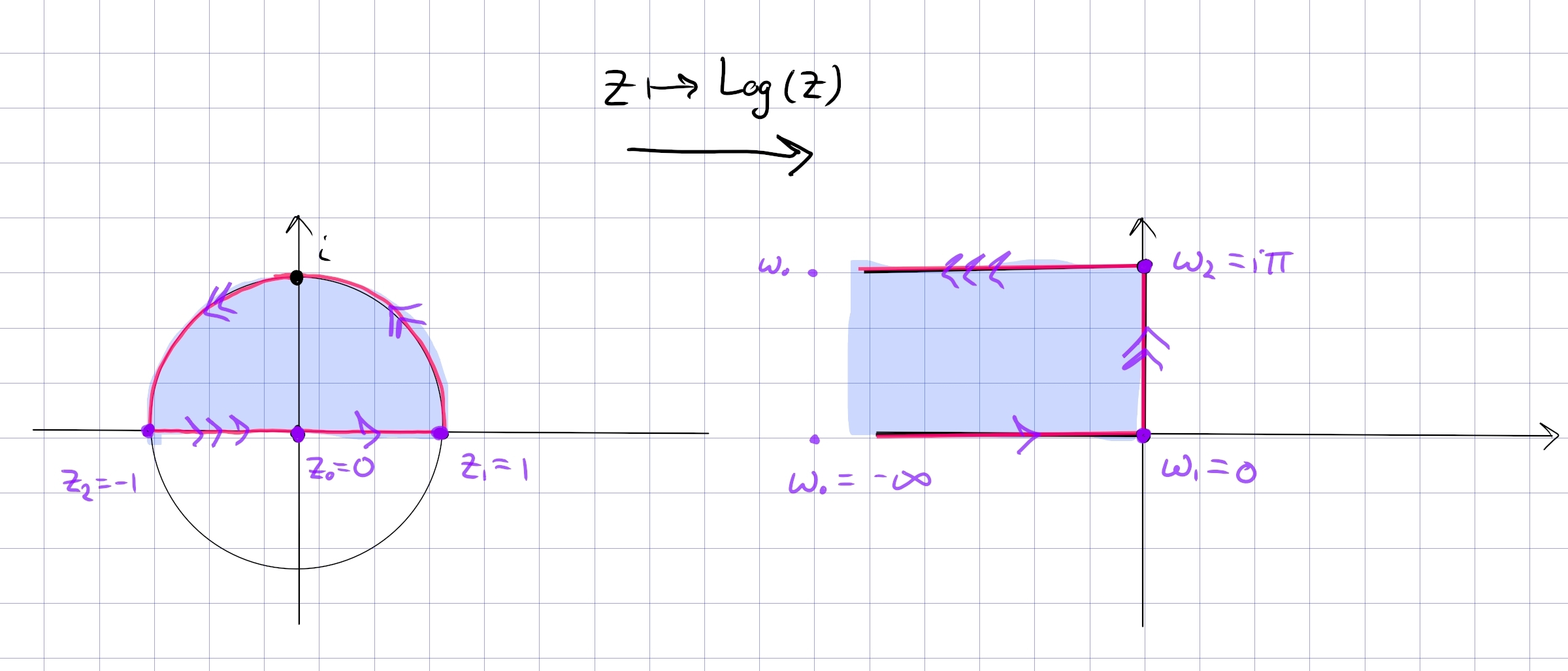
Let \(\Log\) be the principal branch of the logarithm. The map \[ F\colon\ts{z\st\abs{z}<1,\ \Im z>0}\to\ts{w\st\Re w<0,\ 0<\Im w<\pi},\qquad F(z)=\Log z, \] is a biholomorphism, with inverse \(w\mapsto e^w\).
For \(z=re^{i\theta}\) with \(0<r<1\) and \(0<\theta<\pi\), \(\Log z=\ln r+i\theta\) with \(\ln r<0\). Since \(r\mapsto\ln r\) is a bijection \((0,1)\to(-\infty,0)\), \(F\) is a bijection onto the half-strip, and \(e^{\ln r+i\theta}=re^{i\theta}\) gives the inverse, which is holomorphic.
The same computation, with \(\ln r\) ranging over \((-\infty,0)\) or \((0,\infty)\) and \(\theta\) over \((0,\pi)\) or \((-\pi,0)\), shows that \(\Log\) maps
- \(\ts{\abs{z}<1,\ \Im z>0}\) onto the half-strip \(\ts{\Re w<0,\ 0<\Im w<\pi}\) in the second quadrant,
- \(\ts{\abs{z}<1,\ \Im z<0}\) onto the half-strip \(\ts{\Re w<0,\ -\pi<\Im w<0}\) in the third quadrant,
- \(\ts{\abs{z}>1,\ \Im z>0}\) onto the half-strip \(\ts{\Re w>0,\ 0<\Im w<\pi}\) in the first quadrant,
- \(\ts{\abs{z}>1,\ \Im z<0}\) onto the half-strip \(\ts{\Re w>0,\ -\pi<\Im w<0}\) in the fourth quadrant.
On the boundary of the upper half-disc, the segment \((0,1)\) maps onto \((-\infty,0)\), the semicircle \(\ts{e^{i\theta}\st0<\theta<\pi}\) maps onto the segment from \(0\) to \(i\pi\), and the segment \((-1,0)\) maps onto the line \(\ts{t+i\pi\st t<0}\).