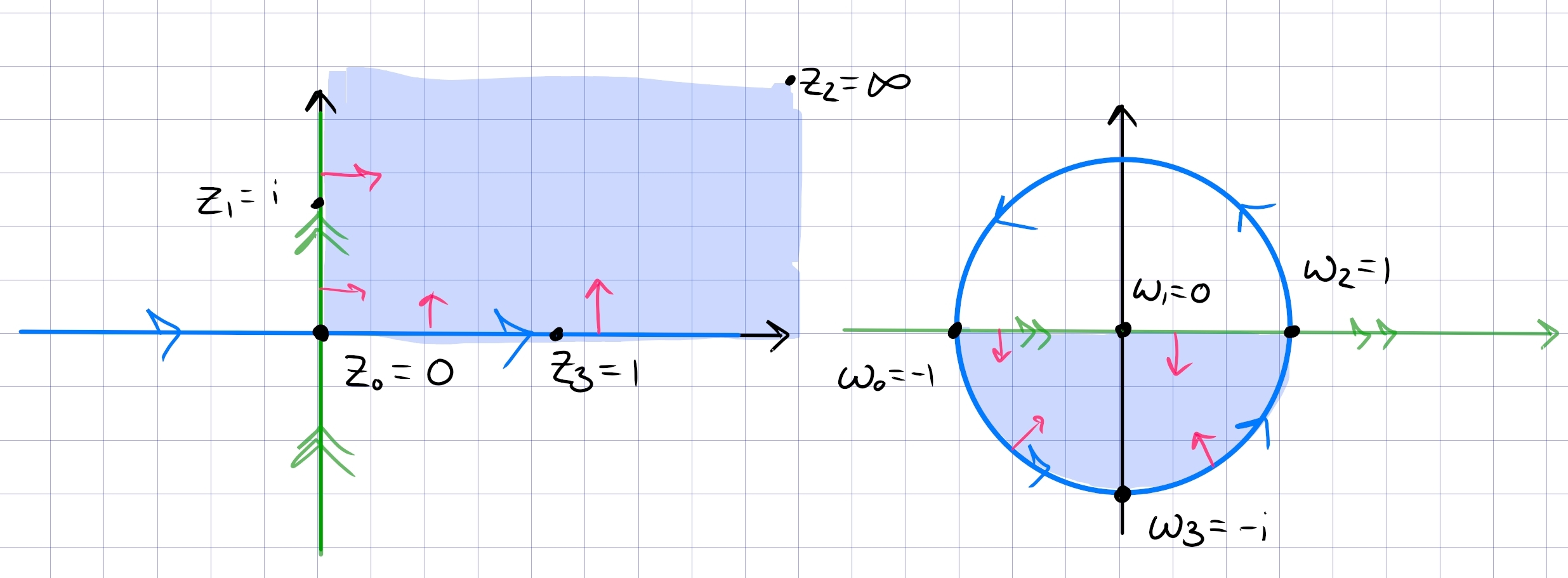
Find a fractional linear transformation \(T\) which maps \(\HH\) to \(\DD\), and explicitly describe the image of the first quadrant under \(T\).
Solution
1. The fractional linear map\[ T(z)=\frac{z-i}{z+i} \]is a biholomorphism \(\HH\to\DD\).
Let \(z=x+iy\) with \(y>0\). Then \[ |T(z)|^2 =\frac{x^2+(y-1)^2}{x^2+(y+1)^2}<1, \] so \(T(\HH)\subseteq\DD\).
Solving \(w=T(z)\) for \(z\) gives \[ z=i\frac{1+w}{1-w}. \] For \(|w|<1\) this inverse has positive imaginary part, so it maps \(\DD\) into \(\HH\). Thus \(T\) is a biholomorphism.
2. For \(z=x+iy\in\HH\),\[ \Im T(z)=-\frac{2x}{|z+i|^2}. \]
Multiply numerator and denominator by \(\overline{z+i}=x-i(y+1)\): \[ T(z) =\frac{(x+i(y-1))(x-i(y+1))}{|z+i|^2}. \] The imaginary part of the numerator is \[ x(y-1)-x(y+1)=-2x. \]
3. The first quadrant\[ Q_1=\{z:\Re z>0,\ \Im z>0\} \]is mapped into the lower half of the unit disk.
By 1, \(T(Q_1)\subseteq\DD\). By 2, \(\Re z>0\) implies \[ \Im T(z)<0. \] Hence \[ T(Q_1)\subseteq\{w\in\DD:\Im w<0\}. \]
4. In fact,\[ \boxed{T(Q_1)=\{w\in\DD:\Im w<0\}}. \]
1.Applying 2 to this \(z\) gives\[ \Im w=-\frac{2\Re z}{|z+i|^2}<0, \]so \(\Re z>0\).Thus \(z\in Q_1\) and \(w=T(z)\).