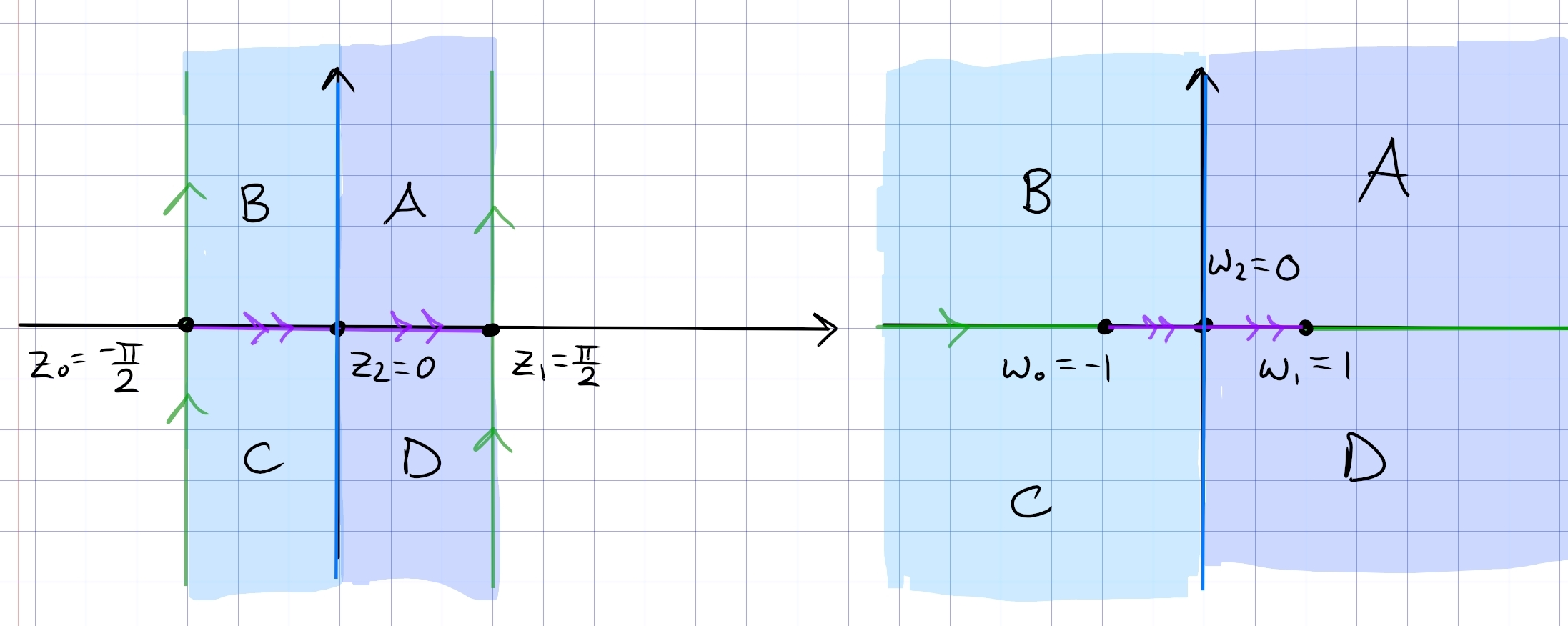
Let \(S\coloneqq\theset{z\in\CC : -\pi/2<\Re z<\pi/2,\ \Im z>0}\). Then \(\sin\) restricts to a biholomorphism \(S\to\HH\), and its inverse \(\arcsin\colon\HH\to S\) is a biholomorphism from the upper half-plane onto the vertical half-strip.
Let \(J(u)\coloneqq\frac12\qty{u+\inverseof{u}}\) for \(u\neq0\). For every \(z\in\CC\), \[ \sin(z)=\frac{e^{iz}-e^{-iz}}{2i}=-\frac12\qty{ie^{iz}+\frac{1}{ie^{iz}}}=-J\qty{ie^{iz}}, \] so \(\sin\) on \(S\) is the composite of the following holomorphic maps, each of which is a bijection onto the stated set.
\(z\mapsto iz\) maps \(S\) onto \(\theset{\zeta : \Re\zeta<0,\ \abs{\Im\zeta}<\pi/2}\).
\(\zeta\mapsto e^\zeta\) maps that half-strip onto \(\theset{w : \abs{w}<1,\ \Re w>0}\): for \(\zeta=s+it\) with \(s<0\) and \(\abs{t}<\pi/2\), \(e^\zeta\) has modulus \(e^s\in(0,1)\) and argument \(t\in(-\pi/2,\pi/2)\), and each such modulus and argument occur exactly once.
\(w\mapsto iw\) maps that half-disc onto the upper half-disc \(\theset{u : \abs{u}<1,\ \Im u>0}\).
\(J\) maps the upper half-disc onto the lower half-plane. For \(u=re^{i\theta}\) with \(0<r<1\) and \(0<\theta<\pi\), \(\Im J(u)=\frac12\qty{r-\inverseof{r}}\sin\theta<0\). For \(c\) in the lower half-plane, the solutions of \(J(u)=c\) are the roots of \(u^2-2cu+1=0\), whose product is \(1\); neither root lies on the unit circle, where \(J\) is real, so exactly one root \(u\) satisfies \(\abs{u}<1\), and \(\Im J(u)<0\) forces \(\sin\theta>0\), so that root lies in the upper half-disc.
\(v\mapsto-v\) maps the lower half-plane onto \(\HH\).
A bijective holomorphic map has a holomorphic inverse, so \(\sin\colon S\to\HH\) is a biholomorphism.
The boundary of \(S\) maps onto \(\RR\): the segment \([-\pi/2,\pi/2]\) maps onto \([-1,1]\), the ray \(\pi/2+it\) (\(t\ge0\)) maps to \(\sin(\pi/2+it)=\cosh t\), tracing \([1,\infty)\), and the ray \(-\pi/2+it\) maps to \(-\cosh t\), tracing \((-\infty,-1]\). The imaginary axis \(it\) (\(t>0\)) maps to \(\sin(it)=i\sinh t\), the positive imaginary axis.