Find a conformal map that sends \(i\RR\) to \(\abs{z-{1\over 2}} = {1\over 2}\).
- The double angle formulas: \[ \sin(2t) = {2\tan(t) \over 1+\tan^2(t)} && \cos(2t) = {1-\tan^2(t) \over 1+\tan^2(t)} .\]
- Parameterize a line by \(x=\tan(t)\) for \(t\in (-\pi/2, \pi/2)\)
- The boundary behavior of \(F(z) \da {i-z\over i+z}\) from [@SS03, Chapter 8, Theorem 1.2]: with \(x=\tan(t)\), \(F(\RR) = \ts{\cos(2t)+i\sin(2t) = e^{2it} \st t\in (-\pi/2, \pi/2)}\).
Solution
The line \(-i\infty\to 0 \to i\infty\) is to be mapped to the circle traversed \(0\to 1\to 0\):
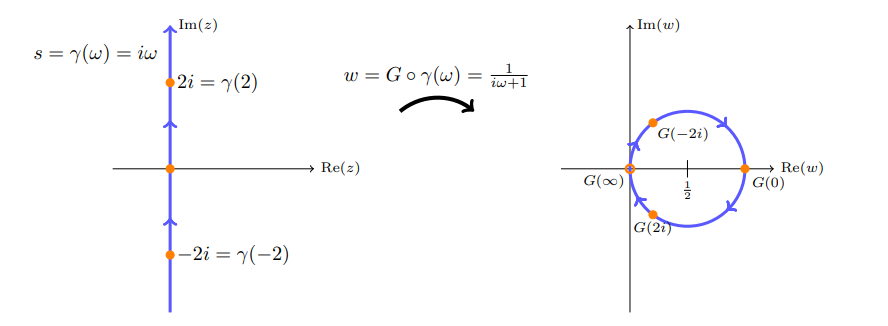
Take the cross ratio \(R(z) = (z, 0, \infty, -1)\) to send
- \(0\to 1\)
- \(\infty\to 0\)
- \(-1\to \infty\)
This yields \[ R(z) = {z-\infty \over z+1}{0+1\over 0-\infty} = {1\over z+1} .\] Some deductions:
- \(R\) preserves circles, so \(\RR\mapsto \RR\).
- The segment \(0\to\infty\mapsto 1\to 0\)
- The ray \(-1\to 0 \to \infty \mapsto \infty\to 1\to 0\)
- The ray \(-\infty \to -1 \mapsto 0\to -\infty\)
- \(R\) preserves angles, so at \(w=R(0)=1\) the image of \(i\RR\) is orthogonal to \(\RR\), so it is either a circle or the vertical line through \(1\).
- \(R\) sends \(-i\infty \to 0 \to i\infty\) to \(0\to 1\to 0\), so the image passes through \(0\) and \(1\) and is a circle.
- Parameterize \(i\RR = \ts{it\st t\in \RR}\) and put \(t=\tan(s)\) with \(s\in(-\pi/2,\pi/2)\). Then \[ R(i\RR) &= \ts{{1\over 1+it}} \\ &= \ts{1-it\over 1+t^2} \\ &= \ts{{1\over 1+t^2} - i {t\over 1+t^2}} \\ &= \ts{{1\over 2} \qty{ 1 + {1-t^2\over 1+t^2} } - i{1\over 2}\qty{2t\over 1+t^2}} \\ &= \ts{{1\over 2}\qty{1 + \cos(2s) - i\sin(2s)}} \\ &= \ts{{1\over 2} + {1\over 2}e^{-2is} } ,\] which is the circle of radius \(1/2\) about \(1/2\) with the point \(0=R(\infty)\) removed.
Conclusion:
- \(i\RR \to \ts{\abs{z-{1\over 2}} = {1\over 2} }\) by \(z\to {1\over 1+z}\).
- The reverse map: \(w\mapsto {1-w\over w}\).