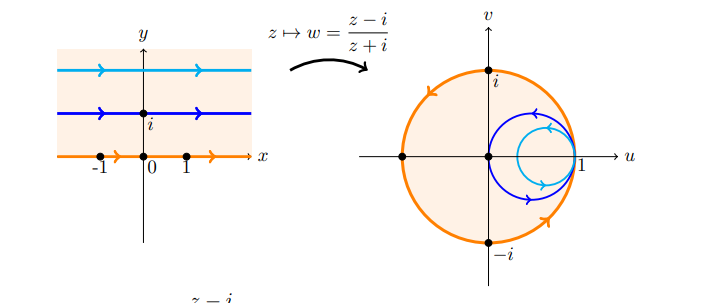
The Möbius transformation \[ \begin{aligned} F\colon \HH=\ts{z\st \Im(z) > 0 } &\to \DD=\ts{w\st \abs{w} < 1 }, \\ z &\mapsto {i-z \over i+z} \end{aligned} \] is a biholomorphism with inverse \(w\mapsto i \qty{1-w \over 1+w}\).
For \(z\in\HH\), the point \(z\) is closer to \(i\) than to \(-i\), so \(\abs{i-z}<\abs{i+z}\) and \(F(z)\in\DD\). Solving \(w(i+z)=i-z\) for \(z\) gives \(z=i\frac{1-w}{1+w}\), and for \(w\in\DD\), \[ \Im\qty{i\frac{1-w}{1+w}}=\frac{1-\abs{w}^2}{\abs{1+w}^2}>0, \] so the inverse maps \(\DD\) into \(\HH\). Both maps are holomorphic on these sets and mutually inverse.
\(F\) extends to a homeomorphism from \(\RR\cup\theset{\infty}\) onto the unit circle, with \(F(\infty) = -1\), \(F(-1)=-i\), and \(F(0)=1\). As \(x\) increases from \(-\infty\) to \(\infty\) along \(\RR\), \(F(x)\) travels counterclockwise around the circle, starting at \(-1\) and passing through the lower half first.