Prove the following: suppose \(\abs{f(z)}\leq 1\), then for all \(z, w\in \DD\), \[ \left|\frac{f(z)-f(w)}{1-\overline{f(w)} f(z)}\right| \leq\left|\frac{z-w}{1-\bar{w} z}\right| \quad\text{ and } \left|f^{\prime}(z)\right| \leq \frac{1-|f(z)|^{2}}{1-|z|^{2}} .\] If equality holds for some \(z\neq w\) in either expression, then \(f= \lambda F\) where \(F\) is a linear fractional transformation and \(\abs{\lambda} = 1\), so \(f\in \Aut(\DD)\).
Note that this does not require \(f(0) = 0\).
Solution
Solution
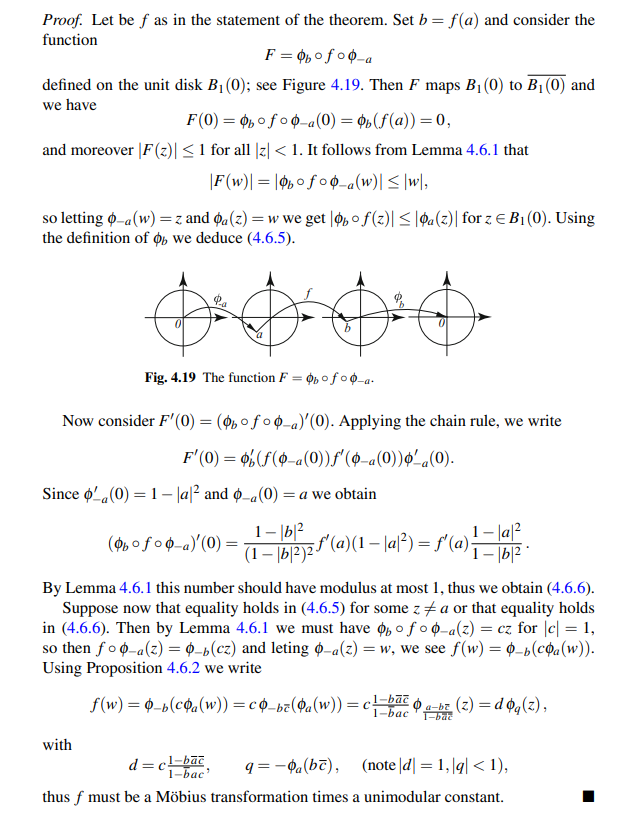
For \(a\in\mathbb D\), write \[ \phi_a(\zeta)=\frac{a-\zeta}{1-\overline a\zeta}. \] This is an automorphism of \(\mathbb D\), interchanging \(0\) and \(a\).
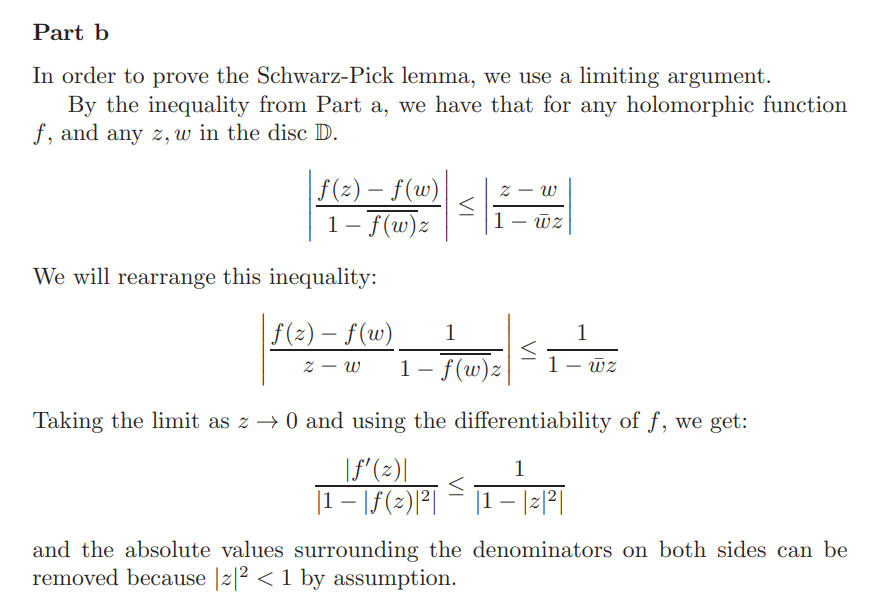
Fix \(w\in\mathbb D\) and define \[ g=\phi_{f(w)}\circ f\circ\phi_w. \] Then \(g:\mathbb D\to\mathbb D\) is holomorphic and \(g(0)=0\). Schwarz’s lemma therefore gives \(|g(\zeta)|\le|\zeta|\). Taking \(\zeta=\phi_w(z)\) and using \(\phi_w^{-1}=\phi_w\) yields \[ \left|\frac{f(z)-f(w)}{1-\overline{f(w)}f(z)}\right| \le \left|\frac{z-w}{1-\overline wz}\right|. \]
Divide by \(|z-w|\) and let \(z\to w\). Since \[ \left|\frac{z-w}{1-\overline wz}\right| =\frac{|z-w|}{|1-\overline wz|}, \] we obtain \[ \frac{|f'(w)|}{1-|f(w)|^2} \le\frac1{1-|w|^2}, \] or equivalently \[ |f'(w)|\le\frac{1-|f(w)|^2}{1-|w|^2}. \]
If equality holds in the two-point inequality for some distinct \(z,w\), then Schwarz’s lemma has equality at a nonzero point for the corresponding \(g\), so \(g(\zeta)=\lambda\zeta\) with \(|\lambda|=1\). Thus \(f\) is a composition of disk automorphisms and is itself in \(\operatorname{Aut}(\mathbb D)\). The same conclusion follows if equality holds in the derivative inequality at one point, by the derivative equality case of Schwarz’s lemma.