(The two sequences)
Let \(\Sigma\) have rays \(\Sigma(1)\) with primitive generators \(u_\rho\). Each ray \(\rho\) gives a prime divisor \(D_\rho\), the closure of the corresponding codimension-one orbit, and \[ \Div_T(X_\Sigma) = \bigoplus_{\rho \in \Sigma(1)} \ZZ D_\rho \cong \ZZ^{\Sigma(1)} . \] There are exact sequences \[ M \to \bigoplus_{\rho} \ZZ D_\rho \to \Cl(X_\Sigma) \to 0 , \qquad M \to \CDiv_T(X_\Sigma) \to \Pic(X_\Sigma) \to 0 , \] compatible with the inclusions \(\CDiv_T \subseteq \Div_T\) and \(\Pic \subseteq \Cl\). The left map is \[ m \mapsto \operatorname{div}(\chi^m) = \sum_{\rho \in \Sigma(1)} \inp{m}{u_\rho} D_\rho , \] whose kernel is \(M \cap \bigcap_\rho u_\rho^\perp\). It is injective, so both sequences are short exact, exactly when the \(u_\rho\) span \(N_\RR\), that is, when \(X_\Sigma\) has no torus factor. [@Ful93]
(Cartier divisors as a limit over the fan)
Order \(\Sigma\) by inclusion of faces and let \(M(\sigma) = \sigma^\perp \cap M\). Restriction to the affine opens \(U_\sigma\) identifies \[ \CDiv_T(X_\Sigma) \cong \varprojlim_{\sigma \in \Sigma} M/M(\sigma) , \] the inverse limit over the face poset of the groups \(\CDiv_T(U_\sigma) \cong M/M(\sigma)\) of local data \(m_\sigma\).
(Quotient construction)
Suppose the \(u_\rho\) span \(N_\RR\). Let \(S = \CC[x_\rho : \rho \in \Sigma(1)]\), for \(\sigma \in \Sigma\) let \(x^{\hat\sigma} = \prod_{\rho \notin \sigma(1)} x_\rho\), and let \(B(\Sigma) = \gens{x^{\hat\sigma} : \sigma \in \Sigma}\) be the irrelevant ideal, generated by the \(x^{\hat\sigma}\) for maximal \(\sigma\). Then \(Z(\Sigma) = V(B(\Sigma)) \subseteq \CC^{\Sigma(1)}\) is a union of coordinate subspaces of codimension at least \(2\). Applying \(\Hom_\ZZ(-, \CC^\times)\) to \(0 \to M \to \ZZ^{\Sigma(1)} \to \Cl(X_\Sigma) \to 0\) gives \[ 1 \to G \to (\CC^\times)^{\Sigma(1)} \to T_N \to 1 , \qquad G = \Hom_\ZZ(\Cl(X_\Sigma), \CC^\times) , \] and \(X_\Sigma\) is the good categorical quotient \(\qty(\CC^{\Sigma(1)} \sm Z(\Sigma)) /\!\!/ G\). It is a geometric quotient if and only if \(\Sigma\) is simplicial.
A primitive collection is a subset \(C \subseteq \Sigma(1)\) not contained in \(\sigma(1)\) for any \(\sigma \in \Sigma\), every proper subset of which is contained in some \(\sigma(1)\); then \(Z(\Sigma) = \bigcup_C V(x_\rho : \rho \in C)\) over the primitive collections.
(The cone over the quadric surface)
Let \(\sigma = \Cone(e_1, e_2, e_1 + e_3, e_2 + e_3) \subseteq \RR^3\), a cone with four edges, so not simplicial, and \(X_\sigma = V(xz - yw) \subseteq \CC^4\), the affine cone over \(\PP^1 \times \PP^1\).
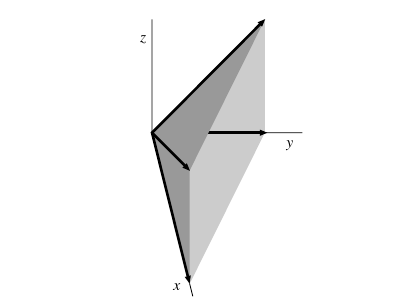
Here \[ \Cl(X_\sigma) = \operatorname{coker}\qty( \ZZ^3 \xrightarrow{A} \ZZ^4 ) = \ZZ , \qquad A = \begin{bmatrix} 1 & 0 & 0 \\ 0 & 1 & 0 \\ 1 & 0 & 1 \\ 0 & 1 & 1 \end{bmatrix} , \] generated by \(D_\rho\) for any ray \(\rho\), while \(\Pic(X_\sigma) = 0\) because \(X_\sigma\) is affine.
For \(\PP^n\), with rays \(e_1, \ldots, e_n\) and \(e_0 = -\sum_i e_i\), the only primitive collection is \(\ts{e_0, \ldots, e_n}\), so \(Z = \ts{0}\), and \(G = \CC^\times\) acts on \(\CC^{n+1}\) by \(\lambda \cdot (x_0, \ldots, x_n) = (\lambda x_0, \ldots, \lambda x_n)\), recovering \(\PP^n = (\CC^{n+1} \sm \ts{0})/\CC^\times\).
(Canonical divisor)
\(\omega_{X_\Sigma} \cong \OO\big( -\sum_\rho D_\rho \big)\), so \(K_X \sim -\sum_{\rho \in \Sigma(1)} D_\rho\).
So the class group is the cokernel of an explicit integer matrix whose rows are the ray generators. Two consequences are immediate. It has rank \(\size \Sigma(1) - \dim N_\RR\), and it has torsion exactly when the rays fail to generate \(N\) as a lattice. When \(\Sigma\) is simplicial, \(\Pic\) has finite index in \(\Cl\) and \(\rank \Pic(X_\Sigma) = \size \Sigma(1) - \dim N_\RR\) as well — for \(\FF_a\) this is \(4 - 2 = 2\), a fibre and a section.
Cartier divisors are cut out locally: \(D = \sum a_\rho D_\rho\) is Cartier iff for every maximal cone \(\sigma\) there is \(m_\sigma \in M\) with \(\inp{m_\sigma}{u_\rho} = -a_\rho\) for all \(\rho \leq \sigma\), and then \(D|_{U_\sigma} = \operatorname{div}(\chi^{-m_\sigma})\). Equivalently \(\CDiv_T(U_\sigma) \cong M/M(\sigma)\) where \(M(\sigma) = \sigma^\perp \intersect M\).
For \(\PP^n\) the \(n+1\) rays give \(D_0, \ldots, D_n\), all linearly equivalent, so \(K_{\PP^n} \sim -(n+1)H\) and \(\omega_{\PP^n} = \OO(-n-1)\) falls out of counting rays.
Dependencies
PR-O8V3IThe orbit-cone correspondenceuses
Backlinks
T-FULBETTIBetti numbers of a smooth complete toric variety from the cone countsusesT-TORSURFSmooth complete toric surfaces and their intersection numbersusesT-TORCOHOMThe Stanley--Reisner presentation of the cohomology of a smooth toric varietyusesD-TORQDThe polytope of a divisor, and its lattice points as sectionsusesFE-TORP2The projective plane, computed entirely from its fanusesFE-TORWPSWeighted projective space as a toric varietyuses