(The fan)
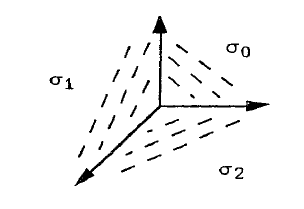
\(N = \ZZ^2\) with rays \(u_1 = e_1\), \(u_2 = e_2\), \(u_0 = -e_1 - e_2\), and the three two-dimensional cones spanned by consecutive pairs. Each is smooth, the support is all of \(N_\RR\), so \(\PP^2\) is smooth and complete, with \(\chi = \size\Sigma(2) = 3\).
(The charts)
Let \(\sigma_0 = \Cone(e_1, e_2)\), \(\sigma_1 = \Cone(e_2, -e_1-e_2)\), \(\sigma_2 = \Cone(-e_1-e_2, e_1)\). Their duals are
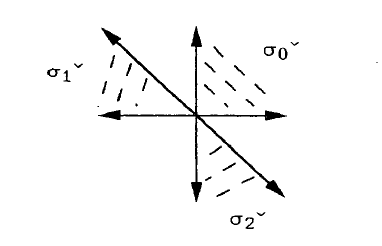
and each \(U_{\sigma_i} \cong \CC^2\), with coordinates \[ U_{\sigma_0} : (x, y), \qquad U_{\sigma_1} : (x^{-1}, x^{-1}y), \qquad U_{\sigma_2} : (y^{-1}, xy^{-1}) . \] Setting \(x = t_1/t_0\) and \(y = t_2/t_0\) identifies \(U_{\sigma_i}\) with the standard chart \(\ts{t_i \neq 0}\) of \(\PP^2\), and the gluings agree.
(Class group)
The map \(M \to \ZZ^3\) is \(m \mapsto (\inp{m}{u_1}, \inp{m}{u_2}, \inp{m}{u_0})\), with matrix rows \((1,0), (0,1), (-1,-1)\). The cokernel is \(\ZZ\) via \((a_1, a_2, a_0) \mapsto a_1 + a_2 + a_0\), since \(e_1 \mapsto (1,0,-1)\) and \(e_2 \mapsto (0,1,-1)\) both have coordinate sum \(0\). So \(\Cl(\PP^2) = \ZZ\), all three \(D_i\) map to \(1\), and \(D_1 \sim D_2 \sim D_0 = H\) — the three coordinate lines.
(Anticanonical polytope)
\(K_X = -(D_0 + D_1 + D_2) = -3H\), so \(-K_X = 3H\) and \[ P_{-K} = \ts{ m \st m_1 \geq -1,\ m_2 \geq -1,\ -m_1 - m_2 \geq -1 } = \operatorname{Conv}\big( (-1,-1),\ (2,-1),\ (-1,2) \big) , \] the triangle \(3\Delta\) translated to have the origin in its interior. Counting its lattice points gives \(1 + 2 + 3 + 4 = 10 = h^0(\OO(3))\), which is the dimension of the space of plane cubics. Its polar dual is \(\operatorname{Conv}\big( (1,0), (0,1), (-1,-1) \big)\), the convex hull of the ray generators, so \(P_{-K}\) is reflexive.
\(-K_X = 3H\) is Cartier and ample, so \(\PP^2\) is Fano, and the whole verification was three rays and a lattice-point count. Replacing \(-K\) by \(D = dH\) gives \(P_D = d\Delta\) with \(\binom{d+2}{2}\) lattice points, reproducing \(h^0(\PP^2, \OO(d))\) without a single cohomology computation.