



- Note: outline omitted!
Solution
1. If \(f\in C([0,1])\) and \(\int_0^1 f(x)x^n\,dx=0\) for every \(n\ge0\), then \(f\equiv0\).
Assume \(f\in C([0,1])\) and \(\int_0^1 f(x)x^n\,dx=0\) for every \(n\ge0\). Then \(\int_0^1 f p=0\) for every polynomial \(p\). By Weierstrass, choose polynomials \(p_k\to f\) uniformly. Since \(f\in L^1\), \[ \int_0^1 f(x)^2\,dx =\lim_{k\to\infty}\int_0^1 f(x)p_k(x)\,dx=0. \] Hence \(f=0\) almost everywhere, and continuity gives \(f\equiv0\).
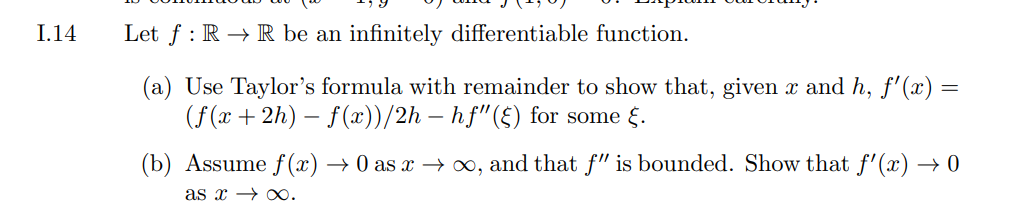
2. If \(f\) is twice differentiable, \(f(x)\to0\) as \(x\to\infty\), and \(|f''|\le M\), then \(f'(x)\to0\).
Taylor’s theorem applied from \(x\) to \(x+2h\) gives \[ f(x+2h)=f(x)+2hf'(x)+2h^2f''(\xi) \] for some \(\xi\) between \(x\) and \(x+2h\), hence \[ f'(x)=\frac{f(x+2h)-f(x)}{2h}-h f''(\xi). \] If \(f(x)\to0\) as \(x\to\infty\) and \(|f''|\le M\), fix \(\varepsilon>0\) and choose \(h>0\) so that \(Mh<\varepsilon/2\). For \(x\) large, both \(|f(x)|\) and \(|f(x+2h)|\) are \(<h\varepsilon/2\), so the first term has absolute value \(<\varepsilon/2\). Thus \(|f'(x)|<\varepsilon\) eventually, proving \(f'(x)\to0\).
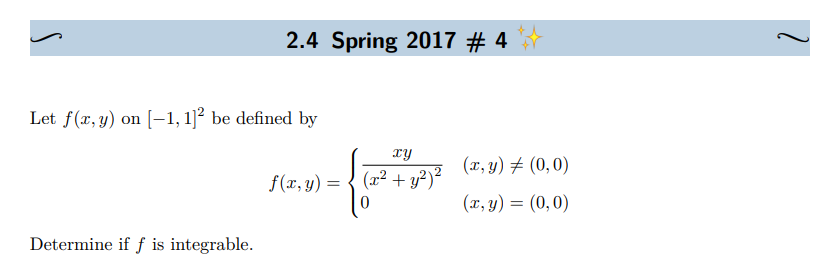
3. The function \(xy/(x^2+y^2)^2\) is not integrable on \([-1,1]^2\).
Away from the origin the function is continuous. In polar coordinates, \[ \left|\frac{xy}{(x^2+y^2)^2}\right| =\frac{|\sin\theta\cos\theta|}{r^2}. \] On any small disk around the origin, \[ \iint |f|\,dx\,dy \ge c\int_0^\delta \frac{dr}{r}=\infty \] for a positive angular constant \(c\). Hence \(f\notin L^1([-1,1]^2)\); in particular it is not Lebesgue integrable.
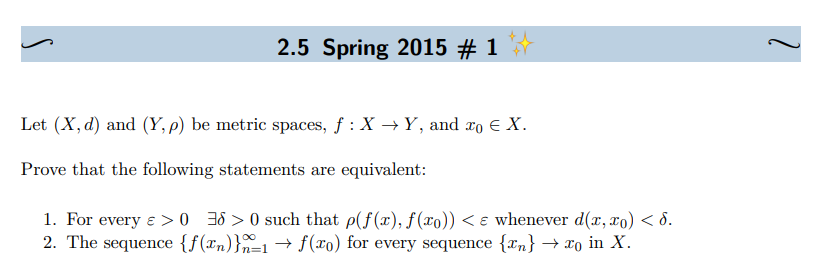
4. A map \(f\colon(X,d)\to(Y,\rho)\) of metric spaces is continuous at \(x_0\) if and only if \(f(x_n)\to f(x_0)\) for every sequence \(x_n\to x_0\).
If \(f\) is continuous at \(x_0\) and \(x_n\to x_0\), the epsilon-delta definition immediately gives \(f(x_n)\to f(x_0)\). Conversely, if continuity fails, there is \(\varepsilon_0>0\) such that for every \(n\) one can choose \(x_n\) with \(d(x_n,x_0)<1/n\) but \(\rho(f(x_n),f(x_0))\ge\varepsilon_0\). Then \(x_n\to x_0\) while \(f(x_n)\not\to f(x_0)\), contradicting the sequential condition.
5. \(1/x\) is uniformly continuous on \((1,\infty)\) but not on \((0,\infty)\).
On \((1,\infty)\), \[ \left|\frac1x-\frac1y\right|=\frac{|x-y|}{xy}\le |x-y|, \] so \(1/x\) is Lipschitz and therefore uniformly continuous. On \((0,\infty)\) take \(x_n=1/n\) and \(y_n=1/(n+1)\). Then \(|x_n-y_n|\to0\), but \[ \left|\frac1{x_n}-\frac1{y_n}\right|=1, \] so uniform continuity fails.
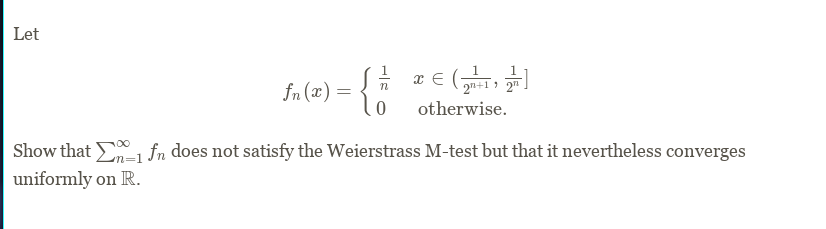
6. For \(f_n=\frac1n\mathbf1_{(2^{-(n+1)},2^{-n}]}\), the series \(\sum_n f_n\) converges uniformly, but \(\sum_n\|f_n\|_\infty=\infty\).
The supports are pairwise disjoint, so at each \(x\) at most one term is nonzero. Therefore the tail satisfies \[ \sup_x\left|\sum_{n>N}f_n(x)\right|\le\frac1{N+1}\to0, \] so the series converges uniformly. But \(\|f_n\|_\infty=1/n\) and \(\sum_n1/n=\infty\), so the M-test does not apply.
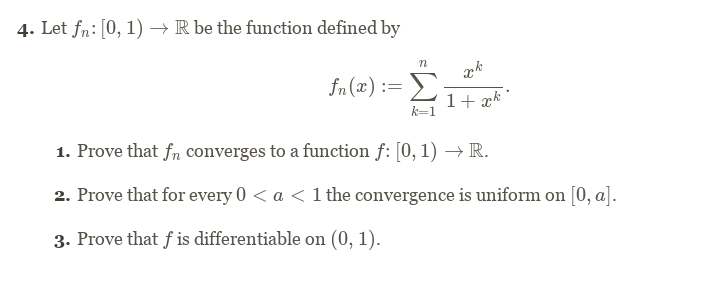
7. \(\sum_{k\ge1}x^k/(1+x^k)\) converges on \([0,1)\), uniformly on each \([0,a]\) with \(a<1\), and its sum is differentiable on \((0,1)\).
For fixed \(x<1\), \[ 0\le \frac{x^k}{1+x^k}\le x^k, \] so the series converges. On every \([0,a]\) with \(a<1\), the bound by \(a^k\) gives uniform convergence by the M-test. Moreover \[ \left(\frac{x^k}{1+x^k}\right)'=\frac{kx^{k-1}}{(1+x^k)^2}, \] and on \([0,a]\) this is bounded by \(ka^{k-1}\), whose series converges. Hence termwise differentiation is valid locally uniformly, and the sum is differentiable on \((0,1)\).
8. Let \((r_n)\) enumerate \(\QQ\), and let \(f(r_n)=1/n\) and \(f(x)=0\) for irrational \(x\). Then \(\lim_{x\to c}f(x)=0\) for every \(c\in\RR\).
Given \(\varepsilon>0\), choose \(N\) with \(1/N<\varepsilon\). Only the finitely many points \(r_1,\dots,r_N\) can have value at least \(\varepsilon\). For a fixed \(c\), choose a punctured neighborhood of \(c\) avoiding those finitely many points other than possibly \(c\) itself. Then \(|f(x)|<\varepsilon\) throughout that punctured neighborhood, so \[ \lim_{x\to c}f(x)=0. \] Thus \(f\) is continuous exactly at the irrational points and discontinuous exactly at the rational points.
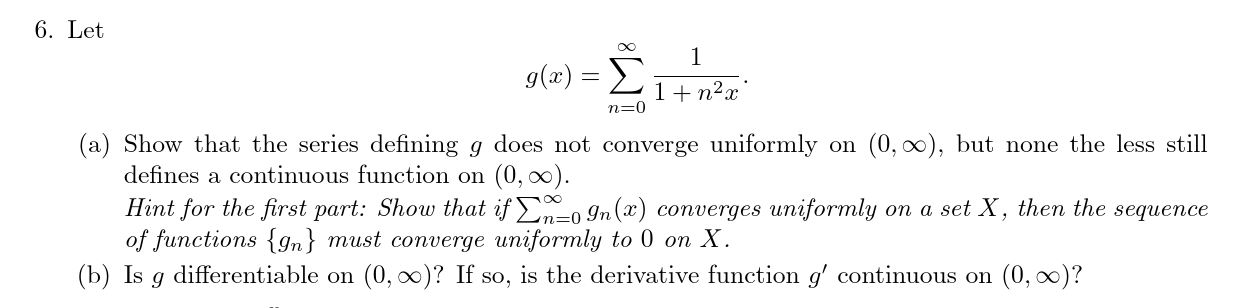
9. \(g(x)=\sum_{n\ge1}(1+n^2x)^{-1}\) does not converge uniformly on \((0,\infty)\), converges uniformly on each \([a,\infty)\) with \(a>0\), and is \(C^1\) on \((0,\infty)\).
Uniform convergence on \((0,\infty)\) fails because a necessary condition would be \[ \sup_{x>0}\frac1{1+n^2x}\to0, \] but the supremum is \(1\) for every \(n\). On every \([a,\infty)\), \(a>0\), \[ \frac1{1+n^2x}\le\frac1{n^2a}, \] so the series converges uniformly there and \(g\) is continuous. Also \[ g'(x)=-\sum_{n\ge1}\frac{n^2}{(1+n^2x)^2}. \] On \([a,\infty)\) the derivative terms are bounded by \(1/(n^2a^2)\), so the derivative series converges uniformly. Hence \(g\) is differentiable on \((0,\infty)\) and \(g'\) is continuous there.
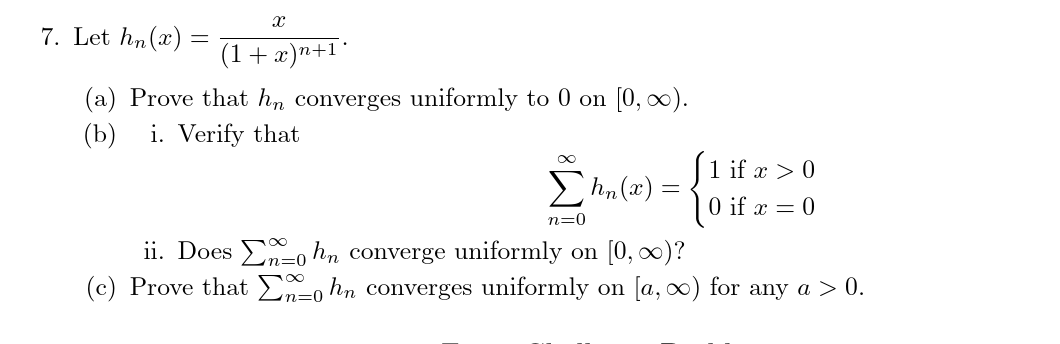
10. \(h_n(x)=x/(1+x)^{n+1}\) tends to \(0\) uniformly on \([0,\infty)\), and \(\sum_{n\ge0}h_n\) converges uniformly on each \([a,\infty)\) with \(a>0\) but not on \([0,\infty)\).
For \(n\ge1\), differentiating shows the maximum on \([0,\infty)\) occurs at \(x=1/n\), with \[ \|h_n\|_\infty=\frac{n^n}{(n+1)^{n+1}}\le\frac1{n+1}\to0. \] Thus \(h_n\to0\) uniformly. For \(x>0\), \[ \sum_{n=0}^\infty h_n(x) =\frac{x}{1+x}\sum_{n=0}^\infty(1+x)^{-n}=1, \] while at \(x=0\) the sum is \(0\). Hence the series cannot converge uniformly on \([0,\infty)\) because its pointwise sum is discontinuous. On \([a,\infty)\) with \(a>0\), the tail beginning at \(N\) equals \((1+x)^{-N}\), so its supremum is \((1+a)^{-N}\to0\); therefore convergence is uniform there.
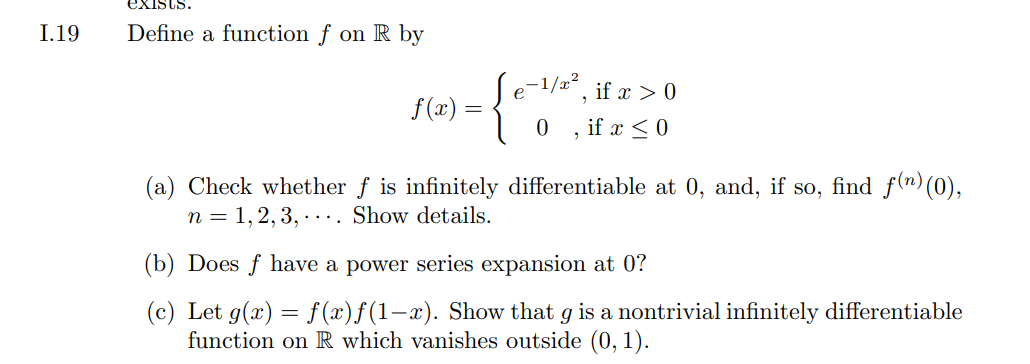
11. The function \(f(x)=e^{-1/x^2}\) for \(x>0\), \(f(x)=0\) for \(x\le0\), is \(C^\infty\) with \(f^{(n)}(0)=0\) for every \(n\), and \(f(x)f(1-x)\) is a smooth function that is positive on \((0,1)\) and zero elsewhere.
Repeated differentiation on \(x>0\) gives \(f^{(n)}(x)=P_n(1/x)e^{-1/x^2}\) for a polynomial \(P_n\). Since \(t^m e^{-t^2}\to0\) as \(t\to\infty\) for every \(m\), all right derivatives tend to \(0\) at the origin, matching the left derivatives. Hence \(f\in C^\infty\) and \(f^{(n)}(0)=0\) for every \(n\). Its Taylor series at \(0\) is therefore identically zero, so it does not equal \(f\) for \(x>0\). Finally \(g(x)=f(x)f(1-x)\) is smooth, nonzero on \((0,1)\), and vanishes outside \((0,1)\).
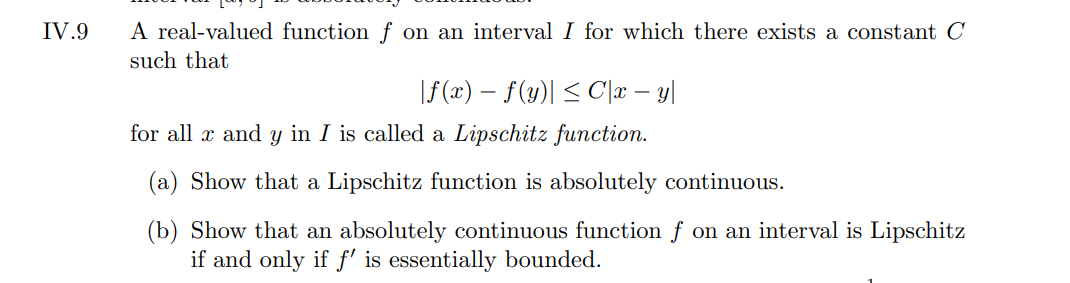
12. A Lipschitz function on an interval is absolutely continuous, and an absolutely continuous \(f\) is Lipschitz if and only if \(f'\in L^\infty\).
If \(|f(x)-f(y)|\le C|x-y|\), then for pairwise disjoint intervals \((a_j,b_j)\), \[ \sum_j|f(b_j)-f(a_j)|\le C\sum_j(b_j-a_j), \] so \(f\) is absolutely continuous. If \(f\) is absolutely continuous, then \[ f(y)-f(x)=\int_x^y f'(t)\,dt. \] Thus \(f'\in L^\infty\) implies \[ |f(y)-f(x)|\le\|f'\|_\infty|y-x|, \] so \(f\) is Lipschitz. Conversely, a Lipschitz function is differentiable a.e. and \(|f'|\) is bounded a.e. by its Lipschitz constant.
13. For integrable \(f\ge0\) on \([0,1]\), \(\lim_{n\to\infty}\int_0^1 f^{1/n}=m(\{f>0\})\).
For nonnegative integrable \(f\), \[ f(x)^{1/n}\to\mathbf1_{\{f>0\}}(x) \] pointwise. Also \(t^{1/n}\le1+t\) for \(t\ge0\), so \(f^{1/n}\le1+f\in L^1([0,1])\). Dominated convergence yields \[ \lim_{n\to\infty}\int_0^1 f(x)^{1/n}\,dx =m(\{x:f(x)>0\}). \]
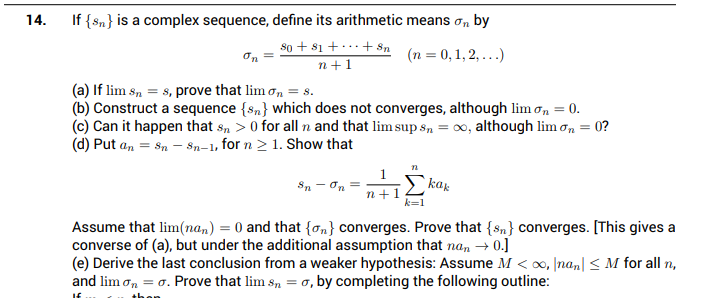
14. Let \(\sigma_n=(s_0+\cdots+s_n)/(n+1)\) be the Cesàro means of \((s_n)\). Convergence of \(s_n\) implies convergence of \(\sigma_n\) to the same limit; the converse fails, even for \(s_n\ge0\); and it holds if \(n(s_n-s_{n-1})\to0\).
If \(s_n\to s\), then \(\sigma_n\to s\) by the Cesaro theorem, proved directly by splitting the average into a fixed initial block and a tail where \(|s_k-s|\) is small.
Take \(s_n=(-1)^n\). Then \(s_n\) does not converge, while \(\sigma_n\to0\).
Let \(s_{2^k}=k\) and \(s_n=0\) otherwise. Then \(s_n\ge0\) and \(\limsup s_n=\infty\), but for \(2^m\le n<2^{m+1}\), \[ 0\le\sigma_n\le\frac{1+2+\cdots+m}{2^m}\to0. \]
With \(a_n=s_n-s_{n-1}\), \[ \sum_{k=1}^nka_k =ns_n-\sum_{k=0}^{n-1}s_k =(n+1)(s_n-\sigma_n), \] so \[ s_n-\sigma_n=\frac1{n+1}\sum_{k=1}^nka_k. \] If \(na_n\to0\) and \(\sigma_n\) converges, the right side tends to \(0\) by Cesaro averaging, hence \(s_n\) converges to the same limit as \(\sigma_n\).
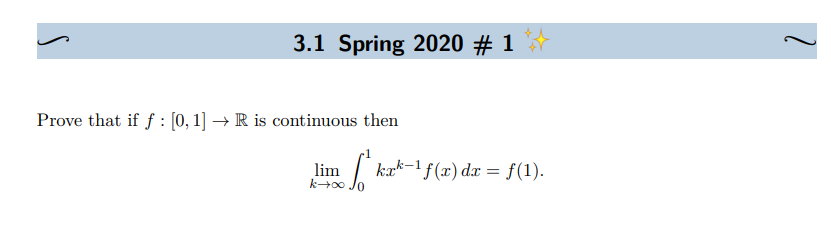
15. For \(f\in C([0,1])\), \(\lim_{k\to\infty}k\int_0^1x^{k-1}f(x)\,dx=f(1)\).
Let \(f\in C([0,1])\). Since \(\int_0^1kx^{k-1}\,dx=1\), \[ k\int_0^1x^{k-1}f(x)\,dx-f(1) =k\int_0^1x^{k-1}(f(x)-f(1))\,dx. \] Given \(\varepsilon>0\), choose \(a<1\) so that \(|f(x)-f(1)|<\varepsilon\) on \([a,1]\). The contribution from \([a,1]\) is at most \(\varepsilon\). On \([0,a]\) it is at most \(2\|f\|_\infty a^k\). Hence the expression tends to \(0\), proving the limit is \(f(1)\).
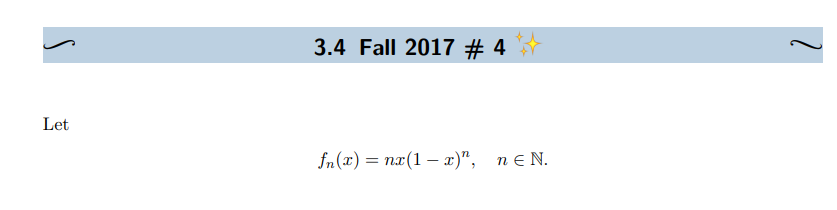
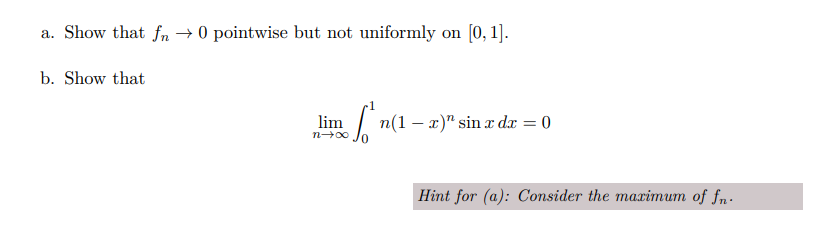
16. \(f_n(x)=nx(1-x)^n\) converges to \(0\) pointwise but not uniformly on \([0,1]\), and \(\int_0^1 n(1-x)^n\sin x\,dx\to0\).
For each fixed \(x\in(0,1]\), exponential decay of \((1-x)^n\) dominates the factor \(n\), while \(f_n(0)=0\), so \(f_n\to0\) pointwise. The maximum occurs at \(x=1/(n+1)\) and equals \[ \frac{n}{n+1}\left(\frac{n}{n+1}\right)^n\to e^{-1}, \] so convergence is not uniform. Finally, since \(0\le\sin x\le x\) on \([0,1]\), \[ 0\le \int_0^1 n(1-x)^n\sin x\,dx \le n\int_0^1x(1-x)^n\,dx =\frac{n}{(n+1)(n+2)}\to0. \]
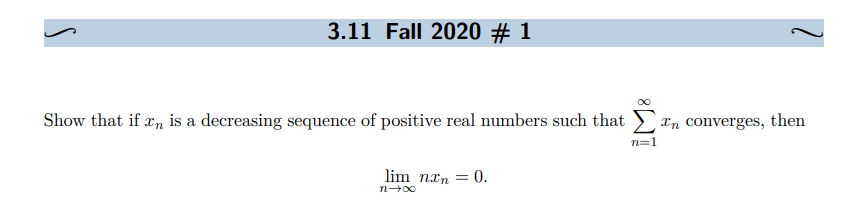
17. A decreasing summable positive sequence satisfies \(nx_n\to0\).
Let \((x_n)\) be decreasing, positive, and suppose \(\sum_nx_n<\infty\). Then \[ \sum_{k=\lfloor n/2\rfloor+1}^{n}x_k \ge \bigl(n-\lfloor n/2\rfloor\bigr)x_n \ge \frac n2x_n. \] The left side is a tail block of a convergent positive series and therefore tends to \(0\). Hence \(nx_n\to0\).