One session on real-analysis preliminaries. The UNL workshop packet is listed under real analysis workshop packet.
Reverse triangle inequality, $\sup$ and $\inf$, and the Archimedean property (Tag E-JY5OT)
Derive the reverse triangle inequality from the triangle inequality.
Let \(E\subseteq \RR\). Define \(\sup E\) and \(\inf E\).
What is the Archimedean property?
Solution
- In a normed space, \(\big||x| - |y|\big| \le |x - y|\).
<1>1. \(|x| - |y| \le |x - y|\).
The triangle inequality applied to \(x = (x - y) + y\) gives \(|x| \le |x - y| + |y|\).
<1>2. \(|y| - |x| \le |x - y|\).
The triangle inequality applied to \(y = (y - x) + x\) gives \(|y| \le |y - x| + |x|\), and \(|y - x| = |x - y|\).
<1>3. Q.E.D.
Steps <1>1 and <1>2 bound both \(|x| - |y|\) and its negative by \(|x - y|\).
Let \(E \subseteq \RR\) be nonempty. If \(E\) is bounded above, \(\sup E\) is the real number \(s\) such that \(x \le s\) for all \(x \in E\), and \(s \le t\) for every \(t\) with \(x \le t\) for all \(x \in E\); equivalently, \(s\) is an upper bound and for every \(\eps > 0\) there is \(x \in E\) with \(x > s - \eps\). By completeness of \(\RR\) it exists. If \(E\) is not bounded above, \(\sup E = +\infty\). Similarly \(\inf E\) is the greatest lower bound of \(E\), or \(-\infty\) if \(E\) is not bounded below, and \(\inf E = -\sup(-E)\).
The Archimedean property: for every \(x \in \RR\) there is \(n \in \NN\) with \(n > x\). Equivalently, for every \(\eps > 0\) there is \(n \in \NN\) with \(1/n < \eps\).
Suppose no \(n \in \NN\) exceeds \(x\). Then \(\NN\) is bounded above, so by completeness it has a least upper bound \(s\). Since \(s - 1\) is not an upper bound, some \(n \in \NN\) has \(n > s - 1\), so \(n + 1 > s\) with \(n + 1 \in \NN\), contradicting that \(s\) is an upper bound.
Completeness, compactness, and Heine–Borel in metric spaces (Tag P-65060)
What does it mean for a metric space to be complete?
Give two or more equivalently definitions for compactness in a complete metric space.
What is an interior point? An isolated point? A limit point?
What does it mean for a set to be open? Closed?
What is the closure of a subspace \(E\subseteq X\)?
What does it mean for \(E\subseteq X\) to be a dense subspace?
What does it mean for a family of sets to form a basis for a topology?
- What is a basis for the standard topology on \(\RR^d\)?
Let \(X\) be a subset of \(\RR^d\). Prove the Heine-Borel theorem:
Show that \(X\) compact \(\implies X\) is closed
Show that \(X\) compact \(\implies X\) is bounded
Show that a closed subset of a compact set must be bounded.
Show that if \(X\) closed and bounded \(\implies X\) is compact.
Find an example of a metric space with a closed and bounded subspace that is not compact.
- How can this be modified to obtain a necessary and sufficient condition?
Determine if the following subsets of \(\RR\) are opened, closed, both, or neither:
\(\QQ\)
\(\ZZ\)
\(\ts{1}\)
\(\ts{p \in \ZZ^{\geq 0} \st p\text{ is prime}}\)
\(\ts{ {1\over n} \st n\in \ZZ^{\geq 0}}\)
\(\ts{ {1\over n} \st n\in \ZZ^{\geq 0}} \union \ts{0}\)
Solution
Let \((X,d)\) be a metric space and \(E \subseteq X\).
\((X,d)\) is complete if every Cauchy sequence in \(X\) converges to a point of \(X\).
For a metric space \(K\) the following are equivalent: every open cover of \(K\) has a finite subcover (the definition of compactness); every sequence in \(K\) has a subsequence converging in \(K\); \(K\) is complete and totally bounded, that is, for every \(\eps > 0\) finitely many \(\eps\)-balls cover \(K\).
\(x\) is an interior point of \(E\) if \(B(x,r) \subseteq E\) for some \(r > 0\); an isolated point of \(E\) if \(x \in E\) and \(B(x,r) \cap E = \theset{x}\) for some \(r > 0\); a limit point of \(E\) if \((B(x,r)\setminus\theset{x}) \cap E \neq \emptyset\) for every \(r > 0\).
\(E\) is open if every point of \(E\) is an interior point, and closed if \(X \setminus E\) is open, equivalently if \(E\) contains all its limit points.
The closure \(\overline E\) is the smallest closed set containing \(E\), equivalently \(E\) together with its limit points.
\(E\) is dense if \(\overline E = X\), equivalently every nonempty open subset of \(X\) meets \(E\).
A family \(\mathcal B\) of subsets of a set \(X\) is a basis for a topology if every point lies in some \(B \in \mathcal B\), and for \(B_1, B_2 \in \mathcal B\) and \(x \in B_1 \cap B_2\) there is \(B_3 \in \mathcal B\) with \(x \in B_3 \subseteq B_1 \cap B_2\); the topology it generates consists of the unions of members of \(\mathcal B\). The open balls \(B(x,r)\), \(x \in \RR^d\), \(r > 0\), form a basis for the standard topology on \(\RR^d\), as do the open boxes.
<1>1. If \(K \subseteq \RR^d\) is compact, then \(K\) is closed.
<2>1. Fix \(x \in \RR^d \setminus K\). For \(y \in K\) the balls \(U_y = B(y, \abs{x-y}/3)\) and \(V_y = B(x, \abs{x-y}/3)\) are disjoint.
\(\abs{x-y} > 0\), and a common point \(z\) would give \(\abs{x-y} \le \abs{x-z} + \abs{z-y} < 2\abs{x-y}/3\).
<2>2. There are \(y_1, \ldots, y_k \in K\) with \(K \subseteq U_{y_1} \cup \cdots \cup U_{y_k}\).
The balls \(U_y\), \(y \in K\), form an open cover of the compact set \(K\).
<2>3. Q.E.D.
\(V = \bigcap_{i=1}^k V_{y_i}\) is an open ball about \(x\). A point \(z \in V \cap K\) would lie in some \(U_{y_i}\) by step <2>2 and in \(V_{y_i}\), contradicting step <2>1. So every point of \(\RR^d \setminus K\) has a neighborhood disjoint from \(K\), and \(\RR^d \setminus K\) is open.
Sequences, uniform convergence, and Bolzano-Weierstrass (Tag P-JPDRQ)
Can a convergent sequence of real numbers have a subsequence converging to a different limit?
What does it mean for a sequence of functions to converge pointwise and to converge uniformly?
- Give an example of a sequence that converges pointwise but not uniformly.
Prove that every sequence admits a monotone subsequence.
Prove the monotone convergence theorem for sequences.
Prove the Bolzano-Weierstrass Theorem.
Solution
Functions \(f_n\colon E \to \RR\) converge pointwise to \(f\) if \(f_n(x) \to f(x)\) for every \(x \in E\), and converge uniformly to \(f\) if \(\sup_{x \in E}|f_n(x) - f(x)| \to 0\).
<1>1. Every subsequence of a sequence converging to \(x\) converges to \(x\).
For \(\eps > 0\), all but finitely many terms lie within \(\eps\) of \(x\), and so do all but finitely many terms of any subsequence. Limits in \(\RR\) are unique.
<1>2. \(f_n(x) = x^n\) on \([0,1]\) converges pointwise but not uniformly.
\(x^n \to 0\) for \(x \in [0,1)\) and \(1^n = 1\), so the pointwise limit is \(\chi_{\theset1}\), but \(\sup_{[0,1]}|x^n - \chi_{\theset1}(x)| = 1\) for every \(n\).
<1>3. Every real sequence \((a_n)\) has a monotone subsequence.
Call \(n\) a peak if \(a_n \ge a_m\) for all \(m \ge n\). If there are infinitely many peaks \(n_1 < n_2 < \cdots\), then \(a_{n_1} \ge a_{n_2} \ge \cdots\). Otherwise let \(n_1\) exceed every peak. Since \(n_k\) is not a peak, there is \(n_{k+1} > n_k\) with \(a_{n_{k+1}} > a_{n_k}\), which gives an increasing subsequence.
<1>4. An increasing sequence bounded above converges to its supremum, and an increasing sequence not bounded above tends to \(\infty\).
If \(s = \sup_n a_n < \infty\) and \(\eps > 0\), then \(s - \eps\) is not an upper bound, so \(a_N > s - \eps\) for some \(N\), and \(s - \eps < a_n \le s\) for \(n \ge N\). If \((a_n)\) is not bounded above, for every \(M\) some \(a_N > M\), and \(a_n \ge a_N > M\) for \(n \ge N\). Decreasing sequences are handled by passing to \((-a_n)\).
<1>5. Every bounded real sequence has a convergent subsequence.
By step <1>3 it has a monotone subsequence, which is bounded and therefore converges by step <1>4.
-- What does it mean for a series to converge? How can you check this? (Tag P-X1WOB)
– What does it mean for a series to converge? How can you check this? - What does it mean for a series to converge uniformly? What do you have to show to prove it does not converge uniformly? - Show that if \(\sum_{n\in \NN} a_n < \infty\) converges, then \[a_n \ctz{n}\]. - Show that convergent sequences have small tails in the following sense: \[\sum_{n > N} a_n \ctz{N}\]. - Is this a necessary and sufficient condition for convergence? - State the ratio, root, integral, and alternating series tests. - Prove that the harmonic series diverges - Derive a formula for the sum of a geometric series. - State and prove the \(p\dash\)test. - What does it mean for a series to converge absolutely? - Find a sequence that converges but not absolutely.
Solution
<1>1. What convergence of a series means, and how to check it.
\(\sum_{n\ge 1}a_n\) converges iff the sequence of partial sums \(s_N = \sum_{n\le N}a_n\) converges (to a finite limit). Practical checks: (i) necessary: \(a_n \to 0\); (ii) Cauchy criterion: for every \(\eps > 0\) there is \(N\) with \(|\sum_{n=M+1}^{K}a_n| < \eps\) for all \(K > M \ge N\); (iii) tests: comparison, ratio, root, integral, alternating series, and absolute convergence.
<1>2. Uniform convergence of a series, and how to disprove it.
\(\sum f_n\) converges uniformly on \(E\) iff the partial sums \(S_N = \sum_{n\le N}f_n\) converge uniformly on \(E\): \(\sup_{x\in E}|S_N(x) - S(x)| \to 0\). To show it does NOT converge uniformly: exhibit \(\eps > 0\) and points \(x_N \in E\) with \(|S_N(x_N) - S(x_N)| \ge \eps\) for infinitely many \(N\) (or: the tail \(\sup_{x\in E}|\sum_{n>N}f_n(x)|\) fails to tend to \(0\)).
<1>3. If \(\sum_n a_n\) converges, then \(a_n \to 0\).
\(a_n = s_n - s_{n-1} \to s - s = 0\).
<1>4. Convergent sequences have small tails; this is necessary and sufficient.
\(\sum_{n\ge1}a_n\) converges iff the tails \(T_N = \sum_{n>N}a_n\) satisfy \(T_N \to 0\) as \(N \to \infty\) (this is just \(s_N \to s\), with \(T_N = s - s_N\)). So yes, it is a necessary and sufficient condition for convergence (of the partial sums themselves); note this concerns series, and it is equivalent to the Cauchy criterion.
<1>5. Ratio test.
if \(a_n \ne 0\) eventually and \(\limsup |a_{n+1}/a_n| < 1\), then \(\sum a_n\) converges absolutely; if \(\liminf |a_{n+1}/a_n| > 1\), it diverges. Proof of the first: pick \(r\) with \(\limsup < r < 1\); then \(|a_n| \le C r^n\) eventually, and the geometric series \(\sum r^n\) converges.
<1>6. Root test.
if \(\limsup \sqrt[n]{|a_n|} < 1\), then \(\sum a_n\) converges absolutely (choose \(r\) with the limsup \(< r < 1\); eventually \(\sqrt[n]{|a_n|} \le r\), i.e. \(|a_n| \le r^n\)); if \(\limsup\sqrt[n]{|a_n|} > 1\), the terms do not tend to \(0\) and the series diverges.
<1>7. Integral test.
if \(f \ge 0\) is decreasing on \([1,\infty)\), then \(\sum_{n=1}^N f(n)\) and \(\int_1^N f\) converge or diverge together, since \(\int_1^{N+1}f \le \sum_{n=1}^N f(n) \le f(1) + \int_1^N f\) (compare the sum to the integral over unit intervals).
<1>8. Alternating series test.
if \(a_n \ge 0\) decreases to \(0\), then \(\sum (-1)^{n+1}a_n\) converges: the even and odd partial sums are monotone and bounded (interleaved), so both converge to a common limit, and the error after \(N\) terms is bounded by \(a_{N+1}\).
<1>9. The harmonic series diverges.
group terms: \(1 + \tfrac12 + (\tfrac13+\tfrac14) + (\tfrac15+\cdots+\tfrac18) + \cdots \ge 1 + \tfrac12 + \tfrac12 + \tfrac12 + \cdots = \infty\); or use the integral test with \(f(x) = 1/x\) (\(\int_1^\infty dx/x = \infty\)).
<1>10. Sum of a geometric series.
\(s_N = \sum_{n=0}^{N-1} x^n\) satisfies \((1-x)s_N = 1 - x^N\), so \(s_N = \frac{1-x^N}{1-x}\) for \(x \ne 1\); if \(|x| < 1\), \(s_N \to \frac{1}{1-x}\). If \(|x| \ge 1\) and \(x \ne 1\), the terms do not tend to \(0\), so it diverges; at \(x = 1\), \(s_N = N \to \infty\).
<1>11. The \(p\)-test.
\(\sum_{n\ge1} n^{-p}\) converges iff \(p > 1\). For \(p > 1\) use the integral test: \(\int_1^\infty x^{-p}dx = \frac{1}{p-1} < \infty\); for \(p \le 1\): \(\sum n^{-p} \ge \sum n^{-1} = \infty\) (or integral test for \(p < 1\)).
<1>12. Absolute vs. conditional convergence.
\(\sum a_n\) converges absolutely iff \(\sum |a_n| < \infty\), which implies convergence (by the Cauchy criterion: \(|\sum_{M+1}^K a_n| \le \sum_{M+1}^K |a_n|\)). Conditional convergence means \(\sum a_n\) converges but \(\sum|a_n| = \infty\). Example: \(\sum (-1)^{n+1}/n\) converges (alternating series test, <1>8) but \(\sum 1/n\) diverges (<1>9).
<1>13. Q.E.D.
Uniform continuity, sets of discontinuities, and non-uniform limits of continuous functions (Tag P-E33SA)
What does it mean for a function to be uniformly continuous on a set?
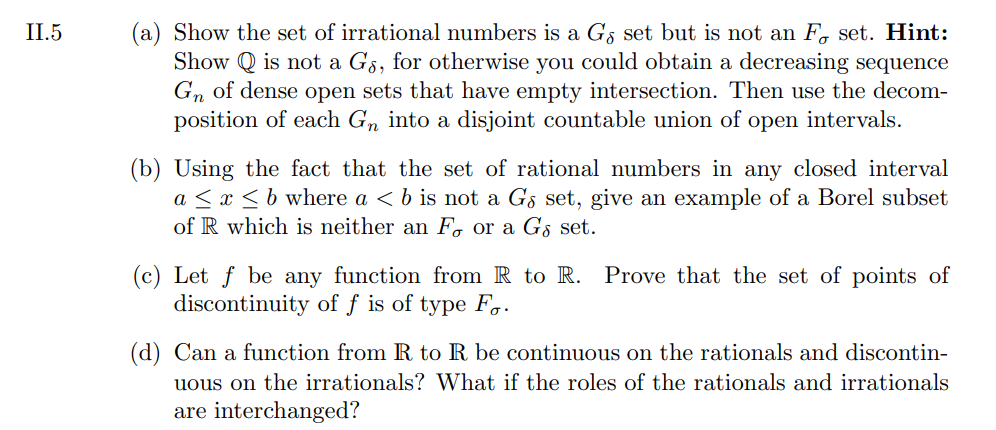
Is it possible for a function \(f:\RR\to \RR\) to be discontinuous precisely on the rationals \(\QQ\)? If so, produce such a function, if not, why?
- Can the set of discontinuities be precisely the irrationals \(\RR\sm\QQ\)?
Find a sequence of continuous functions that does not converge uniformly, but still has a pointwise limit that is continuous.
Solution
A function \(f\) is uniformly continuous on \(E\) if for every \(\eps > 0\) there is \(\delta > 0\) such that \(|f(x) - f(y)| < \eps\) for all \(x, y \in E\) with \(|x - y| < \delta\).
<1>1. Thomae’s function, \(f(p/q) = 1/q\) for \(p/q\) in lowest terms with \(q \geq 1\) and \(f(x) = 0\) for irrational \(x\), is discontinuous exactly on \(\QQ\).
<2>1. \(f\) is continuous at every irrational \(x\).
Given \(\eps > 0\), the set \(\theset{p/q : |p/q - x| < 1,\ 1/q \ge \eps}\) is finite and does not contain \(x\). Choose \(\delta < 1\) smaller than the distance from \(x\) to each of its points. Then \(|f(y)| < \eps = \eps + |f(x)|\) for \(|y - x| < \delta\).
<2>2. \(f\) is discontinuous at every rational \(p/q\).
\(f(p/q) = 1/q > 0\), while irrationals \(y \to p/q\) have \(f(y) = 0\).
<2>3. Q.E.D.
Steps <2>1 and <2>2.
<1>2. No function \(f\colon \RR \to \RR\) is discontinuous exactly on \(\RR \setminus \QQ\).
<2>1. The set of discontinuities of \(f\) is an \(F_\sigma\) set.
Let \(\omega_f(x) = \inf_{\delta > 0}\sup\theset{|f(y) - f(z)| : y, z \in B(x,\delta)}\) be the oscillation of \(f\) at \(x\). The set \(\theset{\omega_f < 1/n}\) is open, so \(\theset{\omega_f \ge 1/n}\) is closed, and \(f\) is discontinuous at \(x\) exactly when \(\omega_f(x) \geq 1/n\) for some \(n\).
<2>2. \(\RR \setminus \QQ\) is not an \(F_\sigma\) set.
If \(\RR\setminus\QQ = \bigcup_n F_n\) with \(F_n\) closed, then \(\QQ = \bigcap_n U_n\) with \(U_n = \RR \setminus F_n\) open and dense, since \(U_n \supseteq \QQ\). The sets \(U_n\) and \(\RR \setminus \theset q\), \(q \in \QQ\), are countably many open dense sets with empty intersection, contradicting the Baire category theorem.
<2>3. Q.E.D.
Steps <2>1 and <2>2.
<1>3. \(f_n(x) = \dfrac{nx}{1 + n^2 x^2}\) on \([0,1]\) are continuous and converge pointwise, but not uniformly, to the continuous function \(0\).
\(f_n(0) = 0\), and for \(x > 0\), \(0 \le f_n(x) \le \frac{nx}{n^2 x^2} = \frac{1}{nx} \to 0\). But \(f_n(1/n) = \frac12\) for every \(n\), so \(\sup_{[0,1]}|f_n - 0| \ge \frac12\).
Uniform limits, differentiability counterexamples, and the Cantor set (Tag E-GMYE2)
Find a function that is differentiable but not continuously differentiable.
Prove the uniform limit theorem: a uniform limit of continuous function is continuous.
Show that the uniform limit of bounded functions is uniformly bounded.
Construct sequences of functions \(\ts{f_n}_{n\in \NN}\) and \(\ts{g_n}_{n\in \NN}\) which converge uniformly on some set \(E\), and yet their product sequence \(\ts{h_n}_{n\in \NN}\) with \(h_n \da f_n g_n\) does not converge uniformly.
- Show that if \(f_n, g_n\) are additionally bounded, then \(h_n\) does converge uniformly.
Find a sequence of functions such that \[\frac{d}{d x} \lim _{n \rightarrow \infty} f_{n}(x) \neq \lim _{n \rightarrow \infty} \frac{d}{d x} f_{n}(x)\]
Find a uniform limit of differentiable functions that is not differentiable.
Prove that the Cantor set is a Borel set.
Show the Cantor ternary set is totally disconnected; that is show it contains no nonempty open interval.
Solution
<1>1. \(f(x) = x^2\sin(1/x)\) for \(x \ne 0\), \(f(0) = 0\), is differentiable on \(\RR\) but not continuously differentiable.
<2>1. \(f\) is differentiable everywhere, with \(f'(0) = 0\) and \(f'(x) = 2x\sin(1/x) - \cos(1/x)\) for \(x \neq 0\).
\(\frac{f(h) - f(0)}{h} = h\sin(1/h)\) and \(|h\sin(1/h)| \leq |h| \to 0\). For \(x \neq 0\), \(f\) is a product and composition of differentiable functions near \(x\), and the product and chain rules give the formula.
<2>2. \(f'\) is discontinuous at \(0\).
At \(x_k = 1/(2k\pi)\), \(f'(x_k) = -1\) for every \(k\), while \(x_k \to 0\) and \(f'(0) = 0\).
<2>3. Q.E.D.
Steps <2>1 and <2>2.
<1>2. If \(f_n \to f\) uniformly on \(E\) and each \(f_n\) is continuous, then \(f\) is continuous.
<2>1. Fix \(x_0 \in E\) and \(\eps > 0\). There are \(n\) with \(\|f - f_n\|_\infty < \eps/3\) and \(\delta > 0\) with \(|f_n(x) - f_n(x_0)| < \eps/3\) for \(x \in E\), \(|x - x_0| < \delta\).
The first is uniform convergence; the second is continuity of \(f_n\) at \(x_0\).
<2>2. Q.E.D.
For \(x \in E\) with \(|x - x_0| < \delta\), step <2>1 and the triangle inequality give \(|f(x) - f(x_0)| \le |f(x) - f_n(x)| + |f_n(x) - f_n(x_0)| + |f_n(x_0) - f(x_0)| < \eps\).
<1>3. If \(f_n \to f\) uniformly and each \(f_n\) is bounded, then \(f\) is bounded, and \(\sup_{n}\|f_n\|_\infty < \infty\).
Choose \(N\) with \(\|f - f_n\|_\infty \le 1\) for \(n \geq N\). Then \(\|f\|_\infty \le \|f_N\|_\infty + 1\), and \(\|f_n\|_\infty \leq \|f\|_\infty + 1\) for \(n \geq N\), so \(\sup_n \|f_n\|_\infty \leq \max(\|f_1\|_\infty, \ldots, \|f_{N-1}\|_\infty, \|f\|_\infty + 1)\).
<1>4. Products of uniformly convergent sequences need not converge uniformly; they do if every \(f_n\) and \(g_n\) is bounded.
<2>1. On \(E = [1, \infty)\), \(f_n(x) = x + \frac{1}{n}\) and \(g_n(x) = x\) converge uniformly, but \(h_n = f_n g_n\) does not.
\(\sup_{x\ge1}|f_n(x) - x| = 1/n \to 0\), and \(g_n\) is constant in \(n\). But \(h_n(x) = x^2 + \frac{x}{n} \to x^2\) pointwise, and \(\sup_{x\ge1}|h_n(x) - x^2| = \sup_{x\ge1}\frac{x}{n} = \infty\) for every \(n\).
<2>2. If \(f_n \to f\) and \(g_n \to g\) uniformly and every \(f_n\) and \(g_n\) is bounded, then \(f_n g_n \to fg\) uniformly.
By step <1>3, \(g\) is bounded and there is \(M\) with \(\|f_n\|_\infty \le M\) for all \(n\) and \(\|g\|_\infty \le M\). Then \(|f_n g_n - fg| \le |f_n|\,|g_n - g| + |g|\,|f_n - f| \le M\|g_n - g\|_\infty + M\|f_n - f\|_\infty \to 0\) uniformly on \(E\).
<2>3. Q.E.D.
Steps <2>1 and <2>2.
<1>5. \(f_n(x) = \frac{\sin(nx)}{n}\) satisfies \(\frac{d}{dx}\lim_n f_n \ne \lim_n \frac{d}{dx}f_n\) at \(x = 0\).
\(|f_n| \leq 1/n\), so \(f_n \to 0\) uniformly and \(\frac{d}{dx}\lim_n f_n(x) = 0\). But \(f_n'(x) = \cos(nx)\), so \(\lim_n f_n'(0) = 1 \ne 0\).
<1>6. \(f_n(x) = \sqrt{x^2 + \frac{1}{n}}\) are differentiable on \(\RR\) and converge uniformly to \(|x|\), which is not differentiable at \(0\).
<2>1. \(f_n \to |x|\) uniformly.
\(0 \le \sqrt{x^2 + 1/n} - |x| = \frac{1/n}{\sqrt{x^2 + 1/n} + |x|} \le \frac{1/n}{\sqrt{1/n}} = \frac{1}{\sqrt n} \to 0\).
<2>2. Each \(f_n\) is smooth, and \(|x|\) is not differentiable at \(0\).
\(x \mapsto \sqrt{x^2 + c}\) is smooth for \(c > 0\), since \(x^2 + c > 0\). The function \(|x|\) has left derivative \(-1\) and right derivative \(1\) at \(0\).
<2>3. Q.E.D.
Steps <2>1 and <2>2.
<1>7. The Cantor set \(C\) is a Borel set.
\(C = \bigcap_n C_n\), where \(C_n\) is the union of the \(2^n\) closed intervals of length \(3^{-n}\) remaining after \(n\) stages. Each \(C_n\) is closed, so \(C\) is closed, and closed sets are Borel.
<1>8. \(C\) contains no nonempty open interval.
\(m(C) \le m(C_n) = (2/3)^n\) for all \(n\), so \(m(C) = 0\). A nonempty open interval has positive measure, so it is not contained in \(C\).
Continuity, uniform convergence of series, Cesàro means, and limits of integrals (Tag P-4FH62)



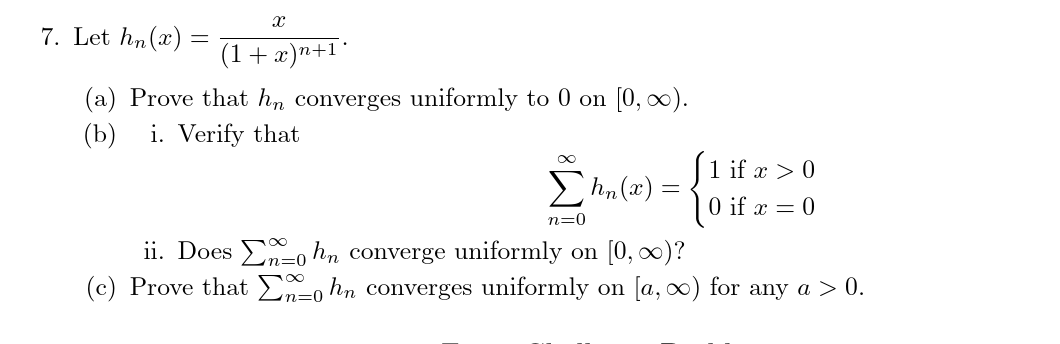
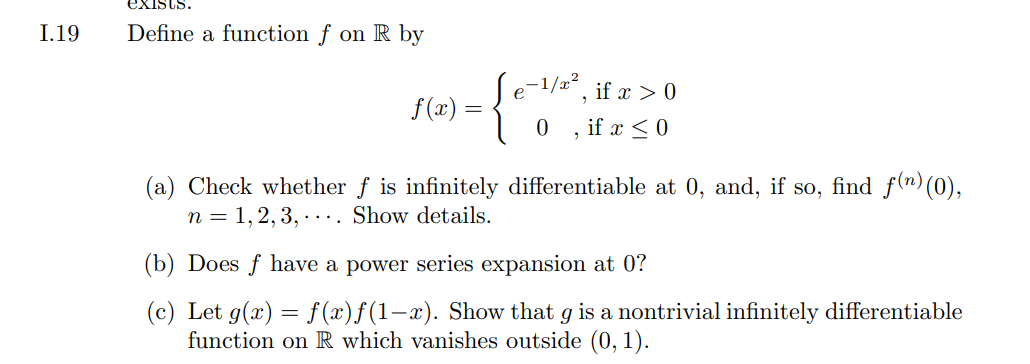
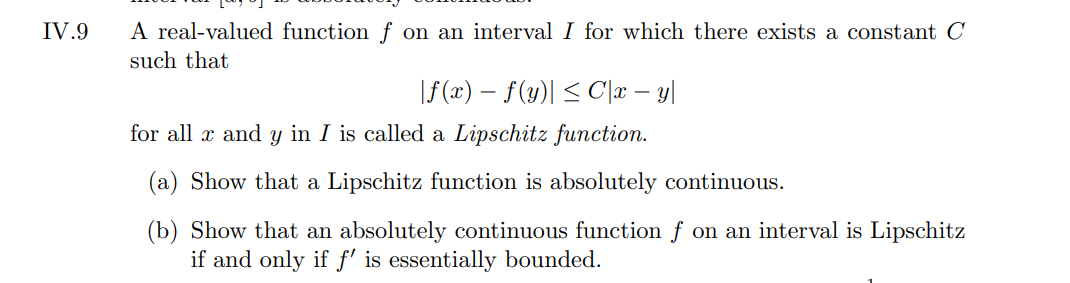

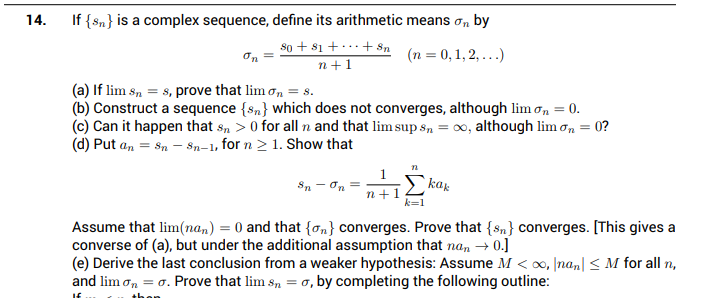
- Note: outline omitted!
Solution
<1>1. If \(f\in C([0,1])\) and \(\int_0^1 f(x)x^n\,dx=0\) for every \(n\ge0\), then \(f\equiv0\).
Assume \(f\in C([0,1])\) and \(\int_0^1 f(x)x^n\,dx=0\) for every \(n\ge0\). Then \(\int_0^1 f p=0\) for every polynomial \(p\). By Weierstrass, choose polynomials \(p_k\to f\) uniformly. Since \(f\in L^1\), \[ \int_0^1 f(x)^2\,dx =\lim_{k\to\infty}\int_0^1 f(x)p_k(x)\,dx=0. \] Hence \(f=0\) almost everywhere, and continuity gives \(f\equiv0\).
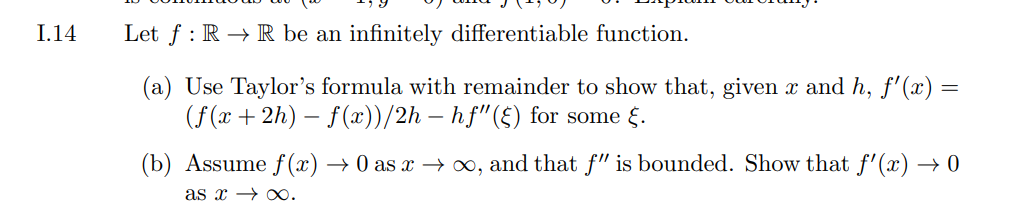
<1>2. If \(f\) is twice differentiable, \(f(x)\to0\) as \(x\to\infty\), and \(|f''|\le M\), then \(f'(x)\to0\).
Taylor’s theorem applied from \(x\) to \(x+2h\) gives \[ f(x+2h)=f(x)+2hf'(x)+2h^2f''(\xi) \] for some \(\xi\) between \(x\) and \(x+2h\), hence \[ f'(x)=\frac{f(x+2h)-f(x)}{2h}-h f''(\xi). \] If \(f(x)\to0\) as \(x\to\infty\) and \(|f''|\le M\), fix \(\varepsilon>0\) and choose \(h>0\) so that \(Mh<\varepsilon/2\). For \(x\) large, both \(|f(x)|\) and \(|f(x+2h)|\) are \(<h\varepsilon/2\), so the first term has absolute value \(<\varepsilon/2\). Thus \(|f'(x)|<\varepsilon\) eventually, proving \(f'(x)\to0\).
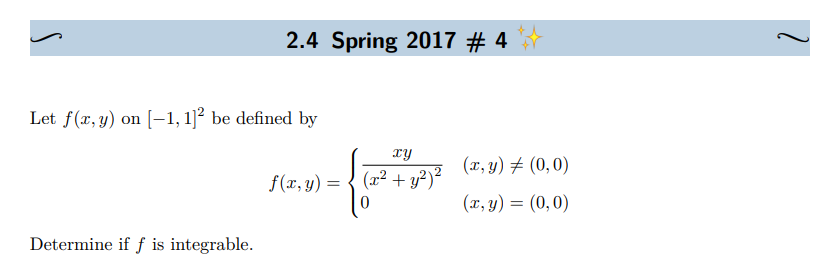
<1>3. The function \(xy/(x^2+y^2)^2\) is not integrable on \([-1,1]^2\).
Away from the origin the function is continuous. In polar coordinates, \[ \left|\frac{xy}{(x^2+y^2)^2}\right| =\frac{|\sin\theta\cos\theta|}{r^2}. \] On any small disk around the origin, \[ \iint |f|\,dx\,dy \ge c\int_0^\delta \frac{dr}{r}=\infty \] for a positive angular constant \(c\). Hence \(f\notin L^1([-1,1]^2)\); in particular it is not Lebesgue integrable.
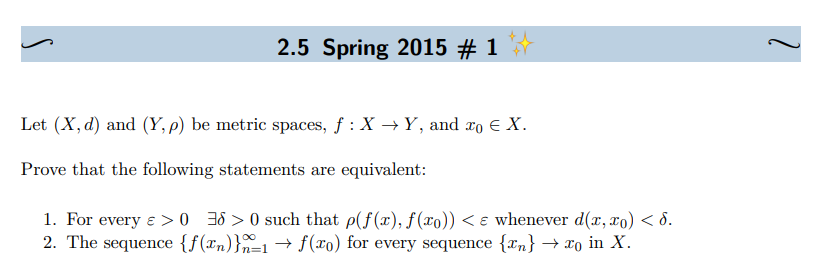
<1>4. A map \(f\colon(X,d)\to(Y,\rho)\) of metric spaces is continuous at \(x_0\) if and only if \(f(x_n)\to f(x_0)\) for every sequence \(x_n\to x_0\).
If \(f\) is continuous at \(x_0\) and \(x_n\to x_0\), the epsilon-delta definition immediately gives \(f(x_n)\to f(x_0)\). Conversely, if continuity fails, there is \(\varepsilon_0>0\) such that for every \(n\) one can choose \(x_n\) with \(d(x_n,x_0)<1/n\) but \(\rho(f(x_n),f(x_0))\ge\varepsilon_0\). Then \(x_n\to x_0\) while \(f(x_n)\not\to f(x_0)\), contradicting the sequential condition.
<1>5. \(1/x\) is uniformly continuous on \((1,\infty)\) but not on \((0,\infty)\).
On \((1,\infty)\), \[ \left|\frac1x-\frac1y\right|=\frac{|x-y|}{xy}\le |x-y|, \] so \(1/x\) is Lipschitz and therefore uniformly continuous. On \((0,\infty)\) take \(x_n=1/n\) and \(y_n=1/(n+1)\). Then \(|x_n-y_n|\to0\), but \[ \left|\frac1{x_n}-\frac1{y_n}\right|=1, \] so uniform continuity fails.
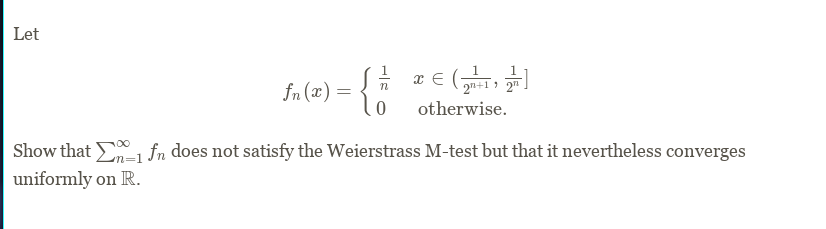
<1>6. For \(f_n=\frac1n\mathbf1_{(2^{-(n+1)},2^{-n}]}\), the series \(\sum_n f_n\) converges uniformly, but \(\sum_n\|f_n\|_\infty=\infty\).
The supports are pairwise disjoint, so at each \(x\) at most one term is nonzero. Therefore the tail satisfies \[ \sup_x\left|\sum_{n>N}f_n(x)\right|\le\frac1{N+1}\to0, \] so the series converges uniformly. But \(\|f_n\|_\infty=1/n\) and \(\sum_n1/n=\infty\), so the M-test does not apply.
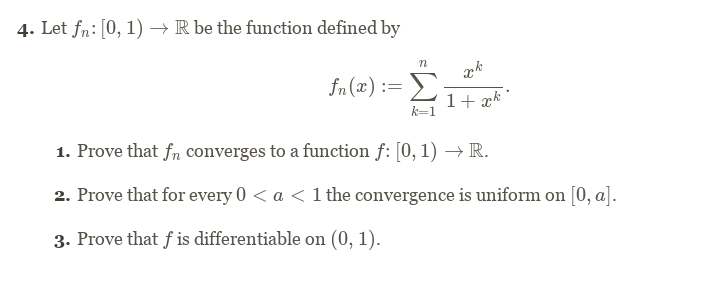
<1>7. \(\sum_{k\ge1}x^k/(1+x^k)\) converges on \([0,1)\), uniformly on each \([0,a]\) with \(a<1\), and its sum is differentiable on \((0,1)\).
For fixed \(x<1\), \[ 0\le \frac{x^k}{1+x^k}\le x^k, \] so the series converges. On every \([0,a]\) with \(a<1\), the bound by \(a^k\) gives uniform convergence by the M-test. Moreover \[ \left(\frac{x^k}{1+x^k}\right)'=\frac{kx^{k-1}}{(1+x^k)^2}, \] and on \([0,a]\) this is bounded by \(ka^{k-1}\), whose series converges. Hence termwise differentiation is valid locally uniformly, and the sum is differentiable on \((0,1)\).
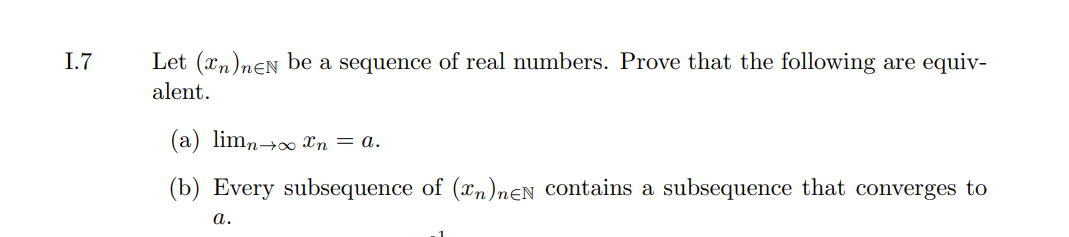
<1>8. Let \((r_n)\) enumerate \(\QQ\), and let \(f(r_n)=1/n\) and \(f(x)=0\) for irrational \(x\). Then \(\lim_{x\to c}f(x)=0\) for every \(c\in\RR\).
Given \(\varepsilon>0\), choose \(N\) with \(1/N<\varepsilon\). Only the finitely many points \(r_1,\dots,r_N\) can have value at least \(\varepsilon\). For a fixed \(c\), choose a punctured neighborhood of \(c\) avoiding those finitely many points other than possibly \(c\) itself. Then \(|f(x)|<\varepsilon\) throughout that punctured neighborhood, so \[ \lim_{x\to c}f(x)=0. \] Thus \(f\) is continuous exactly at the irrational points and discontinuous exactly at the rational points.
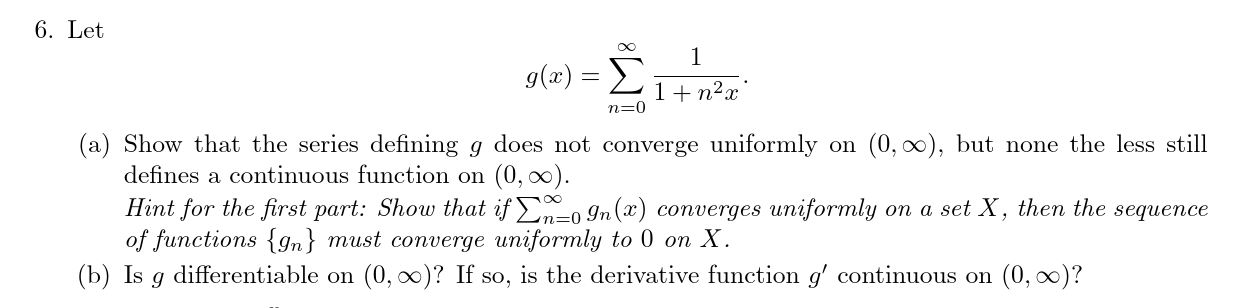
<1>9. \(g(x)=\sum_{n\ge1}(1+n^2x)^{-1}\) does not converge uniformly on \((0,\infty)\), converges uniformly on each \([a,\infty)\) with \(a>0\), and is \(C^1\) on \((0,\infty)\).
Uniform convergence on \((0,\infty)\) fails because a necessary condition would be \[ \sup_{x>0}\frac1{1+n^2x}\to0, \] but the supremum is \(1\) for every \(n\). On every \([a,\infty)\), \(a>0\), \[ \frac1{1+n^2x}\le\frac1{n^2a}, \] so the series converges uniformly there and \(g\) is continuous. Also \[ g'(x)=-\sum_{n\ge1}\frac{n^2}{(1+n^2x)^2}. \] On \([a,\infty)\) the derivative terms are bounded by \(1/(n^2a^2)\), so the derivative series converges uniformly. Hence \(g\) is differentiable on \((0,\infty)\) and \(g'\) is continuous there.
<1>10. \(h_n(x)=x/(1+x)^{n+1}\) tends to \(0\) uniformly on \([0,\infty)\), and \(\sum_{n\ge0}h_n\) converges uniformly on each \([a,\infty)\) with \(a>0\) but not on \([0,\infty)\).
For \(n\ge1\), differentiating shows the maximum on \([0,\infty)\) occurs at \(x=1/n\), with \[ \|h_n\|_\infty=\frac{n^n}{(n+1)^{n+1}}\le\frac1{n+1}\to0. \] Thus \(h_n\to0\) uniformly. For \(x>0\), \[ \sum_{n=0}^\infty h_n(x) =\frac{x}{1+x}\sum_{n=0}^\infty(1+x)^{-n}=1, \] while at \(x=0\) the sum is \(0\). Hence the series cannot converge uniformly on \([0,\infty)\) because its pointwise sum is discontinuous. On \([a,\infty)\) with \(a>0\), the tail beginning at \(N\) equals \((1+x)^{-N}\), so its supremum is \((1+a)^{-N}\to0\); therefore convergence is uniform there.
<1>11. The function \(f(x)=e^{-1/x^2}\) for \(x>0\), \(f(x)=0\) for \(x\le0\), is \(C^\infty\) with \(f^{(n)}(0)=0\) for every \(n\), and \(f(x)f(1-x)\) is a smooth function that is positive on \((0,1)\) and zero elsewhere.
Repeated differentiation on \(x>0\) gives \(f^{(n)}(x)=P_n(1/x)e^{-1/x^2}\) for a polynomial \(P_n\). Since \(t^m e^{-t^2}\to0\) as \(t\to\infty\) for every \(m\), all right derivatives tend to \(0\) at the origin, matching the left derivatives. Hence \(f\in C^\infty\) and \(f^{(n)}(0)=0\) for every \(n\). Its Taylor series at \(0\) is therefore identically zero, so it does not equal \(f\) for \(x>0\). Finally \(g(x)=f(x)f(1-x)\) is smooth, nonzero on \((0,1)\), and vanishes outside \((0,1)\).
<1>12. A Lipschitz function on an interval is absolutely continuous, and an absolutely continuous \(f\) is Lipschitz if and only if \(f'\in L^\infty\).
If \(|f(x)-f(y)|\le C|x-y|\), then for pairwise disjoint intervals \((a_j,b_j)\), \[ \sum_j|f(b_j)-f(a_j)|\le C\sum_j(b_j-a_j), \] so \(f\) is absolutely continuous. If \(f\) is absolutely continuous, then \[ f(y)-f(x)=\int_x^y f'(t)\,dt. \] Thus \(f'\in L^\infty\) implies \[ |f(y)-f(x)|\le\|f'\|_\infty|y-x|, \] so \(f\) is Lipschitz. Conversely, a Lipschitz function is differentiable a.e. and \(|f'|\) is bounded a.e. by its Lipschitz constant.
<1>13. For integrable \(f\ge0\) on \([0,1]\), \(\lim_{n\to\infty}\int_0^1 f^{1/n}=m(\{f>0\})\).
For nonnegative integrable \(f\), \[ f(x)^{1/n}\to\mathbf1_{\{f>0\}}(x) \] pointwise. Also \(t^{1/n}\le1+t\) for \(t\ge0\), so \(f^{1/n}\le1+f\in L^1([0,1])\). Dominated convergence yields \[ \lim_{n\to\infty}\int_0^1 f(x)^{1/n}\,dx =m(\{x:f(x)>0\}). \]
<1>14. Let \(\sigma_n=(s_0+\cdots+s_n)/(n+1)\) be the Cesàro means of \((s_n)\). Convergence of \(s_n\) implies convergence of \(\sigma_n\) to the same limit; the converse fails, even for \(s_n\ge0\); and it holds if \(n(s_n-s_{n-1})\to0\).
If \(s_n\to s\), then \(\sigma_n\to s\) by the Cesaro theorem, proved directly by splitting the average into a fixed initial block and a tail where \(|s_k-s|\) is small.
Take \(s_n=(-1)^n\). Then \(s_n\) does not converge, while \(\sigma_n\to0\).
Let \(s_{2^k}=k\) and \(s_n=0\) otherwise. Then \(s_n\ge0\) and \(\limsup s_n=\infty\), but for \(2^m\le n<2^{m+1}\), \[ 0\le\sigma_n\le\frac{1+2+\cdots+m}{2^m}\to0. \]
With \(a_n=s_n-s_{n-1}\), \[ \sum_{k=1}^nka_k =ns_n-\sum_{k=0}^{n-1}s_k =(n+1)(s_n-\sigma_n), \] so \[ s_n-\sigma_n=\frac1{n+1}\sum_{k=1}^nka_k. \] If \(na_n\to0\) and \(\sigma_n\) converges, the right side tends to \(0\) by Cesaro averaging, hence \(s_n\) converges to the same limit as \(\sigma_n\).
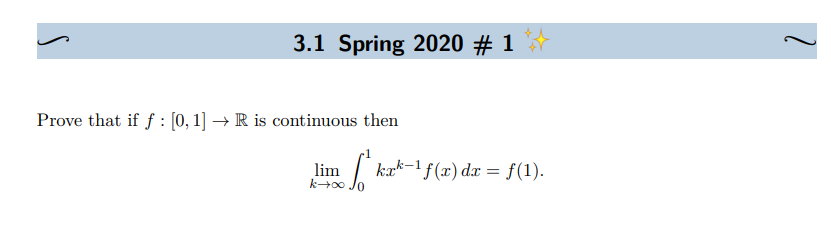
<1>15. For \(f\in C([0,1])\), \(\lim_{k\to\infty}k\int_0^1x^{k-1}f(x)\,dx=f(1)\).
Let \(f\in C([0,1])\). Since \(\int_0^1kx^{k-1}\,dx=1\), \[ k\int_0^1x^{k-1}f(x)\,dx-f(1) =k\int_0^1x^{k-1}(f(x)-f(1))\,dx. \] Given \(\varepsilon>0\), choose \(a<1\) so that \(|f(x)-f(1)|<\varepsilon\) on \([a,1]\). The contribution from \([a,1]\) is at most \(\varepsilon\). On \([0,a]\) it is at most \(2\|f\|_\infty a^k\). Hence the expression tends to \(0\), proving the limit is \(f(1)\).
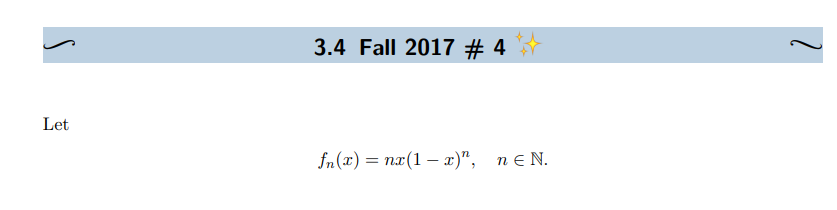
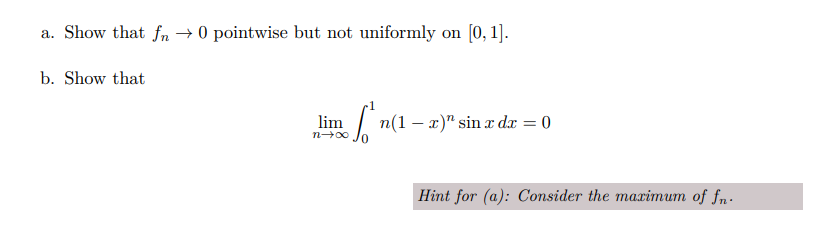
<1>16. \(f_n(x)=nx(1-x)^n\) converges to \(0\) pointwise but not uniformly on \([0,1]\), and \(\int_0^1 n(1-x)^n\sin x\,dx\to0\).
For each fixed \(x\in(0,1]\), exponential decay of \((1-x)^n\) dominates the factor \(n\), while \(f_n(0)=0\), so \(f_n\to0\) pointwise. The maximum occurs at \(x=1/(n+1)\) and equals \[ \frac{n}{n+1}\left(\frac{n}{n+1}\right)^n\to e^{-1}, \] so convergence is not uniform. Finally, since \(0\le\sin x\le x\) on \([0,1]\), \[ 0\le \int_0^1 n(1-x)^n\sin x\,dx \le n\int_0^1x(1-x)^n\,dx =\frac{n}{(n+1)(n+2)}\to0. \]
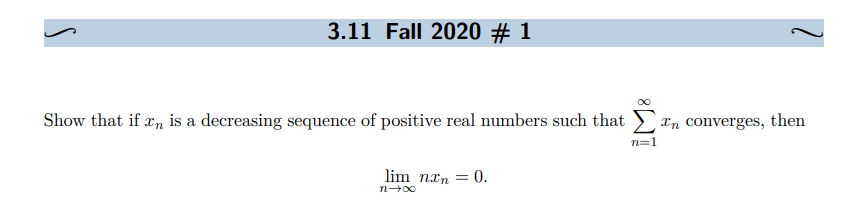
<1>17. A decreasing summable positive sequence satisfies \(nx_n\to0\).
Let \((x_n)\) be decreasing, positive, and suppose \(\sum_nx_n<\infty\). Then \[ \sum_{k=\lfloor n/2\rfloor+1}^{n}x_k \ge \bigl(n-\lfloor n/2\rfloor\bigr)x_n \ge \frac n2x_n. \] The left side is a tail block of a convergent positive series and therefore tends to \(0\). Hence \(nx_n\to0\).