\(
\newcommand{\coloneqq}{\mathrel{\vcenter{:}}=}
\newcommand{\qty}[1]{\left( {#1} \right)}
\newcommand{\AA}{{\mathbf{A}}}
\newcommand{\CC}{{\mathbf{C}}}
\newcommand{\DD}{\mathbb{D}}
\newcommand{\EE}{{\mathbb{E}}}
\newcommand{\FF}{{ \mathbf{F} }}
\newcommand{\GG}{{\mathbf{G}}}
\newcommand{\HH}{{\mathbb{H}}}
\newcommand{\KK}{{\mathbb{K}}}
\newcommand{\LL}{{\mathbb{L}}}
\newcommand{\NN}{{\mathbb{N}}}
\newcommand{\PP}{{\mathbf{P}}}
\newcommand{\QQ}{{\mathbf{Q}}}
\newcommand{\RR}{{\mathbf{R}}}
\newcommand{\SS}{{\mathbb{S}}}
\newcommand{\TT}{{\mathbb{T}}}
\newcommand{\UU}{\mathbb{U}}
\newcommand{\VV}{{\mathbf{V}}}
\newcommand{\ZZ}{{\mathbf{Z}}}
\newcommand{\GGr}{{\mathbb{Gr}}}
\newcommand{\OP}{{\mathbb{OP}}}
\newcommand{\SpSp}{{\mathbb{S}}}
\newcommand{\CCpadic}{{ \CC_p }}
\newcommand{\CCstar}{\unitsof{\CC}}
\newcommand{\FFbar}{{\bar\FF}}
\newcommand{\FFp}{{\FF_p}}
\newcommand{\FFpn}{{\FF_{p^n}}}
\newcommand{\Fpbar}{\bar{\FF_p}}
\newcommand{\fq}{{\FF_{q}}}
\newcommand{\fqbar}{\bar{\FF_{q}}}
\newcommand{\fqr}{{\FF_{q^r}}}
\newcommand{\kG}{{kG}}
\newcommand{\kk}{{\mathbf{k}}}
\newcommand{\QQbar}{{ \bar{ \mathbf{Q} } }}
\newcommand{\QQladic}{{ \QQ_\ell }}
\newcommand{\QQpadic}{{ \QQ_{\hat p} }}
\newcommand{\ZZbar}{{ \bar{ \ZZ } }}
\newcommand{\ZZelladic}{{ \ZZ_\ell }}
\newcommand{\ZZG}{{\ZZ G}}
\newcommand{\ZZH}{{\ZZ H}}
\newcommand{\ZZhat}{{ \widehat{ \ZZ } }}
\newcommand{\ZZladic}{{ \ZZ_{\hat \ell} }}
\newcommand{\ZZpadic}{{ \ZZ_{\hat p} }}
\newcommand{\ZZpcomplete}{{ \ZZpadic }}
\newcommand{\ZZplocal}{{ L_p \ZZ }}
\newcommand{\ZZprof}{{ \hat{\ZZ} }}
\newcommand{\ZpZ}{\ZZ/p}
\newcommand{\zlnz}{\ZZ/\ell^n\ZZ}
\newcommand{\zlz}{\ZZ/\ell\ZZ}
\newcommand{\znz}{\ZZ/n\ZZ}
\newcommand{\zpz}{\ZZ/p\ZZ}
\newcommand{\Banach}{\mathcal{B}}
\newcommand{\Hsh}{{ \mathcal{H} }}
\newcommand{\mca}{{\mathcal{A}}}
\newcommand{\mcb}{{\mathcal{B}}}
\newcommand{\mcc}{{\mathcal{C}}}
\newcommand{\mcd}{{\mathcal{D}}}
\newcommand{\mce}{{\mathcal{E}}}
\newcommand{\mcf}{{\mathcal{F}}}
\newcommand{\mcg}{{\mathcal{G}}}
\newcommand{\mch}{{\mathcal{H}}}
\newcommand{\mci}{{\mathcal{I}}}
\newcommand{\mcj}{{\mathcal{J}}}
\newcommand{\mck}{{\mathcal{K}}}
\newcommand{\mcl}{{\mathcal{L}}}
\newcommand{\mcm}{{\mathcal{M}}}
\newcommand{\mcn}{{\mathcal{N}}}
\newcommand{\mco}{{\mathcal{O}}}
\newcommand{\mcp}{{\mathcal{P}}}
\newcommand{\mcq}{{\mathcal{Q}}}
\newcommand{\mcr}{{\mathcal{R}}}
\newcommand{\mcs}{{\mathcal{S}}}
\newcommand{\mct}{{\mathcal{T}}}
\newcommand{\mcTop}{\mathcal{T}\mathsf{op}}
\newcommand{\mcu}{{\mathcal{U}}}
\newcommand{\mcv}{{\mathcal{V}}}
\newcommand{\mcw}{{\mathcal{W}}}
\newcommand{\mcx}{{\mathcal{X}}}
\newcommand{\mcy}{{\mathcal{Y}}}
\newcommand{\mcz}{{\mathcal{Z}}}
\newcommand{\OO}{{\mathcal{O}}}
\newcommand{\Path}{\mathcal{P}}
\newcommand{\liea}{{\mathfrak{a}}}
\newcommand{\lieb}{{\mathfrak{b}}}
\newcommand{\lied}{{\mathfrak{d}}}
\newcommand{\lief}{{\mathfrak{f}}}
\newcommand{\lieg}{{\mathfrak{g}}}
\newcommand{\liegl}{{\mathfrak{gl}}}
\newcommand{\lieh}{{\mathfrak{h}}}
\newcommand{\liel}{{\mathfrak{l}}}
\newcommand{\lien}{{\mathfrak{n}}}
\newcommand{\lieo}{{\mathfrak{o}}}
\newcommand{\liep}{{\mathfrak{p}}}
\newcommand{\lieq}{{\mathfrak{q}}}
\newcommand{\lier}{{\mathfrak{r}}}
\newcommand{\lies}{{\mathfrak{s}}}
\newcommand{\liesl}{{\mathfrak{sl}}}
\newcommand{\lieso}{{\mathfrak{so}}}
\newcommand{\liesp}{{\mathfrak{sp}}}
\newcommand{\liesu}{{\mathfrak{su}}}
\newcommand{\liet}{{\mathfrak{t}}}
\newcommand{\lieu}{{\mathfrak{u}}}
\newcommand{\lieW}{{\mathfrak{W}}}
\newcommand{\liey}{{\mathfrak{y}}}
\newcommand{\mfa}{{\mathfrak{a}}}
\newcommand{\mfb}{{\mathfrak{b}}}
\newcommand{\mfc}{{\mathfrak{c}}}
\newcommand{\mfC}{{\mathfrak{C}}}
\newcommand{\mfe}{{\mathfrak{e}}}
\newcommand{\mff}{{\mathfrak{f}}}
\newcommand{\mfF}{{\mathfrak{F}}}
\newcommand{\mfg}{{\mathfrak{g}}}
\newcommand{\mfh}{{\mathfrak{h}}}
\newcommand{\mfk}{{\mathfrak{k}}}
\newcommand{\mfm}{{\mathfrak{m}}}
\newcommand{\mfn}{{\mathfrak{n}}}
\newcommand{\mfo}{{\mathfrak{o}}}
\newcommand{\mfp}{{\mathfrak{p}}}
\newcommand{\mfq}{{\mathfrak{q}}}
\newcommand{\mfr}{{\mathfrak{r}}}
\newcommand{\mfs}{{\mathfrak{s}}}
\newcommand{\mfS}{{\mathfrak{S}}}
\newcommand{\mfu}{{\mathfrak{u}}}
\newcommand{\mfv}{{\mathfrak{v}}}
\newcommand{\mfX}{{\mathfrak{X}}}
\newcommand{\mm}{{\mathfrak{m}}}
\newcommand{\bigo}{{ \mathsf{O}}}
\newcommand{\Gal}{{ \mathsf{Gal}}}
\newcommand{\Herm}{{\mathsf{Herm}}}
\newcommand{\AMGM}{{\mathrm{AMGM}}}
\newcommand{\CM}{{\mathrm{CM}}}
\newcommand{\CR}{{\mathrm{CR}}}
\newcommand{\CS}{\mathrm{CS}}
\newcommand{\CY}{{ \text{CY} }}
\newcommand{\dR}{\mathrm{dR}}
\newcommand{\EKL}{{\mathrm{EKL}}}
\newcommand{\Ell}{\mathrm{Ell}}
\newcommand{\Fix}{\mathrm{Fix}}
\newcommand{\FP}{\mathrm{FP}}
\newcommand{\FS}{{ \text{FS} }}
\newcommand{\Hasse}{{\mathrm{Hasse}}}
\newcommand{\homog}{{ \mathrm{homog} }}
\newcommand{\IAS}{\mathrm{IAS}}
\newcommand{\KSBA}{\mathrm{KSBA}}
\newcommand{\Lat}{\mathrm{Lat}}
\newcommand{\LC}{{\mathrm{LC}}}
\newcommand{\lci}{\mathrm{lci}}
\newcommand{\MHS}{\mathrm{MHS}}
\newcommand{\mot}{{ \mathrm{mot}}}
\newcommand{\nef}{\mathrm{nef}}
\newcommand{\Nil}{{\mathrm{Nil}}}
\newcommand{\Nis}{{\mathrm{Nis}}}
\newcommand{\Noeth}{{ \mathrm{Noeth} }}
\newcommand{\Orb}{{\mathrm{Orb}}}
\newcommand{\PD}{\mathrm{PD}}
\newcommand{\Pet}{{\mathrm{Pet}}}
\newcommand{\QH}{{\mathrm{QH}}}
\newcommand{\Quad}{\mathrm{Quad}}
\newcommand{\RT}{{\mathrm{RT}}}
\newcommand{\SC}{\mathrm{SC}}
\newcommand{\slc}{\mathrm{slc}}
\newcommand{\SNF}{\mathrm{SNF}}
\newcommand{\spinor}{\mathrm{sp}}
\newcommand{\tame}{{\mathrm{tame}}}
\newcommand{\tb}{\mathrm{tb}}
\newcommand{\td}{\mathrm{td}}
\newcommand{\tw}{\mathrm{tw}}
\newcommand{\VHS}{{\mathrm{VHS} }}
\newcommand{\vir}{{\mathrm{vir}}}
\newcommand{\VMHS}{\mathrm{VMHS}}
\newcommand{\WI}{\mathrm{WI}}
\newcommand{\Zar}{{\mathrm{Zar}}}
\newcommand{\alev}{{\,\mathrm{a.e.}}}
\newcommand{\amp}{{\mathrm{amp}}}
\newcommand{\an}{{\mathrm{an}}}
\newcommand{\can}{{\mathrm{can}}}
\newcommand{\cell}{{ \mathrm{cell}}}
\newcommand{\crys}{{\mathrm{crys}}}
\newcommand{\cusp}{{ \mathrm{cusp} }}
\newcommand{\elliptic}{{\mathrm{ell}}}
\newcommand{\ess}{{\mathrm{ess}}}
\newcommand{\even}{\text{even}}
\newcommand{\fd}{{\mathrm{fd}}}
\newcommand{\fg}{{\mathrm{fg}}}
\newcommand{\fin}{{\mathrm{fin}}}
\newcommand{\free}{{\mathrm{free}}}
\newcommand{\ft}{\mathrm{ft}}
\newcommand{\hol}{\text{hol}}
\newcommand{\holonomy}{{\mathrm{holon}}}
\newcommand{\holomorphic}{\text{holo}}
\newcommand{\inc}{{\mathrm{inc}}}
\newcommand{\irr}{{\mathrm{irr}}}
\newcommand{\isotrop}{\mathrm{isotrop}}
\newcommand{\lf}{{\mathrm{lf}}}
\newcommand{\lft}{\mathrm{lft}}
\newcommand{\odd}{\text{odd}}
\newcommand{\perf}{{\mathrm{perf}}}
\newcommand{\poly}{\mathrm{poly}}
\newcommand{\prop}{{\mathrm{prop}}}
\newcommand{\qproj}{{\mathrm{qproj}}}
\newcommand{\ram}{{\mathrm{ram}}}
\newcommand{\red}{{ \text{red} }}
\newcommand{\reg}{\mathrm{reg}}
\newcommand{\semi}{{\mathrm{semi}}}
\newcommand{\semisimple}{{\mathrm{ss}}}
\newcommand{\semisimplification}{{\mathrm{ss}}}
\newcommand{\sing}{{\mathrm{sing}}}
\newcommand{\smol}{{\mathrm{small}}}
\newcommand{\snc}{{\mathrm{snc}}}
\newcommand{\ss}{{\mathrm{ss}}}
\newcommand{\stable}{\mathrm{st}}
\newcommand{\std}{\text{std}}
\newcommand{\trop}{\mathrm{trop}}
\newcommand{\unstable}{\mathrm{unst}}
\newcommand{\vamp}{{\mathrm{v.amp}}}
\newcommand{\zar}{{\mathrm{zar}}}
\newcommand{\ab}{{\operatorname{ab}}}
\newcommand{\ad}{{ \operatorname{ad}}}
\newcommand{\Ad}{{ \operatorname{Ad} }}
\newcommand{\adjoint}{\dagger}
\newcommand{\ae}{{ \text{a.e.} }}
\newcommand{\afp}{A_{/\FF_p}}
\newcommand{\AG}{\operatorname{AG}}
\newcommand{\AGL}{\operatorname{AGL}}
\newcommand{\AJ}{\operatorname{AJ}}
\newcommand{\Alb}{\operatorname{Alb}}
\newcommand{\Amp}{{\operatorname{Amp}}}
\newcommand{\Ann}{\operatorname{Ann}}
\newcommand{\AO}{\operatorname{AO}}
\newcommand{\arccot}{\operatorname{arccot}}
\newcommand{\arccsc}{\operatorname{arccsc}}
\newcommand{\arcsec}{\operatorname{arcsec}}
\newcommand{\area}{\operatorname{area}}
\newcommand{\Arg}{\operatorname{Arg}}
\newcommand{\ASL}{\operatorname{ASL}}
\newcommand{\Aut}{\operatorname{Aut}}
\newcommand{\Ball}{{B}}
\newcommand{\Base}{{ \operatorname{Base}}}
\newcommand{\bb}{\operatorname{BB}}
\newcommand{\bd}{{\del}}
\newcommand{\Betti}{{\operatorname{Betti}}}
\newcommand{\BiHol}{\operatorname{BiHol}}
\newcommand{\Bil}{\operatorname{Bil}}
\newcommand{\Bl}{\operatorname{Bl}}
\newcommand{\BM}{{\operatorname{BM}}}
\newcommand{\Brauer}{\mathrm{Br}}
\newcommand{\Bs}{\operatorname{Bs}}
\newcommand{\by}{\times}
\newcommand{\candim}{\operatorname{candim}}
\newcommand{\Cart}{\operatorname{Cart}}
\newcommand{\CDiv}{\operatorname{CDiv}}
\newcommand{\CF}{\operatorname{CF}}
\newcommand{\CH}{{\operatorname{CH}}}
\newcommand{\ch}{\operatorname{ch}}
\newcommand{\character}{\operatorname{ch}}
\newcommand{\characteristic}{\operatorname{char}}
\newcommand{\charpoly}{{\mathrm{charpoly}}}
\newcommand{\chern}{{\mathrm{ch}}}
\newcommand{\chp}{\operatorname{ch. p}}
\newcommand{\Chow}{{\operatorname{Ch}}}
\newcommand{\cl}{{ \operatorname{cl}}}
\newcommand{\Cl}{\operatorname{Cl}}
\newcommand{\CaCl}{\operatorname{CaCl}}
\newcommand{\kxnz}{k[x_0, \cdots, x_{n}]}
\newcommand{\codom}{\operatorname{codom}}
\newcommand{\codim}{\operatorname{codim}}
\newcommand{\coev}{\operatorname{coev}}
\newcommand{\coh}{\operatorname{coh}}
\newcommand{\cohdim}{\operatorname{cohdim}}
\newcommand{\coim}{\operatorname{coim}}
\newcommand{\coinfl}{\operatorname{coinf}}
\newcommand{\coinv}{{\operatorname{coinv}}}
\newcommand{\coker}{\operatorname{coker}}
\newcommand{\colspace}{\operatorname{colspace}}
\newcommand{\compact}{\operatorname{cpt}}
\newcommand{\Cone}{{ \mathrm{Cone} }}
\newcommand{\cone}{\operatorname{cone}}
\newcommand{\Conf}{{\mathrm{Conf}}}
\newcommand{\Conj}{{\mathrm{Conj}}}
\newcommand{\const}{{\operatorname{const.}}}
\newcommand{\cores}{\operatorname{coRes}}
\newcommand{\corank}{\operatorname{corank}}
\newcommand{\covol}{\operatorname{coVol}}
\newcommand{\Cox}{{ \operatorname{Cox} }}
\newcommand{\CP}{{\mathbf{CP}}}
\newcommand{\Crit}{\operatorname{Crit}}
\newcommand{\crit}{\operatorname{crit}}
\newcommand{\cross}{\times}
\newcommand{\csch}{\operatorname{csch}}
\newcommand{\cts}{\text{cts}}
\newcommand{\curl}{\operatorname{curl}}
\newcommand{\Curv}{\operatorname{Curv}}
\newcommand{\Cyl}{{ \mathrm{Cyl} }}
\newcommand{\Deck}{\operatorname{Deck}}
\newcommand{\ddim}{\operatorname{ddim}}
\newcommand{\Def}{\operatorname{Def}}
\newcommand{\definedas}{\coloneqq}
\newcommand{\del}{{\partial}}
\newcommand{\delbar}{{ \bar{\del}}}
\newcommand{\depth}{\operatorname{depth}}
\newcommand{\Der}{{ \operatorname{Der} }}
\newcommand{\det}{\operatorname{det}}
\newcommand{\diag}{\operatorname{diag}}
\newcommand{\diam}{{\operatorname{diam}}}
\newcommand{\Diff}{\operatorname{Diff}}
\newcommand{\Diffeo}{{\operatorname{Diffeo}}}
\newcommand{\disc}{{\operatorname{disc}}}
\newcommand{\discriminant}{{\Delta}}
\newcommand{\Disk}{{\operatorname{Disk}}}
\newcommand{\Dist}{\operatorname{Dist}}
\newcommand{\dist}{\operatorname{dist}}
\newcommand{\div}{\operatorname{div}}
\newcommand{\Div}{\operatorname{Div}}
\newcommand{\dlog}{\operatorname{dLog}}
\newcommand{\dom}{\operatorname{dom}}
\newcommand{\dP}{{\operatorname{dP}}}
\newcommand{\DSt}{{ \operatorname{DSt}}}
\newcommand{\Eff}{\operatorname{Eff}}
\newcommand{\Emb}{{\operatorname{Emb}}}
\newcommand{\En}{{\operatorname{En}}}
\newcommand{\Endo}{{ \operatorname{End} }}
\newcommand{\eo}{{\operatorname{eo}}}
\newcommand{\essdim}{\operatorname{essdim}}
\newcommand{\et}{\text{ét}}
\newcommand{\Et}{\text{Ét}}
\newcommand{\eul}{{\operatorname{eul}}}
\newcommand{\ev}{\operatorname{ev}}
\newcommand{\exist}{{\exists}}
\newcommand{\Exists}{\operatorname{\exists}}
\newcommand{\Ext}{\operatorname{Ext}}
\newcommand{\EZ}{\operatorname{EZ}}
\newcommand{\F}{{\operatorname{F}}}
\newcommand{\fet}{\text{fét}}
\newcommand{\ff}{\operatorname{ff}}
\newcommand{\Fil}{{\operatorname{Fil}}}
\newcommand{\Fl}{\operatorname{Fl}}
\newcommand{\Flat}{{\operatorname{Flat}}}
\newcommand{\Forall}{\operatorname{\forall}}
\newcommand{\Forget}{Forget}
\newcommand{\fp}{{ \operatorname{fp} }}
\newcommand{\fppf}{{\operatorname{fppf}}}
\newcommand{\Fppf}{\mathrm{\operatorname{Fppf}}}
\newcommand{\fpqc}{{\operatorname{fpqc}}}
\newcommand{\Fr}{\operatorname{Fr}}
\newcommand{\Frac}{\operatorname{Frac}}
\newcommand{\Frame}{\operatorname{Frame}}
\newcommand{\Frob}{\operatorname{Frob}}
\newcommand{\gal}{{ \operatorname{Gal}}}
\newcommand{\gendim}{\operatorname{gendim}}
\newcommand{\generic}{{\mathrm{gen}}}
\newcommand{\genus}{{\operatorname{gen}}}
\newcommand{\GF}{{\mathbf{GF}}}
\newcommand{\GL}{\operatorname{GL}}
\newcommand{\gp}{{\operatorname{gp} }}
\newcommand{\Gr}{{\operatorname{Gr}}}
\newcommand{\grad}{\operatorname{grad}}
\newcommand{\graded}{\operatorname{gr}}
\newcommand{\grdim}{{\operatorname{gr\,dim}}}
\newcommand{\Griff}{\operatorname{Griff}}
\newcommand{\GU}{\operatorname{GU}}
\newcommand{\GW}{{\operatorname{GW}}}
\newcommand{\hash}{{\sharp}}
\newcommand{\HC}{{\operatorname{HC}}}
\newcommand{\hd}{\operatorname{Head}}
\newcommand{\he}{\operatorname{h.e.}}
\newcommand{\height}{\operatorname{ht}}
\newcommand{\HF}{\operatorname{HF}}
\newcommand{\HFK}{\operatorname{HFK}}
\newcommand{\Hilb}{\operatorname{Hilb}}
\newcommand{\hilbdim}{\operatorname{hilbdim}}
\newcommand{\Hol}{\operatorname{Hol}}
\newcommand{\Hom}{{ \operatorname{Hom} }}
\newcommand{\Homcx}{\operatorname{Hom}^{\bullet}}
\newcommand{\Homeo}{{\operatorname{Homeo}}}
\newcommand{\Honda}{\mathrm{\operatorname{Honda}}}
\newcommand{\HP}{{\operatorname{HP}}}
\newcommand{\HT}{{\operatorname{HT}}}
\newcommand{\hyp}{{\operatorname{hyp}}}
\newcommand{\Id}{\operatorname{Id}}
\newcommand{\id}{\operatorname{id}}
\newcommand{\im}{\operatorname{im}}
\newcommand{\Index}{\operatorname{Index}}
\newcommand{\Inertia}{{\mathrm{In}}}
\newcommand{\infl}{\operatorname{inf}}
\newcommand{\Inn}{\operatorname{Inn}}
\newcommand{\Intersect}{\bigcap}
\newcommand{\Isom}{{\mathrm{Isom}}}
\newcommand{\Jac}{\operatorname{Jac}}
\newcommand{\jan}{\operatorname{Jan}}
\newcommand{\JCF}{\operatorname{JCF}}
\newcommand{\Kahler}{\operatorname{Kähler}}
\newcommand{\Kl}{\operatorname{Kl}}
\newcommand{\ko}{{\operatorname{ko}}}
\newcommand{\krulldim}{\operatorname{krulldim}}
\newcommand{\ks}{\operatorname{ks}}
\newcommand{\Kthree}{\mathrm{K3}}
\newcommand{\lcm}{\operatorname{lcm}}
\newcommand{\Ld}{\operatorname{{\mathbb{L} }}}
\newcommand{\len}{\operatorname{len}}
\newcommand{\length}{\operatorname{length}}
\newcommand{\LGr}{{\operatorname{LGr}}}
\newcommand{\Li}{\mathrm{Li}}
\newcommand{\lk}{\operatorname{lk}}
\newcommand{\Log}{\operatorname{Log}}
\newcommand{\Maps}{\operatorname{Maps}}
\newcommand{\mat}{\operatorname{mat}}
\newcommand{\Mat}{\operatorname{Mat}}
\newcommand{\maxspec}{{\operatorname{maxSpec}}}
\newcommand{\MC}{\operatorname{MC}}
\newcommand{\MCG}{{\operatorname{MCG}}}
\newcommand{\Mero}{\operatorname{Mero}}
\newcommand{\mHH}{{\operatorname{HH}}}
\newcommand{\minor}{{\operatorname{minor}}}
\newcommand{\minpoly}{{\operatorname{minpoly}}}
\newcommand{\mod}{\operatorname{mod}}
\newcommand{\Mor}{\operatorname{Mor}}
\newcommand{\mproj}{\operatorname{mProj}}
\newcommand{\mspec}{\operatorname{mSpec}}
\newcommand{\MT}{\operatorname{MT}}
\newcommand{\mTHH}{{\operatorname{THH}}}
\newcommand{\mult}{{\operatorname{mult}}}
\newcommand{\MW}{\operatorname{MW}}
\newcommand{\nd}{\operatorname{nd}}
\newcommand{\NE}{{\operatorname{NE}}}
\newcommand{\Nef}{\operatorname{Nef}}
\newcommand{\nil}{{\operatorname{nil}}}
\newcommand{\Norm}{\operatorname{Nm}}
\newcommand{\NS}{{\operatorname{NS}}}
\newcommand{\nullity}{\operatorname{nullity}}
\newcommand{\nullspace}{\operatorname{nullspace}}
\newcommand{\Num}{\operatorname{Num}}
\newcommand{\Ob}{{\operatorname{Ob}}}
\newcommand{\obs}{\operatorname{obs}}
\newcommand{\Obs}{\operatorname{Obs}}
\newcommand{\OFrame}{\operatorname{OFrame}}
\newcommand{\OGr}{{\operatorname{OGr}}}
\newcommand{\Op}{{\operatorname{Op}}}
\newcommand{\Ord}{{ \mathrm{Ord} }}
\newcommand{\order}{{\operatorname{Ord}}}
\newcommand{\oriented}{{ \operatorname{oriented} }}
\newcommand{\Orth}{{\operatorname{O}}}
\newcommand{\Out}{\operatorname{Out}}
\newcommand{\per}{\operatorname{per}}
\newcommand{\period}{\operatorname{period}}
\newcommand{\PGL}{\operatorname{PGL}}
\newcommand{\PHS}{\operatorname{PHS}}
\newcommand{\Pic}{\operatorname{Pic}}
\newcommand{\Pin}{{\operatorname{Pin}}}
\newcommand{\Pl}{\operatorname{Pl}}
\newcommand{\Places}{{\operatorname{Places}}}
\newcommand{\PO}{{\operatorname{PO}}}
\newcommand{\pr}{{\operatorname{pr}}}
\newcommand{\prim}{{\operatorname{prim}}}
\newcommand{\prin}{\operatorname{prin}}
\newcommand{\Prin}{\operatorname{Prin}}
\newcommand{\Proj}{\operatorname{Proj}}
\newcommand{\projection}{\operatorname{proj}}
\newcommand{\PSL}{{\operatorname{PSL}}}
\newcommand{\PSU}{{\operatorname{PSU}}}
\newcommand{\pt}{{\operatorname{pt}}}
\newcommand{\PV}{{ \operatorname{PV} }}
\newcommand{\qc}{{\operatorname{qc}}}
\newcommand{\QHB}{\operatorname{QHB}}
\newcommand{\qst}{{\quad \operatorname{such that} \quad}}
\newcommand{\Quot}{\operatorname{Quot}}
\newcommand{\radic}{\operatorname{rad}}
\newcommand{\Rad}{\operatorname{Rad}}
\newcommand{\Ram}{\operatorname{Ram}}
\newcommand{\range}{\operatorname{range}}
\newcommand{\rank}{\operatorname{rank}}
\newcommand{\Rat}{\operatorname{Rat}}
\newcommand{\RCF}{\operatorname{RCF}}
\newcommand{\Rd}{\operatorname{{\mathbb{R} }}}
\newcommand{\Rees}{{\operatorname{Rees}}}
\newcommand{\Reg}{\operatorname{Reg}}
\newcommand{\Rel}{\operatorname{Rel}}
\newcommand{\reldim}{\operatorname{reldim}}
\newcommand{\res}{\operatorname{res}}
\newcommand{\Res}{\operatorname{Res}}
\newcommand{\resultant}{{\mathrm{res}}}
\newcommand{\RHom}{\operatorname{\mathbb{R}Hom}}
\newcommand{\Ric}{\operatorname{Ric}}
\newcommand{\rc}{{\operatorname{rc}}}
\newcommand{\rot}{\operatorname{rot}}
\newcommand{\rowspace}{\operatorname{rowspace}}
\newcommand{\RP}{{\mathbf{RP}}}
\newcommand{\RREF}{\operatorname{RREF}}
\newcommand{\Sat}{\operatorname{Sat}}
\newcommand{\Sec}{\operatorname{Sec}}
\newcommand{\sech}{{ \mathrm{sech} }}
\newcommand{\selfmap}{{\circlearrowleft}}
\newcommand{\Sel}{\operatorname{Sel}}
\newcommand{\SF}{\operatorname{SF}}
\newcommand{\SGr}{{\operatorname{SGr}}}
\newcommand{\sgn}{\operatorname{sgn}}
\newcommand{\SHerm}{{\operatorname{SHerm}}}
\newcommand{\Sieg}{{\mathrm{Sieg}}}
\newcommand{\sign}{\operatorname{sign}}
\newcommand{\signature}{\operatorname{sig}}
\newcommand{\Sim}{\operatorname{Sim}}
\newcommand{\sinc}{\operatorname{sinc}}
\newcommand{\Sing}{{\operatorname{Sing}}}
\newcommand{\size}{{\sharp}}
\newcommand{\SL}{{\operatorname{SL}}}
\newcommand{\slope}{{\mathrm{slope}}}
\newcommand{\Sm}{{\operatorname{Sm}}}
\newcommand{\sm}{\setminus}
\newcommand{\smz}{\setminus\theset{0}}
\newcommand{\SO}{{\operatorname{SO}}}
\newcommand{\soc}{\operatorname{Soc}}
\newcommand{\spanof}{\operatorname{span}}
\newcommand{\Spc}{\operatorname{Spc}}
\newcommand{\Spec}{\operatorname{Spec}}
\newcommand{\Spf}{\operatorname{Spf}}
\newcommand{\Spin}{{\operatorname{Spin}}}
\newcommand{\spinornorm}{{\mathrm{spinornorm}}}
\newcommand{\Sq}{\operatorname{Sq}}
\newcommand{\sq}{\square}
\newcommand{\SSym}{{\operatorname{SSym}}}
\newcommand{\Stab}{{\operatorname{Stab}}}
\newcommand{\Star}{\operatorname{Star}}
\newcommand{\Sub}{{\mathrm{Sub}}}
\newcommand{\submfds}{\operatorname{SubMfds}}
\newcommand{\SU}{{\operatorname{SU}}}
\newcommand{\Sum}{\sum}
\newcommand{\supp}{\operatorname{supp}}
\newcommand{\Supp}{{\operatorname{Supp}}}
\newcommand{\Sw}{{\mathrm{Sw}}}
\newcommand{\Syl}{{\operatorname{Syl}}}
\newcommand{\Sym}{\operatorname{Sym}}
\newcommand{\sym}{\operatorname{Sym}^*}
\newcommand{\Symalg}{\sym}
\newcommand{\Symb}{\operatorname{Symb}}
\newcommand{\Symbil}{\operatorname{SymBil}}
\newcommand{\Symp}{{\operatorname{Sp}}}
\newcommand{\Tatesymbol}{\operatorname{TateSymb}}
\newcommand{\Taut}{\operatorname{Taut}}
\newcommand{\TC}{{\operatorname{TC}}}
\newcommand{\TCH}{{\operatorname{TCH}}}
\newcommand{\Th}{\operatorname{Th}}
\newcommand{\THC}{{\operatorname{THC}}}
\newcommand{\thinrank}{T_n\dash\operatorname{rank}}
\newcommand{\Todd}{\operatorname{Td}}
\newcommand{\Tor}{\operatorname{Tor}}
\newcommand{\tors}{{\operatorname{tors}}}
\newcommand{\Tot}{{ \operatorname{Tot} }}
\newcommand{\TP}{{\operatorname{TP}}}
\newcommand{\tr}{{\mathrm{tr}}}
\newcommand{\Tr}{\operatorname{Tr}}
\newcommand{\trace}{\operatorname{tr}}
\newcommand{\Trace}{\operatorname{Trace}}
\newcommand{\trdeg}{{\mathrm{trdeg}}}
\newcommand{\transfer}{\operatorname{transfer}}
\newcommand{\triv}{\operatorname{triv}}
\newcommand{\Triv}{\operatorname{Triv}}
\newcommand{\tspt}{{\{\operatorname{pt}\}}}
\newcommand{\txand}{{\operatorname{ and }}}
\newcommand{\txor}{{\operatorname{ or }}}
\newcommand{\type}{{\operatorname{type}}}
\newcommand{\U}{{\operatorname{U}}}
\newcommand{\UFrame}{\operatorname{UFrame}}
\newcommand{\unital}{{\operatorname{unital}}}
\newcommand{\Union}{\bigcup}
\newcommand{\unram}{{\scriptscriptstyle\mathrm{un}}}
\newcommand{\USp}{{\operatorname{USp}}}
\newcommand{\val}{{\operatorname{val}}}
\newcommand{\Verts}{{ \operatorname{Verts} }}
\newcommand{\vol}{\operatorname{vol}}
\newcommand{\volume}{\operatorname{Vol}}
\newcommand{\Vor}{\operatorname{Vor}}
\newcommand{\WDiv}{\operatorname{WDiv}}
\newcommand{\WP}{{\mathbf{WP}}}
\newcommand{\Wedge}{\bigwedge}
\newcommand{\weight}{{ \operatorname{weight} }}
\newcommand{\Wittvectors}{{\mathbb{W}}}
\newcommand{\wt}{{\operatorname{wt}}}
\newcommand{\zbar}{\bar{z}}
\newcommand{\ZHB}{\operatorname{ZHB}}
\newcommand{\Ag}{{\mathcal{A}_g}}
\newcommand{\agbar}{\bar{\Ag}}
\newcommand{\Ahat}{\hat{ \operatorname{A}}_g}
\newcommand{\B}{{\mathbf{B}}}
\newcommand{\bmgn}{{ \bar{\mathcal{M}}_{g, n} }}
\newcommand{\boxtensor}{\boxtimes}
\newcommand{\Cc}{{\check{C}}}
\newcommand{\cechH}{{\check{H}}}
\newcommand{\coind}{\operatorname{coInd}}
\newcommand{\D}{{ \mathsf{D} }}
\newcommand{\dualnumbers}{{ [\eps] / \eps^2 }}
\newcommand{\E}{{\mathbf{E}}}
\newcommand{\fracId}{{ \ddot{\Id} }}
\newcommand{\G}{{\mathsf{G}}}
\newcommand{\hocolim}{\operatorname{hocolim}}
\newcommand{\HZ}{{H\ZZ}}
\newcommand{\I}{\mathrm{I}}
\newcommand{\II}{\mathrm{II}}
\newcommand{\III}{\mathrm{III}}
\newcommand{\intcl}{\operatorname{cl}^{\mathrm{int}}}
\newcommand{\algcl}{\operatorname{cl}^{\mathrm{alg}}}
\newcommand{\sepcl}{\operatorname{cl}^{\mathrm{sep}}}
\newcommand{\iso}{\isomorphic}
\newcommand{\IV}{\mathrm{IV}}
\newcommand{\K}{{\mathsf{K}}}
\newcommand{\kbar}{{ \overline{k} }}
\newcommand{\kfq}{K_{/\FF_q}}
\newcommand{\KH}{\K^{\scriptscriptstyle \mathrm{H}}}
\newcommand{\KM}{\K^{\scriptstyle\mathrm{M}}}
\newcommand{\KMimp}{\hat{\K}^{\scriptscriptstyle \mathrm{M}}}
\newcommand{\KMW}{\K^{\scriptscriptstyle \mathrm{MW}}}
\newcommand{\ksep}{\sepclosure{k}}
\newcommand{\lderive}{\leftderive}
\newcommand{\leftderive}{{\mathbf{L}}}
\newcommand{\liealgk}{{ \liealg_{/k} }}
\newcommand{\lkt}{{L_{\mathrm{K3}}}}
\newcommand{\lktcc}{{L_{\mathrm{K3}, \CC}}}
\newcommand{\lkttd}{{L_{\mathrm{K3}, 2d}}}
\newcommand{\Ltensor}{\overset{\mathbb{L}}{ \otimes}}
\newcommand{\mbar}{\bar{\mathcal{M}}}
\newcommand{\Mg}{{\mathcal{M}_g}}
\newcommand{\mg}{{ \mathcal{M}_{g} }}
\newcommand{\Mgbar}{\bar{\Mg}}
\newcommand{\Mgn}{{ \mathcal{M}_{g, n} }}
\newcommand{\Mell}{{ \mathcal{M}_{\mathrm{ell}} }}
\newcommand{\mH}{{ \mathsf{H} }}
\newcommand{\mviso}{{\mapsvia{\sim}}}
\newcommand{\OX}{{\mathcal{O}_X}}
\newcommand{\Presh}{\presh}
\newcommand{\Prod}{\displaystyle\prod}
\newcommand{\primetop}{{\scriptscriptstyle \mathrm{prime-to-}p}}
\newcommand{\ptd}{{\scriptstyle { \ast } }}
\newcommand{\qiso}{\homotopic}
\newcommand{\rderive}{\rightderive}
\newcommand{\resprod}{\prod^{\res}}
\newcommand{\restensor}{\bigotimes^{\res}}
\newcommand{\rightderive}{{\mathbf{R}}}
\newcommand{\rrarrows}{\rightrightarrows}
\newcommand{\sdot}{{ \mathsf{S}_{\cdot} }}
\newcommand{\Sgn}{{ \Sigma_{g, n} }}
\newcommand{\shriek}{{ ! }}
\newcommand{\Spinc}{\mathrm{Spin}^{{ \scriptscriptstyle \mathbf C} }}
\newcommand{\T}{{\mathbf{T}}}
\newcommand{\Tensor}{\bigotimes}
\newcommand{\tensor}{\otimes}
\newcommand{\tgn}{{ \mathcal{T}_{g, n} }}
\newcommand{\TM}{{\T M}}
\newcommand{\Totprod}{\Tot^{\Pi}}
\newcommand{\Totsum}{\Tot^{\oplus}}
\newcommand{\TX}{{\T X}}
\newcommand{\Ug}{{\mathcal{U}(\mathfrak{g}) }}
\newcommand{\Uh}{{\mathcal{U}(\mathfrak{h}) }}
\newcommand{\V}{{\textrm{V}}}
\newcommand{\VI}{{\textrm{VI}}}
\newcommand{\wdot}{{ \mathsf{w}_{\cdot} }}
\newcommand{\Wedgepower}{\bigwedge\nolimits}
\newcommand{\Xff}{{X_\mathrm{FF}}}
\newcommand{\xpn}{{ x^{p^n} }}
\newcommand{\ZHS}{\ZZ\operatorname{HS}}
\newcommand{\ZVHS}{{ \ZZ\mathrm{VHS} }}
\newcommand{\abuts}{\Rightarrow}
\newcommand{\actson}{\curvearrowright}
\newcommand{\actsonl}{\curvearrowleft}
\newcommand{\asymptotic}{\ll}
\newcommand{\capprod}{\frown}
\newcommand{\containing}{\supseteq}
\newcommand{\convolve}{\ast}
\newcommand{\coveredby}{\leftleftarrows}
\newcommand{\covers}{\rightrightarrows}
\newcommand{\covariant}{\nabla}
\newcommand{\cupprod}{\smile}
\newcommand{\dash}{{\hbox{-}}}
\newcommand{\decreasesto}{\searrow}
\newcommand{\disjoint}{{\amalg}}
\newcommand{\Disjoint}{\bigsqcup}
\newcommand{\divergence}{{ \nabla\cdot }}
\newcommand{\divides}{\mathrel{|}}
\newcommand{\notdivides}{\nmid}
\newcommand{\dV}{\,dV}
\newcommand{\dalpha}{\,d\alpha}
\newcommand{\dA}{\,dA}
\newcommand{\dm}{\,dm}
\newcommand{\dmu}{\,d\mu}
\newcommand{\dn}{\,dn}
\newcommand{\dphi}{\,d\phi}
\newcommand{\dr}{\,dr}
\newcommand{\drho}{\,d\rho}
\newcommand{\ds}{\displaystyle}
\newcommand{\dt}{\,dt}
\newcommand{\dtau}{\,d\tau}
\newcommand{\dtheta}{\,d\theta}
\newcommand{\du}{\,du}
\newcommand{\dw}{\,dw}
\newcommand{\dx}{\,dx}
\newcommand{\dxi}{\,d\xi}
\newcommand{\dy}{\,dy}
\newcommand{\dz}{\,dz}
\newcommand{\dzbar}{\,d\bar{z}}
\newcommand{\dzeta}{\,d\zeta}
\newcommand{\embeds}{\hookrightarrow}
\newcommand{\embedsdense}{{ \underset{ {\scriptscriptstyle\mathrm{dense}} }{\hookrightarrow} }}
\newcommand{\eps}{{\varepsilon}}
\newcommand{\freeprod}{\ast}
\newcommand{\from}{\leftarrow}
\newcommand{\gon}{{\dash\mathrm{gon}}}
\newcommand{\gradient}{\nabla}
\newcommand{\hodgestar}{\star}
\newcommand{\homotopic}{\simeq}
\newcommand{\hq}{{/}}
\newcommand{\increasesto}{\nearrow}
\newcommand{\injects}{\hookrightarrow}
\newcommand{\injectivelim}{\varinjlim}
\newcommand{\colim}{\operatorname*{colim}}
\newcommand{\injectsfrom}{\hookleftarrow}
\newcommand{\injresolve}{\leftleftarrows}
\newcommand{\intersect}{\cap}
\newcommand{\into}{\to}
\newcommand{\iscontainedin}{\subseteq}
\newcommand{\isomorphic}{{ \, \mapsvia{\sim}\, }}
\newcommand{\join}{{ \ast }}
\newcommand{\laplacian}{\Delta}
\newcommand{\mapbackforth}{\operatorname*{\rightleftharpoons}}
\newcommand{\mapstofrom}{\rightleftharpoons}
\newcommand{\modmod}{\gitquot}
\newcommand{\htyquot}{\gitquot}
\newcommand{\normal}{{~\trianglelefteq~}}
\newcommand{\normalizer}{{ N }}
\newcommand{\notimplies}{\centernot\implies}
\newcommand{\ofrom}{\overset{\circ}{\leftarrow}}
\newcommand{\onto}{\twoheadhthtarrow}
\newcommand{\oto}{\overset{\circ}{\rightarrow}}
\newcommand{\padic}{p\dash\text{adic}}
\newcommand{\plocal}{{ \scriptsize {}_{ \localize{p} } }}
\newcommand{\projectivelim}{\varprojlim}
\newcommand{\projresolve}{\rightrightarrows}
\newcommand{\proportional}{\propto}
\newcommand{\qed}{\hfill\ensuremath{\blacksquare}}
\newcommand{\rational}{\rationalmap}
\newcommand{\rationalmap}{\dashrightarrow}
\newcommand{\semidirect}{\rtimes}
\newcommand{\st}{{~\mathrel{\Big\vert}~}}
\newcommand{\suchthat}{\st}
\newcommand{\surjects}{\twoheadrightarrow}
\newcommand{\too}{\longrightarrow}
\newcommand{\transverse}{\pitchfork}
\newcommand{\uniformlyconverges}{\rightrightarrows}
\newcommand{\union}{\cup}
\newcommand{\unioninfty}{{\union\theset{\infty}}}
\newcommand{\up}{\uparrow}
\newcommand{\wait}{{-}}
\newcommand{\wedgeprod}{\vee}
\newcommand{\wreath}{\wr}
\newcommand{\bA}{{\mathbb{A}}}
\newcommand{\bB}{{\mathbb{B}}}
\newcommand{\bC}{{\mathbb{C}}}
\newcommand{\bD}{{\mathbb{D}}}
\newcommand{\bE}{{\mathbb{E}}}
\newcommand{\bF}{{\mathbb{F}}}
\newcommand{\bG}{{\mathbb{G}}}
\newcommand{\bH}{{\mathbb{H}}}
\newcommand{\bI}{{\mathbb{I}}}
\newcommand{\bJ}{{\mathbb{J}}}
\newcommand{\bK}{{\mathbb{K}}}
\newcommand{\bL}{{\mathbb{L}}}
\newcommand{\bM}{{\mathbb{M}}}
\newcommand{\bN}{{\mathbb{N}}}
\newcommand{\bO}{{\mathbb{O}}}
\newcommand{\bP}{{\mathbb{P}}}
\newcommand{\bQ}{{\mathbb{Q}}}
\newcommand{\bR}{{\mathbb{R}}}
\newcommand{\bS}{{\mathbb{S}}}
\newcommand{\bT}{{\mathbb{T}}}
\newcommand{\bU}{{\mathbb{U}}}
\newcommand{\bV}{{\mathbb{V}}}
\newcommand{\bW}{{\mathbb{W}}}
\newcommand{\bX}{{\mathbb{X}}}
\newcommand{\bY}{{\mathbb{Y}}}
\newcommand{\bZ}{{\mathbb{Z}}}
\newcommand{\mfA}{{\mathfrak{A}}}
\newcommand{\mfB}{{\mathfrak{B}}}
\newcommand{\mfD}{{\mathfrak{D}}}
\newcommand{\mfE}{{\mathfrak{E}}}
\newcommand{\mfG}{{\mathfrak{G}}}
\newcommand{\mfH}{{\mathfrak{H}}}
\newcommand{\mfI}{{\mathfrak{I}}}
\newcommand{\mfJ}{{\mathfrak{J}}}
\newcommand{\mfK}{{\mathfrak{K}}}
\newcommand{\mfL}{{\mathfrak{L}}}
\newcommand{\mfM}{{\mathfrak{M}}}
\newcommand{\mfN}{{\mathfrak{N}}}
\newcommand{\mfO}{{\mathfrak{O}}}
\newcommand{\mfP}{{\mathfrak{P}}}
\newcommand{\mfQ}{{\mathfrak{Q}}}
\newcommand{\mfR}{{\mathfrak{R}}}
\newcommand{\mfT}{{\mathfrak{T}}}
\newcommand{\mfU}{{\mathfrak{U}}}
\newcommand{\mfV}{{\mathfrak{V}}}
\newcommand{\mfW}{{\mathfrak{W}}}
\newcommand{\mfY}{{\mathfrak{Y}}}
\newcommand{\mfZ}{{\mathfrak{Z}}}
\newcommand{\hA}{{\widehat{A}}}
\newcommand{\hB}{{\widehat{B}}}
\newcommand{\hC}{{\widehat{C}}}
\newcommand{\hD}{{\widehat{D}}}
\newcommand{\hE}{{\widehat{E}}}
\newcommand{\hF}{{\widehat{F}}}
\newcommand{\hG}{{\widehat{G}}}
\newcommand{\hH}{{\widehat{H}}}
\newcommand{\hI}{{\widehat{I}}}
\newcommand{\hJ}{{\widehat{J}}}
\newcommand{\hK}{{\widehat{K}}}
\newcommand{\hL}{{\widehat{L}}}
\newcommand{\hM}{{\widehat{M}}}
\newcommand{\hN}{{\widehat{N}}}
\newcommand{\hO}{{\widehat{O}}}
\newcommand{\hP}{{\widehat{P}}}
\newcommand{\hQ}{{\widehat{Q}}}
\newcommand{\hR}{{\widehat{R}}}
\newcommand{\hS}{{\widehat{S}}}
\newcommand{\hT}{{\widehat{T}}}
\newcommand{\hU}{{\widehat{U}}}
\newcommand{\hV}{{\widehat{V}}}
\newcommand{\hW}{{\widehat{W}}}
\newcommand{\hX}{{\widehat{X}}}
\newcommand{\hY}{{\widehat{Y}}}
\newcommand{\hZ}{{\widehat{Z}}}
\newcommand{\wA}{{\widetilde{A}}}
\newcommand{\wB}{{\widetilde{B}}}
\newcommand{\wC}{{\widetilde{C}}}
\newcommand{\wD}{{\widetilde{D}}}
\newcommand{\wE}{{\widetilde{E}}}
\newcommand{\wF}{{\widetilde{F}}}
\newcommand{\wG}{{\widetilde{G}}}
\newcommand{\wH}{{\widetilde{H}}}
\newcommand{\wI}{{\widetilde{I}}}
\newcommand{\wJ}{{\widetilde{J}}}
\newcommand{\wK}{{\widetilde{K}}}
\newcommand{\wL}{{\widetilde{L}}}
\newcommand{\wM}{{\widetilde{M}}}
\newcommand{\wN}{{\widetilde{N}}}
\newcommand{\wO}{{\widetilde{O}}}
\newcommand{\wP}{{\widetilde{P}}}
\newcommand{\wQ}{{\widetilde{Q}}}
\newcommand{\wR}{{\widetilde{R}}}
\newcommand{\wS}{{\widetilde{S}}}
\newcommand{\wT}{{\widetilde{T}}}
\newcommand{\wU}{{\widetilde{U}}}
\newcommand{\wV}{{\widetilde{V}}}
\newcommand{\wW}{{\widetilde{W}}}
\newcommand{\wX}{{\widetilde{X}}}
\newcommand{\wY}{{\widetilde{Y}}}
\newcommand{\wZ}{{\widetilde{Z}}}
\newcommand{\oA}{{\overline{A}}}
\newcommand{\oB}{{\overline{B}}}
\newcommand{\oC}{{\overline{C}}}
\newcommand{\oD}{{\overline{D}}}
\newcommand{\oE}{{\overline{E}}}
\newcommand{\oF}{{\overline{F}}}
\newcommand{\oG}{{\overline{G}}}
\newcommand{\oH}{{\overline{H}}}
\newcommand{\oI}{{\overline{I}}}
\newcommand{\oJ}{{\overline{J}}}
\newcommand{\oK}{{\overline{K}}}
\newcommand{\oL}{{\overline{L}}}
\newcommand{\oM}{{\overline{M}}}
\newcommand{\oN}{{\overline{N}}}
\newcommand{\oO}{{\overline{O}}}
\newcommand{\oP}{{\overline{P}}}
\newcommand{\oQ}{{\overline{Q}}}
\newcommand{\oR}{{\overline{R}}}
\newcommand{\oS}{{\overline{S}}}
\newcommand{\oT}{{\overline{T}}}
\newcommand{\oU}{{\overline{U}}}
\newcommand{\oV}{{\overline{V}}}
\newcommand{\oW}{{\overline{W}}}
\newcommand{\oX}{{\overline{X}}}
\newcommand{\oY}{{\overline{Y}}}
\newcommand{\oZ}{{\overline{Z}}}
\newcommand{\uA}{{\underline{A}}}
\newcommand{\uB}{{\underline{B}}}
\newcommand{\uC}{{\underline{C}}}
\newcommand{\uD}{{\underline{D}}}
\newcommand{\uE}{{\underline{E}}}
\newcommand{\uF}{{\underline{F}}}
\newcommand{\uG}{{\underline{G}}}
\newcommand{\uH}{{\underline{H}}}
\newcommand{\uI}{{\underline{I}}}
\newcommand{\uJ}{{\underline{J}}}
\newcommand{\uK}{{\underline{K}}}
\newcommand{\uL}{{\underline{L}}}
\newcommand{\uM}{{\underline{M}}}
\newcommand{\uN}{{\underline{N}}}
\newcommand{\uO}{{\underline{O}}}
\newcommand{\uP}{{\underline{P}}}
\newcommand{\uQ}{{\underline{Q}}}
\newcommand{\uR}{{\underline{R}}}
\newcommand{\uS}{{\underline{S}}}
\newcommand{\uT}{{\underline{T}}}
\newcommand{\uU}{{\underline{U}}}
\newcommand{\uV}{{\underline{V}}}
\newcommand{\uW}{{\underline{W}}}
\newcommand{\uX}{{\underline{X}}}
\newcommand{\uY}{{\underline{Y}}}
\newcommand{\uZ}{{\underline{Z}}}
\newcommand{\Co}{{\mathrm{Co}}}
\newcommand{\Nik}{{\mathrm{Nik}}}
\newcommand{\Nod}{{\mathrm{Nod}}}
\newcommand{\latI}{\mathrm{I}}
\newcommand{\latII}{\mathrm{II}}
\newcommand{\lEn}{L_{\mathrm{En}}}
\newcommand{\lEnII}{{\mathrm{II}}_{1, 9}}
\newcommand{\lias}{L_{\mathrm{IAS}}}
\newcommand{\liasplus}{\lias^+}
\newcommand{\liasminus}{\lias^-}
\newcommand{\rhok}{\rho_{\mathrm{K3}}}
\newcommand{\rhoias}{\rho_{\mathrm{IAS}}}
\newcommand{\utor}{^{\mathrm{tor}}}
\newcommand{\dnor}{_{\mathrm{nor}}}
\newcommand{\fco}{F_{\Co}}
\newcommand{\fell}{F_{ \mathrm{ell} }}
\newcommand{\fen}{F_{\En}}
\newcommand{\fentwo}{F_{\En,2}}
\newcommand{\ftd}{F_{2d}}
\newcommand{\fttz}{F_{(2,2,0)}}
\newcommand{\ofco}{\overline{F}_{\Co}}
\newcommand{\ofen}{\overline{F}_{\En}}
\newcommand{\ofentwo}{\overline{F}_{\En,2}}
\newcommand{\ofttz}{\overline{F}_{(2,2,0)}}
\newcommand{\ten}{T_{\En}}
\newcommand{\tdp}{T_{\dP}}
\newcommand{\sdp}{S_{\dP}}
\newcommand{\sen}{S_{\En}}
\newcommand{\gdp}{{\Gamma_{\dP}}}
\newcommand{\gent}{{\Gamma_{\En, 2}}}
\newcommand{\gell}{\Gamma^{ \mathrm{ell} }}
\newcommand{\tell}{T_{ \mathrm{ell} }}
\newcommand{\idp}{\iota_{\dP}}
\newcommand{\ien}{\iota_{\En}}
\newcommand{\Idp}{I_{\dP}}
\newcommand{\Ien}{I_{\En}}
\newcommand{\inik}{\iota_{ \Nik }}
\newcommand{\Inik}{I_{ \Nik }}
\newcommand{\ienzero}{\iota_{\En, 0}}
\newcommand{\gref}{\Gamma\dref}
\newcommand{\dref}{_{\rm r}}
\newcommand{\OrthObs}{\Orth_*}
\newcommand{\ADE}{\mathrm{ADE}}
\newcommand{\ADEBC}{\mathrm{ADE}+\mathrm{BC}}
\newcommand{\tADE}{\widetilde{ \ADE }}
\newcommand{\Bir}{\operatorname{Bir}}
\newcommand{\Conv}{\operatorname{Conv}}
\newcommand{\Exc}{\operatorname{Exc}}
\newcommand{\GCD}{\operatorname{GCD}}
\newcommand{\M}{\operatorname{M}}
\newcommand{\Projm}{\operatorname{Projm}}
\newcommand{\Specm}{\operatorname{Specm}}
\newcommand{\Ver}{\operatorname{Ver}}
\newcommand{\isoto}{\xrightarrow{\sim}}
\newcommand{\wh}{\widehat}
\newcommand{\la}{\langle}
\newcommand{\ra}{\rangle}
\newcommand{\lrc}{\lrcorner}
\newcommand{\llc}{\llcorner}
\newcommand{\urc}{\urcorner}
\newcommand{\ulc}{\ulcorner}
\newcommand{\uopp}{^{\rm opp}}
\newcommand{\ubb}{^{\rm BB}}
\newcommand{\dto}{\Rightarrow}
\newcommand{\fign}{Fig.~\ref{fig:discforms}}
\newcommand{\hoV}{\widehat{\overline V}}
\newcommand{\hoD}{\widehat{\overline D}}
\newcommand{\ooT}{\overline{\overline T}}
\newcommand{\ias}{\operatorname{IAS}^2}
\newcommand{\lge}{_{\ge0}}
\newcommand{\ocC}{\overline{\mcc}}
\newcommand{\lred}{_{\rm red}}
\newcommand{\mr}{\bar r}
\newcommand{\ma}{\bar a}
\newcommand{\mdelta}{\bar \delta}
\newcommand{\mk}{\bar k}
\newcommand{\me}{\hat e}
\newcommand{\miota}{\hat \iota}
\newcommand{\oPic}{\overline{\Pic}}
\newcommand{\ucox}{^{\rm cox}}
\newcommand{\lir}{_{\rm ir}}
\newcommand{\usat}{^{\rm sat}}
\newcommand{\Cur}{\operatorname{Cur}}
\newcommand{\ohV}{\overline{\hV}}
\newcommand{\dgen}{_{\rm gen}}
\newcommand{\dmon}{_{\rm mon}}
\newcommand{\dias}{_{\rm IAS}}
\newcommand{\dram}{_{\rm ram}}
\newcommand{\drel}{_{\rm rel}}
\newcommand{\dirr}{_{\rm irr}}
\newcommand{\vrel}{V\drel}
\newcommand{\virr}{V\dirr}
\newcommand{\wref}{W\dref}
\newcommand{\chref}{\ch\dref}
\newcommand{\fref}{\mfF\dref}
\newcommand{\fram}{\mfF\dram}
\newcommand{\relpart}{\operatorname{rel}}
\newcommand{\irrpart}{\operatorname{irr}}
\newcommand{\fcref}{\mfC\dref}
\newcommand{\fgen}{\mfF_{\rm gen}}
\newcommand{\fsfref}{\mfF_S^{\fref}}
\newcommand{\ofsfref}{\oF_S^{\fref}}
\newcommand{\upar}{^{\rm par}}
\newcommand{\dleft}{{}_{\rm left}}
\newcommand{\dright}{{}_{\rm right}}
\newcommand{\evn}{\text{even }n}
\newcommand{\odn}{\text{odd }n}
\newcommand{\BB}{\operatorname{BB}}
\newcommand{\ConvOp}{\operatorname{Conv}}
\newcommand{\perfOp}{\operatorname{perf}}
\newcommand{\GIT}{\operatorname{GIT}}
\newcommand{\isoGr}{\operatorname{IsoGr}}
\newcommand{\FG}{F_\Gamma}
\newcommand{\IA}{\mathrm{IA}}
\newcommand{\IAD}{\mathrm{IAD}}
\newcommand{\IARP}{\mathrm{IARP}}
\newcommand{\OStab}{\Orth^*}
\newcommand{\ZZtwoadic}{\ZZ_{\hat 2}}
\newcommand{\cox}{\Cox}
\newcommand{\irrelevant}{\mathrm{irr}}
\newcommand{\relevant}{\mathrm{rel}}
\newcommand{\rcop}{\mathrm{rc}}
\newcommand{\opop}{\mathrm{op}}
\newcommand{\liek}{\mathfrak{k}}
\newcommand{\liev}{\mathfrak{v}}
\newcommand{\tiling}{\mathcal{T}}
\newcommand{\weylgroup}{\mathcal{W}}
\newcommand{\diverge}{\uparrow}
\newcommand{\uksba}{^{\mathrm{KSBA}}}
\newcommand{\uktriv}{^{K\text{-}\mathrm{triv}}}
\newcommand{\textand}{\text{ and }}
\newcommand{\textelse}{\text{ otherwise }}
\newcommand{\textfor}{\text{ for }}
\newcommand{\textif}{\text{ if }}
\newcommand{\textor}{\text{ or }}
\newcommand{\where}{\text{ where }}
\newcommand{\Poincare}{Poincar\'e}
\newcommand{\Bbb}{\mathbb}
\newcommand{\HalphenInvariants}{(10, 10, 1)}
\newcommand{\EnriquesInvariants}{(10, 10, 0)}
\newcommand{\abs}[1]{{\left\lvert {#1} \right\rvert}}
\newcommand{\norm}[1]{{\left\lVert {#1} \right\rVert}}
\newcommand{\normm}[1]{{\left\lVert \left\lVert {#1} \right\rVert\right\rVert}}
\newcommand{\pnorm}[2]{{\left\lVert {#1} \right\rVert}_{#2}}
\newcommand{\matt}[4]{{ \begin{bmatrix} {#1} & {#2} \\ {#3} & {#4} \end{bmatrix} }}
\newcommand{\adjoin}[1]{{ \left[ \scriptstyle {#1} \right] }}
\newcommand{\polynomialring}[1]{{ \left[ {#1} \right] }}
\newcommand{\bracket}[1]{\left\langle #1 \right\rangle}
\newcommand{\generators}[1]{\left\langle{#1}\right\rangle}
\newcommand{\sqgens}[1]{\left[ {#1} \right]}
\newcommand{\freeon}[1]{\left[ {#1} \right]}
\newcommand{\dgens}[1]{\generators{\generators{ #1 }}}
\newcommand{\ceiling}[1]{{\left\lceil #1 \right\rceil}}
\newcommand{\floor}[1]{{\left\lfloor #1 \right\rfloor}}
\newcommand{\bicomplex}[1]{{ {#1}_{\scriptscriptstyle \bullet, \bullet}}}
\newcommand{\cobicomplex}[1]{{ {#1}^{\scriptscriptstyle \bullet, \bullet}}}
\newcommand{\cocomplex}[1]{{ {#1}^{\scriptscriptstyle \bullet}}}
\newcommand{\complex}[1]{{ {#1}_{\scriptscriptstyle \bullet}}}
\newcommand{\decfiltration}[1]{{#1}_{\bullet}}
\newcommand{\incfiltration}[1]{{#1}^{\bullet}}
\newcommand{\ctz}[1]{\, {{\converges{{#1} \to\infty}\longrightarrow 0}} \,}
\newcommand{\fps}[1]{{\llbracket #1 \rrbracket }}
\newcommand{\formalpowerseries}[1]{\fps{#1}}
\newcommand{\functionfield}[1]{{ \left( {#1} \right) }}
\newcommand{\rff}[1]{\functionfield{#1}}
\newcommand{\htyclass}[1]{{ \left[ {#1} \right] }}
\newcommand{\ideal}[1]{\mathcal{#1}}
\newcommand{\inner}[2]{{\left\langle {#1},~{#2} \right\rangle}}
\newcommand{\invert}[1]{{ \left[ { \scriptstyle \frac{1}{#1} } \right] }}
\newcommand{\localize}[1]{\left[ { \scriptstyle \inverseof{#1} } \right]}
\newcommand{\plocalize}[1]{\primelocalize{#1}}
\newcommand{\primelocalize}[1]{\left[ { \scriptstyle \inverseof{({#1}^c)} } \right]}
\newcommand{\fls}[1]{(\hspace{-0.25em}( #1 )\hspace{-0.22em})}
\newcommand{\laurentseries}[1]{\fls{#1}}
\newcommand{\embedsvia}[1]{\xhookrightarrow{#1}}
\newcommand{\open}[1]{\overset{\circ}{#1}}
\newcommand{\poisbrack}[2]{{\left\{ {#1},~{#2} \right\} }}
\newcommand{\dcoset}[3]{{#1}\mkern-3mu\diagdown\mkern-3mu{}^{#2}\mkern-3mu\diagup\mkern-3mu{#3}}
\newcommand{\dcosetl}[2]{{#1}\mkern-3mu\diagdown\mkern-3mu{}^{#2}}
\newcommand{\dcosetr}[2]{{#1}\mkern-3mu\diagup\mkern-3mu{#2}}
\newcommand{\leftquotient}[2]{{#1}\mkern-3mu\diagdown\mkern-3mu{}^{#2}}
\newcommand{\gitquot}{\mathbin{/\!/}}
\newcommand{\jacobsonrad}[1]{{J ({#1}) }}
\newcommand{\nilrad}[1]{{\sqrt{0_{#1}} }}
\newcommand{\Restriction}[2]{\mathrm{Res}^{#1}_{#2}}
\newcommand{\coRestriction}[2]{\mathrm{coRes}^{#1}_{#2}}
\newcommand{\Induction}[2]{\mathrm{Ind}^{#1}_{#2}}
\newcommand{\coInduction}[2]{\mathrm{coInd}^{#1}_{#2}}
\newcommand{\sheafify}[1]{\left( #1 \right)^{\scriptscriptstyle \mathrm{sh}}}
\newcommand{\complete}[1]{{ {}_{ \hat{#1} } }}
\newcommand{\takecompletion}[1]{{ \overbrace{#1}^{\widehat{\hspace{4em}}} }}
\newcommand{\kv}{{ k_{\hat{v}} }}
\newcommand{\Lv}{{ L_{\hat{v}} }}
\newcommand{\coslice}[1]{_{{#1/}}}
\newcommand{\liesover}[1]{{ {}_{/ {#1}} }}
\newcommand{\slice}[1]{_{/ {#1}}}
\newcommand{\symb}[2]{{ \qty{ #1 \over #2 } }}
\newcommand{\tl}[2]{{ #1_1, \cdots, #1_{#2} }}
\newcommand{\tlset}[2]{\theset{ {#1}_{1}, \cdots, {#1}_{#2} }}
\newcommand{\tlz}[2]{{ #1_0, \cdots, #1_{#2} }}
\newcommand{\tsl}[3]{\theset{ {#1}_{#2}, \cdots, {#1}_{#3} }}
\newcommand{\fourier}[1]{\widehat{#1}}
\newcommand{\cartpower}[1]{{ {}^{ \scriptscriptstyle\times^{#1} } }}
\newcommand{\disjointpower}[2]{{#1}^{\scriptscriptstyle\coprod^{#2}}}
\newcommand{\derivedtensorpower}[3]{{ {}^{ \scriptstyle {}_{#1} {\otimes_{#2}^{#3}} } }}
\newcommand{\fiberpower}[3]{{#1}^{\scriptscriptstyle\fiberproduct{#2}^{#3}}}
\newcommand{\powers}[1]{{ {}^{\cdot #1} }}
\newcommand{\prodpower}[2]{{#1}^{\scriptscriptstyle\times^{#2}}}
\newcommand{\skel}[1]{{ {}^{ (#1) } }}
\newcommand{\smashpower}[2]{{#1}^{\scriptscriptstyle\smashprod^{#2}}}
\newcommand{\sumpower}[1]{{ {}^{ \oplus{#1} } }}
\newcommand{\tensorpower}[2]{{ {}^{ \scriptstyle\otimes_{#1}^{#2} } }}
\newcommand{\tensorpowerk}[2]{{#1}^{\scriptscriptstyle\otimes_{k}^{#2}}}
\newcommand{\transp}[1]{{ \, {}^{t}{ \left( #1 \right) } }}
\newcommand{\wedgepower}[2]{{#1}^{\scriptscriptstyle\smashprod^{#2}}}
\newcommand{\twistleft}[2]{{ {}^{#1} #2 }}
\newcommand{\twistright}[2]{{ #2 {}^{#1} }}
\newcommand{\globsec}[1]{{\Gamma\qty{#1} }}
\newcommand{\addbase}[1]{{ {}_{pt} }}
\newcommand{\catspan}[3]{\roof{#1}{#2}{#3}}
\newcommand{\cptf}[1]{\overline{ #1 }}
\newcommand{\cpt}[1]{\overline{#1}}
\newcommand{\normalize}[1]{{#1}^{\nu}}
\newcommand{\ksbacpt}[1]{\cpt{#1}^{\operatorname{KSBA}}}
\newcommand{\normksbacpt}[1]{\normalize{ \cpt{#1} }}
\newcommand{\bbcpt}[1]{\cpt{#1}^{ \operatorname{BB} }}
\newcommand{\gitcpt}[1]{\cpt{#1}^{ \operatorname{GIT} }}
\newcommand{\semifan}[1]{\mathcal{#1}}
\newcommand{\semifans}[1]{\semifan{#1}_{\bullet}}
\newcommand{\semitorfan}{\semifans{F}}
\newcommand{\semitorcpt}[1]{\cpt{#1}^{\semitorfan}}
\newcommand{\semifancpt}[2]{\cpt{#1}^{#2}}
\newcommand{\torfan}{\Sigma}
\newcommand{\torfans}{\torfan_{\bullet}}
\newcommand{\torcpt}[1]{\semifancpt{#1}{ \torfans }}
\newcommand{\coxfan}{\torfan^{\operatorname{Cox}}}
\newcommand{\coxfans}{\torfans^{\operatorname{Cox}}}
\newcommand{\coxcpt}[1]{\semifancpt{#1}{\coxfans}}
\newcommand{\BBfan}{\Sigma^{\operatorname{BB}}}
\newcommand{\halfpd}[1]{D_{#1}}
\newcommand{\fullpd}[1]{\Omega_{#1}}
\newcommand{\dmodgamma}[2]{{#1}/{#2}}
\newcommand{\discgroup}[1]{A_{#1}}
\newcommand{\diverges}{\mapstofrom}
\newcommand{\langL}[1]{{}^{L}{#1}}
\newcommand{\modulo}{{ \bigg/ }}
\newcommand{\openimmerse}{\underset{\scriptscriptstyle O}{\hookrightarrow}}
\newcommand{\qtext}[1]{{\quad \operatorname{#1} \quad}}
\newcommand{\roof}[3]{#1 {\, \scriptstyle {}^\swarrow\, } #2 {\, \scriptstyle {}^\searrow\,} #3}
\newcommand{\shift}[2]{{ \Sigma^{\scriptstyle[#2]} #1 }}
\newcommand{\squares}[1]{{ {#1}_{\scriptscriptstyle \square} }}
\newcommand{\weakeq}{\underset{\scriptscriptstyle W}{\rightarrow}}
\newcommand{\congas}[1]{\underset{#1}{\cong}}
\newcommand{\congbecause}[1]{\overset{#1}{\cong}}
\newcommand{\equalsbecause}[1]{\overset{#1}{=}}
\newcommand{\pwiso}{\underset{\mathrm{pw}}{\cong}}
\newcommand{\lshriek}{{}_{!}}
\newcommand{\pushf}{{}^{*}}
\newcommand{\cofinal}{\mathsf{\emptyset}}
\newcommand{\final}{\theset{\pt}}
\newcommand{\freezmod}[1]{\ZZ\left[ {#1} \right]}
\newcommand{\conjugate}[1]{{\overline{{#1}}}}
\newcommand{\closure}[1]{\overline{#1}}
\newcommand{\univcover}[1]{\overline{#1}}
\newcommand{\bar}[1]{\overline{#1}}
\newcommand{\hat}[1]{\widehat{#1}}
\newcommand{\bundle}[1]{\mathcal{#1}}
\newcommand{\vector}[1]{\mathbf{#1}}
\newcommand{\vhat}[1]{\widehat{ \vector{#1} }}
\newcommand{\diagonal}[1]{\Delta}
\newcommand{\Diagonal}[1]{\Delta}
\newcommand{\correspond}[1]{\theset{\substack{#1}}}
\newcommand{\converges}[1]{\overset{#1}}
\newcommand{\convergesto}[1]{\overset{#1}\too}
\newcommand{\ddd}[2]{{\frac{d #1}{d #2}\,}}
\newcommand{\dd}[2]{{\frac{\partial #1}{\partial #2}\,}}
\newcommand{\evalfrom}{\Big|}
\newcommand{\restrictionof}[2]{{\left.{{#1}} \right|_{{#2}} }}
\newcommand{\ddt}{\tfrac{\dif}{\dif t}}
\newcommand{\ddx}{\tfrac{\dif}{\dif x}}
\newcommand{\logd}{{ \del^{\scriptsize \log} }}
\newcommand{\theset}[1]{\left\{{#1}\right\}}
\newcommand{\thevector}[1]{{\left[ {#1} \right]}}
\newcommand{\mltext}[1]{\left\{\begin{array}{c}#1\end{array}\right\}}
\newcommand{\Suchthat}{\middle\vert}
\newcommand{\multinomial}[1]{\left(\!\!{#1}\!\!\right)}
\newcommand{\realpart}[1]{{\mathcal{Re}({#1})}}
\newcommand{\sheaf}[1]{\operatorname{\mathcal{#1}}}
\newcommand{\smpt}[1]{\setminus\theset{#1}}
\newcommand{\smts}[1]{\setminus\theset{ #1 }}
\newcommand{\stirlingfirst}[2]{\genfrac{[}{]}{0pt}{}{#1}{#2}}
\newcommand{\stirling}[2]{\genfrac\{\}{0pt}{}{#1}{#2}}
\newcommand{\thecat}[1]{\mathbf{#1}}
\newcommand{\constantsheaf}[1]{\underline{#1}}
\newcommand{\vecc}[2]{\textcolor{#1}{\textbf{#2}}}
\newcommand{\places}[1]{\mathrm{Pl}\qty{#1}}
\newcommand{\ZZlocal}[1]{{ \ZZ_{\hat{#1}} }}
\newcommand{\rad}[1]{\sqrt{#1}}
\newcommand{\elts}[2]{{ {#1}_1, {#1}_2, \cdots, {#1}_{#2}}}
\newcommand{\tselts}[2]{{ \theset{ {#1}_1, {#1}_2, \cdots, {#1}_{#2} } }}
\newcommand{\mix}[1]{\overset{\scriptscriptstyle {#1} }{\times}}
\newcommand{\fiberproduct}[1]{\underset{\scriptscriptstyle {#1} }{\times}}
\newcommand{\fiberprod}[3]{{#1} \fiberproduct{#2} {#3}}
\newcommand{\basechange}[1]{{ \fiberproduct{k} {#1} }}
\newcommand{\fprod}[3]{\fiberprod{#1}{#2}{#3}}
\newcommand{\qsymb}[2]{{ \left( {#1} \over {#2} \right) }}
\newcommand{\kx}[1]{k[x_1, \cdots, x_{#1}]}
\newcommand{\lktt}[1]{{L_{\mathrm{K3}, #1}}}
\newcommand{\fractionalpart}[1]{\theset{#1}}
\newcommand{\integerpart}[1]{\left[ {#1}\right]}
\newcommand{\zadjoin}[1]{\ZZ\left[ {#1} \right]}
\newcommand{\mapscorrespond}[2]{\mathrel{\operatorname*{\rightleftharpoons}_{#2}^{#1}}}
\newcommand{\mapsvia}[1]{\xrightarrow{#1}}
\newcommand{\mapsfromvia}[1]{\xleftarrow{#1}}
\newcommand{\mapstovia}[1]{\xmapsto{#1}}
\newcommand{\birationaliso}{\overset{\sim}{\rationalmap}}
\newcommand{\sbirational}{\overset{\sim_{ \Stab} }{\rationalmap}}
\newcommand{\isovia}[1]{\underset{#1}{\iso}}
\newcommand{\isoin}[1]{\overset{#1}{\iso}}
\newcommand{\injectsvia}[1]{\xhookrightarrow{#1}}
\newcommand{\injectsfromvia}[1]{\xhookleftarrow{#1}}
\newcommand{\relspec}{\underline{ \operatorname{Spec}}}
\newcommand{\nerve}[1]{{ \mathcal{N}({#1}) }}
\newcommand{\realize}[1]{{ \abs{#1} }}
\newcommand{\opcat}[1]{{ {#1}^{\operatorname{op}} }}
\newcommand{\oppositeof}[1]{{ {#1}^{\mathrm{op}} }}
\newcommand{\dualof}[1]{{ {#1}^{\vee} }}
\newcommand{\doubledualof}[1]{{ {#1}^{\vee\vee} }}
\newcommand{\inverseof}[1]{{ {#1}^{-1} }}
\newcommand{\unitsof}[1]{{ {#1}^{\times} }}
\newcommand{\nonzeroof}[1]{{ {#1}^{\bullet} }}
\newcommand{\interiorof}[1]{{ {#1}^{\circ} }}
\newcommand{\sepclosure}[1]{{ {#1}^{\operatorname{sep}} }}
\newcommand{\tiltof}[1]{{ {#1}^{\flat} }}
\newcommand{\plusconstruction}[1]{{ {#1}^{+} }}
\newcommand{\completionat}[2]{{ {#1}^{\wedge}_{#2} }}
\newcommand{\procompletion}[1]{{ {#1}^{\wedge_{\scriptscriptstyle \pro}} }}
\newcommand{\isoclasses}[1]{{ {#1}_{/\sim} }}
\newcommand{\glue}[1]{{ \Disjoint_{#1} }}
\newcommand{\normcomplex}[1]{{\norm{\complex{#1}}}}
\newcommand{\Extalgebra}{\cocomplex{\bigwedge}}
\newcommand{\Extalg}{\Extalgebra}
\newcommand{\Extcomplex}{\cocomplex{ \Extalgebra}}
\newcommand{\drcomplex}{{\cocomplex{\Omega}}}
\newcommand{\cxH}{{\complex{H}}}
\newcommand{\ccxH}{{\cocomplex{H}}}
\newcommand{\sheafhom}{\mathop{\mathcal{H}\! \mathit{om}}}
\newcommand{\smallprod}{{ \scriptscriptstyle\prod }}
\newcommand{\eqLH}{{ \equalsbecause{\scriptscriptstyle\text{LH}} }}
\newcommand{\eqae}{\underset{\ae}{=}}
\newcommand{\eq}{\operatorname*{=}}
\newcommand{\RM}[1]{\textup{\uppercase\expandafter{\romannumeral#1}}%}
\newcommand{\caniso}{{ \underset{\can}{\iso} }}
\newcommand{\dif}{\mathop{}\!\operatorname{d}}
\newcommand{\rotate}[2]{{\style{display: inline-block; transform: rotate(#1deg)}{#2}}}
\newcommand{\rrrarrows}{\mathrel{\substack{\textstyle\rightarrow\\[-0.6ex]
\textstyle\rightarrow \\[-0.6ex]
\textstyle\rightarrow}}}
\newcommand{\righttriplearrows}{\operatorname{{\; \tikz{ \foreach \y in {0, 0.1, 0.2} { \draw [-stealth] (0, \y) -- +(0.5, 0);}} \; }}}
\newcommand{\bdlattice}[2]{\overline{#1}_{ #2 }}
\newcommand{\orthcomp}[2]{#1^{\perp #2}}
\newcommand{\thecone}[1]{\mathfrak{#1}}
\newcommand{\theposet}[1]{\mathcal{#1}}
\newcommand{\modulistack}[1]{\mathcal{#1}}
\newcommand{\RN}[1]{\textup{\uppercase\expandafter{\romannumeral#1}}}
\newcommand{\torcptf}[2]{\overline{#1}^{#2}}
\newcommand{\Sets}{{\mathsf{Set}}}
\newcommand{\Poset}{\mathsf{Poset}}
\newcommand{\Groups}{{\mathsf{Group}}}
\newcommand{\Grp}{{\mathsf{Grp}}}
\newcommand{\Ar}{{\mathsf{Ar}}}
\newcommand{\Mot}{{\mathsf{Mot}}}
\newcommand{\SW}{{\mathsf{SW}}}
\newcommand{\cof}{{\mathsf{cof}}}
\newcommand{\fib}{{\mathsf{fib}}}
\newcommand{\der}{{\mathsf{d}}}
\newcommand{\dg}{{\mathsf{dg}}}
\newcommand{\comm}{{\mathsf{C}}}
\newcommand{\pre}{{\mathsf{pre}}}
\newcommand{\fn}{{\mathsf{fn}}}
\newcommand{\smooth}{{\mathsf{sm}}}
\newcommand{\Aff}{{\mathsf{Aff}}}
\newcommand{\Ab}{{\mathsf{Ab}}}
\newcommand{\Add}{{\mathsf{Add}}}
\newcommand{\Assoc}{\mathsf{Assoc}}
\newcommand{\Ch}{\mathsf{Ch}}
\newcommand{\Coh}{{\mathsf{Coh}}}
\newcommand{\Comm}{\mathsf{Comm}}
\newcommand{\Corr}{\mathsf{Cor}}
\newcommand{\Fin}{{\mathsf{Fin}}}
\newcommand{\Free}{\mathsf{Free}}
\newcommand{\Tors}{\mathsf{Tors}}
\newcommand{\Perf}{\mathsf{Perf}}
\newcommand{\Unital}{\mathsf{Unital}}
\newcommand{\eff}{\mathsf{eff}}
\newcommand{\Dc}{\mathbf{D}}
\newcommand{\Db}{\mathsf{D}^b}
\newcommand{\db}{\Db}
\newcommand{\Const}{\mathsf{Const}}
\newcommand{\Stable}{\mathsf{Stab}}
\newcommand{\Vect}{{ \mathsf{Vect}}}
\newcommand{\kvect}{{ \mathsf{Vect}\slice{k}}}
\newcommand{\loc}{{\mathsf{loc}}}
\newcommand{\locfree}{{\mathsf{locfree}}}
\newcommand{\Bun}{{\mathsf{Bun}}}
\newcommand{\Prinbun}{{ \mathsf{PrinBun}}}
\newcommand{\bung}{{\mathsf{Bun}_G}}
\newcommand{\Local}{\mathsf{Local}}
\newcommand{\Field}{\mathsf{Field}}
\newcommand{\Number}{\mathsf{Number}}
\newcommand{\Numberfield}{\Field\slice{\QQ}}
\newcommand{\NF}{\Numberfield}
\newcommand{\Art}{\mathsf{Art}}
\newcommand{\Global}{\mathsf{Global}}
\newcommand{\Ring}{\mathsf{Ring}}
\newcommand{\CMon}{\mathsf{CMon}}
\newcommand{\CRing}{\mathsf{CRing}}
\newcommand{\DedekindDomain}{\mathsf{DedekindDom}}
\newcommand{\IntDomain}{\mathsf{IntDom}}
\newcommand{\Dom}{\mathsf{Dom}}
\newcommand{\Domain}{\mathsf{Domain}}
\newcommand{\DVR}{\mathsf{DVR}}
\newcommand{\Dedekind}{\mathsf{Dedekind}}
\newcommand{\Quat}{{\mathsf{Quat}}}
\newcommand{\Mod}{{\mathsf{Mod}}}
\newcommand{\modr}{\modsright{R}}
\newcommand{\grMod}{{\mathsf{grMod}}}
\newcommand{\zmod}{\modsleft{\ZZ}}
\newcommand{\qmod}{\modsleft{\QQ}}
\newcommand{\rmod}{\modsleft{R}}
\newcommand{\kmod}{\modsleft{k}}
\newcommand{\cmod}{\modsleft{ \CC }}
\newcommand{\fmod}{\modsleft{ \FF }}
\newcommand{\oxmods}{\mods{\OO_X}}
\newcommand{\amod}{\mods{A}}
\newcommand{\gmod}{\mods{G}}
\newcommand{\lmod}{\mods{L}}
\newcommand{\Dmod}{\modsleft{\mathcal{D}}}
\newcommand{\dmod}{\Dmod}
\newcommand{\gr}{{\mathsf{gr}\,}}
\newcommand{\mmod}{{\dash\mathsf{Mod}}}
\newcommand{\Rep}{{\mathsf{Rep}}}
\newcommand{\Irr}{{\mathsf{Irr}}}
\newcommand{\Adm}{{\mathsf{Adm}}}
\newcommand{\semisimp}{{\mathsf{ss}}}
\newcommand{\Hodge}{{\mathsf{Hodge}}}
\newcommand{\VectBundle}{{ \Bun\qty{\GL_r}}}
\newcommand{\VectSp}{{ \VectSp }}
\newcommand{\VectBun}{{ \VectBundle }}
\newcommand{\Bung}{{ \Bun\qty{G}}}
\newcommand{\Alg}{\mathsf{Alg}}
\newcommand{\Hopf}{\mathsf{Hopf}}
\newcommand{\alg}{\Alg}
\newcommand{\scalg}{\mathsf{sCAlg}}
\newcommand{\cAlg}{{\mathsf{cAlg}}}
\newcommand{\calg}{\mathsf{CAlg}}
\newcommand{\liegmod}{{\mathfrak{g}\dash\mathsf{Mod}}}
\newcommand{\liealg}{{\mathsf{Lie}\dash\Alg}}
\newcommand{\Lie}{\mathsf{Lie}}
\newcommand{\kalg}{{}_{k} \Alg}
\newcommand{\kAlg}{\kalg}
\newcommand{\falg}{{}_{\FF} \Alg}
\newcommand{\ralg}{{}_{R} \Alg}
\newcommand{\rAlg}{\ralg}
\newcommand{\zalg}{{}_{\ZZ} \Alg}
\newcommand{\CCalg}{{}_{\CC} \Alg}
\newcommand{\dga}{{\mathsf{dg\Alg}}}
\newcommand{\cdga}{{ \mathsf{c}\dga }}
\newcommand{\FMP}{\mathsf{FMP}}
\newcommand{\dgla}{\dg\Lie\Alg}
\newcommand{\DGLA}{\dgla}
\newcommand{\Poly}{{\mathsf{Poly}}}
\newcommand{\Hk}{{\mathsf{Hk}}}
\newcommand{\Asm}{{\mathsf{Asm}}}
\newcommand{\kSch}{{\mathsf{Sch}_{/k}}}
\newcommand{\Grpd}{{\mathsf{Grpd}}}
\newcommand{\inftyGrpd}{{ \underset{\infty}{ \Grpd }}}
\newcommand{\Algebroid}{{\mathsf{Algd}}}
\newcommand{\Loc}{\mathsf{Loc}}
\newcommand{\Locsys}{\mathsf{LocSys}}
\newcommand{\RingedSpace}{\mathsf{RingSp}}
\newcommand{\LRS}{\Loc\RingedSpace}
\newcommand{\IndCoh}{{\mathsf{IndCoh}}}
\newcommand{\dbcoh}{\mathsf{D}^b\mathsf{Coh}}
\newcommand{\DbCoh}{\dbcoh}
\newcommand{\DCoh}{\mathsf{D}\mathsf{Coh}}
\newcommand{\dcoh}{\DCoh}
\newcommand{\QCoh}{{\mathsf{QCoh}}}
\newcommand{\qcoh}{\QCoh}
\newcommand{\ind}{\Indcat}
\newcommand{\Pro}{\mathsf{pro}}
\newcommand{\pro}{\Pro}
\newcommand{\Cov}{{\mathsf{Cov}}}
\newcommand{\presh}{\underset{ \mathsf{pre}} {\mathsf{Sh}}}
\newcommand{\prest}{{\underset{ \mathsf{pre}} {\mathsf{St}} }}
\newcommand{\Descent}{{\mathsf{Descent}}}
\newcommand{\Desc}{{\mathsf{Desc}}}
\newcommand{\FFlat}{{\mathsf{FFlat}}}
\newcommand{\Perv}{\mathsf{Perv}}
\newcommand{\smsch}{{ \smooth\Sch }}
\newcommand{\Sch}{{\mathsf{Sch}}}
\newcommand{\Schf}{{\mathsf{Schf}}}
\newcommand{\Sh}{{\mathsf{Sh}}}
\newcommand{\Stacks}{{\mathsf{St}}}
\newcommand{\Var}{{\mathsf{Var}}}
\newcommand{\Vark}{{ \Var_{/k}}}
\newcommand{\Open}{{\mathsf{Open}}}
\newcommand{\CW}{{\mathsf{CW}}}
\newcommand{\ssets}{\mathsf{sSet}}
\newcommand{\hoTop}{{\mathsf{hoTop}}}
\newcommand{\hoType}{{\mathsf{hoType}}}
\newcommand{\ho}{{\mathsf{ho}}}
\newcommand{\SHC}{{\mathsf{SHC}}}
\newcommand{\SH}{{\mathsf{SH}}}
\newcommand{\Spaces}{{\mathsf{Spaces}}}
\newcommand{\Spectra}{{\mathsf{Sp}}}
\newcommand{\Sp}{{\mathsf{Sp}}}
\newcommand{\Top}{{\mathsf{Top}}}
\newcommand{\Bord}{{\mathsf{Bord}}}
\newcommand{\TQFT}{{\mathsf{TQFT}}}
\newcommand{\Kc}{{\mathsf{K^c}}}
\newcommand{\triang}{{\mathsf{triang}}}
\newcommand{\TTC}{{\mathsf{TTC}}}
\newcommand{\dchrmod}{{\derivedcat{\Ch(\rmod)}}}
\newcommand{\Finset}{{\mathsf{FinSet}}}
\newcommand{\Cat}{\mathsf{Cat}}
\newcommand{\Fun}{{\mathsf{Fun}}}
\newcommand{\Kan}{{\mathsf{Kan}}}
\newcommand{\Monoid}{\mathsf{Mon}}
\newcommand{\Arrow}{\mathsf{Arrow}}
\newcommand{\quasiCat}{{ \mathsf{quasiCat}}}
\newcommand{\inftycat}{{ \underset{\infty}{ \Cat} }}
\newcommand{\core}{{ \mathsf{core}}}
\newcommand{\Indcat}{\mathsf{Ind}}
\newcommand{\Prism}{\mathsf{Prism}}
\newcommand{\Solid}{\mathsf{Solid}}
\newcommand{\WCart}{\mathsf{WCart}}
\newcommand{\Quadform}{{\mathsf{QuadForm}}}
\newcommand{\HI}{{\mathsf{HI}}}
\newcommand{\DM}{{\mathsf{DM}}}
\newcommand{\hoA}{{\mathsf{ho}_*^{\scriptstyle \AA^1}}}
\newcommand{\Tw}{\mathsf{Tw}}
\newcommand{\SB}{\mathsf{SB}}
\newcommand{\CSA}{\mathsf{CSA}}
\newcommand{\CSS}{{ \mathsf{CSS}}}
\newcommand{\FGL}{\mathsf{FGL}}
\newcommand{\FI}{{\mathsf{FI}}}
\newcommand{\CE}{{\mathsf{CE}}}
\newcommand{\Fuk}{{\mathsf{Fuk}}}
\newcommand{\Lag}{{\mathsf{Lag}}}
\newcommand{\Mfd}{{\mathsf{Mfd}}}
\newcommand{\Riem}{\mathsf{Riem}}
\newcommand{\Wein}{{\mathsf{Wein}}}
\newcommand{\deltaring}{{\delta\dash\mathsf{Ring}}}
\newcommand{\terminal}{{ 0_{\scriptscriptstyle \uparrow}}}
\newcommand{\initial}{{ \mathscr \emptyset^{\scriptscriptstyle \downarrow}}}
\newcommand{\coeq}{\operatorname{coeq}}
\newcommand{\cocoeq}{\operatorname{eq}}
\newcommand{\cat}[1]{\mathsf{#1}}
\newcommand{\GSets}{{G\dash\mathsf{Set}}}
\newcommand{\derivedcat}[1]{\Dc {#1}}
\newcommand{\bderivedcat}[1]{\Db {#1}}
\newcommand{\ChainCx}[1]{\mathsf{Ch}\qty{ #1 }}
\newcommand{\Fieldsover}[1]{{ \mathsf{Fields}_{#1}}}
\newcommand{\torsors}[1]{{\mathsf{#1}\dash\mathsf{Torsors}}}
\newcommand{\torsorsright}[1]{\mathsf{Torsors}\dash\mathsf{#1}}
\newcommand{\torsorsleft}[1]{\mathsf{#1}\dash\mathsf{Torsors}}
\newcommand{\bimods}[2]{({#1}, {#2})\dash\mathsf{biMod}}
\newcommand{\modsleft}[1]{{}_{#1}\Mod}
\newcommand{\modsright}[1]{\Mod_{#1}}
\newcommand{\mods}[1]{\modsleft{#1}}
\newcommand{\stmods}[1]{{\mathsf{#1}\dash\mathsf{stMod}}}
\newcommand{\grmods}[1]{{\mathsf{#1}\dash\mathsf{grMod}}}
\newcommand{\comods}[1]{{\mathsf{#1}\dash\mathsf{coMod}}}
\newcommand{\gsetsleft}[1]{{}_{#1}\Sets}
\newcommand{\gsetsright}[1]{\Sets_{#1}}
\newcommand{\gset}[1]{\gsetsleft{#1}}
\newcommand{\gsets}[1]{\gset{#1}}
\newcommand{\VectBundlerk}[1]{{ \Bun\qty{\GL_{#1}}}}
\newcommand{\VectBunrk}[1]{{ \VectBundlerk{#1}}}
\newcommand{\algs}[1]{{ {}_{#1} \Alg }}
\newcommand{\inftycatn}[1]{{ \underset{(\infty, {#1})}{ \Cat} }}
\newcommand{\GSpaces}{{G\dash\mathsf{Spaces}}}
\newcommand{\gspaces}[1]{{#1}\dash{\mathsf{Spaces}}}
\newcommand{\Torsor}[1]{{\mathsf{#1}\dash\mathsf{Torsor}}}
\newcommand{\Torsorleft}[1]{{\mathsf{#1}\dash\mathsf{Torsor}}}
\newcommand{\Torsorright}[1]{{\mathsf{Torsor}\dash\mathsf{#1}}}
\newcommand{\adj}[4]{#1 \mathrel{\underset{#4}{\overset{#3}{\rightleftarrows}}} #2}
\newcommand{\tmf}{\mathrm{tmf}}
\newcommand{\taf}{\mathrm{taf}}
\newcommand{\TAF}{\mathrm{TAF}}
\newcommand{\TMF}{\mathrm{TMF}}
\newcommand{\String}{\mathrm{String}}
\newcommand{\BO}{{\B \Orth}}
\newcommand{\EO}{{\mathsf{E} \Orth}}
\newcommand{\BSO}{{\B\SO}}
\newcommand{\ESO}{{\mathsf{E}\SO}}
\newcommand{\BG}{{\B G}}
\newcommand{\EG}{{\mathsf{E} G}}
\newcommand{\BP}{{\operatorname{BP}}}
\newcommand{\BU}{\B{\operatorname{U}}}
\newcommand{\MO}{{\operatorname{MO}}}
\newcommand{\MSO}{{\operatorname{MSO}}}
\newcommand{\MSpin}{{\operatorname{MSpin}}}
\newcommand{\MString}{{\operatorname{MString}}}
\newcommand{\MU}{{\operatorname{MU}}}
\newcommand{\KO}{{\operatorname{KO}}}
\newcommand{\KU}{{\operatorname{KU}}}
\newcommand{\ku}{{\operatorname{ku}}}
\newcommand{\smashprod}{\wedge}
\newcommand{\hofib}{{\operatorname{hofib}}}
\newcommand{\cofib}{{\operatorname{cofib}}}
\newcommand{\hocofib}{{\operatorname{hocofib}}}
\newcommand{\Loop}{{\Omega}}
\newcommand{\Loops}{\Loop}
\newcommand{\Suspend}{{\Sigma}}
\newcommand{\Suspendpinf}{\operatorname{{\Sigma_+^\infty}}}
\newcommand{\Loopinf}{\operatorname{{\Omega^\infty}}}
\newcommand{\Loopsinf}{\Loopinf}
\)
We summarize the relevant moduli spaces:
\[
\begin{aligned}
\fen &= \bD(\ten)/\Orth^+(\ten)^* &
\fentwo &= \bD(\ten)/\gent \\
\fco &= \bD(T_\Co) / \Orth^+(T_\Co)^* &
F_{\Co, 2} &= \bD(T_\Co)/\Gamma_{\Co, 2}
\end{aligned}
\]
where
\[
\begin{aligned}
\gent &= \Orth(\ten) \intersect \Orth(\tdp) \iscontainedin \Orth(\lkt) \\
\Gamma_{\Co, 2} &= \mathrm{Stab}_{\Orth(\ten)}(T_\Co) \iscontainedin \Orth(\ten) \\
F_{\Nod} &= \bD(T_\Nod)/\Orth^+(T_\Nod)^* \\
F_{\Nod, 2} &= ???
\end{aligned}
\]
where \(\tdp\) is described in (Alexeev et al. 2025 ) . Note that we implicitly use the embedding \(\eta: T_\Co \injects \ten\) of the primitive-embedding lemma (Lemma 48.1 ).
Question 47.1 Degree 2 polarized Coble surfaces do not seem to appear in previous literature, merely (unpolarized?) Cobles with \(n\) boundary components. So I can not yet determine a more explicit description of \(\Gamma_{\Co, 2}\) .
We note, as in (Dolgachev and Kondō 2013 ) , that \(T_{\Co} \cong v^{\perp \ten}\) for some \(v^2=-2\) , which implies that there is a birational isomorphism \(\fco \birationaliso \mch_{-2}/\Orth^+(\ten)^*\) .
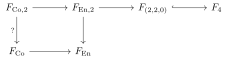
The tower relates the degree-\(2\) numerically polarized Coble and Enriques moduli \(F_{\Co,2}\) , \(\fentwo\) , their unpolarized quotients \(\fco\) , \(\fen\) , and the degree-\((2,2,0)\) K3 moduli space \(\fttz\injects F_4\) . The map \(F_{\Co,2}\to \fco\) marked \(?\) is the one not yet determined, for the reason above: \(\Gamma_{\Co,2}\) has no explicit description.
Period domains
By passing to the K3 cover, one can embed \(\fco\) into an arithmetic quotient of a 9-dimensional Hermitian symmetric domain of type \(\rm{IV}\) . Let \(\lkt = U^3 \oplus E_8^2\) be the canonical K3 lattice. We recall that for any primitively embedded lattice \(S\injects \lkt\) , letting \(T \definedas S^{\perp \lkt}\) , there is a Hodge-theoretic description of the coarse moduli space \(F_S\) of \(S\) -polarized K3 surfaces given by \[F_S \definedas D_T/\Orth^+(T)^*\]
where \(\Orth^+(T)^* \definedas \Orth^+(T) \intersect \ker\qty{\Orth(T) \to \Orth(q_T)}\) , the group \(\Orth^+(T)\) is the index-two subgroup of \(\Orth(T)\) preserving the component \(D_T\) , and \(D_T\) is a connected component of
\[
\Omega_T \definedas \theset{[v]\in \PP(T_\CC) \st v^2=0,\, v\bar v > 0}
.
\]
Proposition 47.4 (Dimension of a type IV domain) Let \(T\) be a lattice of rank \(r\) and signature \((2, r-2)\) . Then the type IV domain \(D_T\) has complex dimension \(r - 2\) .
Proof . \(T_\CC\) has dimension \(r\) , so \(\PP(T_\CC)\) has dimension \(r-1\) . The equation \(v^2 = 0\) is a single nondegenerate quadratic equation and cuts out a smooth quadric hypersurface of dimension \(r-2\) inside \(\PP(T_\CC)\) . The condition \(v\bar v > 0\) is open, so it selects an open subset of that quadric, and \(D_T\) is one of its connected components.
Corollary 47.5 (Dimension of $M$-polarized K3 moduli) Let \(M\injects\lkt\) be a primitive embedding of a lattice of signature \((1, \rank(M) - 1)\) with orthogonal complement \(T = M^{\perp\lkt}\) . Then \[
\dim_\CC D_T = \rank(T) - 2 = 20 - \rank(M)
.
\] For the Coble lattices \(\rank(S_\Co) = 11\) , so \(\dim_\CC D_{T_\Co} = 9\) .
Proof . \(22\) , so \(\rank(T) = 22 - \rank(M)\) , and \(T\) has signature \((2, 20 - \rank(M))\) ; apply the type-IV dimension proposition (Proposition 47.4 ).
Letting \(E_{10} \definedas U \oplus E_8\) , one can similarly consider the Enriques lattices \(\sen := E_{10}(2)\) with \(\ten = U \oplus E_{10}(2)\) . Letting
\[
\mch_{-2d} = \Union_{\delta^2 = -2d} \delta^{\perp D_T}
,
\]
be the union of the hyperplane sections cut out by the vectors \(\delta\) of norm \(-2d\) , as in Figure 47.1 , one can thus present
\[
\begin{aligned}
\fen &= \qty{D_{\ten} \sm \mch_{-2}} / \Orth^+(\ten)^* \\
\fco &= \mch_{-2} / \Orth^+(\ten)^* \\
F_{\Nod} &= \qty{\mch_{-4} \sm \mch_{-2}} / \Orth^+(\ten)^*
\end{aligned}
\]
where surfaces along the divisor \(\mch_{-2}\) in \(\fen\) correspond precisely to Coble surfaces and those along \(\mch_{-4}\sm \mch_{-2}\) correspond to Enriques surfaces with \(A_1\) singularities.
Figure 47.1: The period domain \(D_{\ten}\) together with the hyperplanes \(v_i^{\perp}\) cut out by vectors \(v_i\) of fixed negative norm. The Coble surfaces are precisely the periods lying on the hyperplanes of \(\mch_{-2}\) .
Alternatively, one can construct the period domain for \(\fco\) directly. Following (Dolgachev and Kondō 2013 Prop. 3.1) almost verbatim, let \(S\) be the blowup of \(\PP^2\) along 10 \(A_1\) singularities of a rational sextic curve \(C\) . The double branched cover \(f:X\to S\) branched along the proper transform of \(C\) contains the pullback of ten exceptional classes \(E_1,\cdots, E_{10}\) over the ten \(A_1\) singularities, as well as \(E_0\) , the pullback of a hyperplane class. Since \(E_i^2 = -2\) for \(1\leq i \leq 10\) , and one can show that \(E_0^2 = 2\) , the \(E_i\) generate a lattice isometric to
\[
S_\Co \definedas \generators{2}\oplus \generators{-2}^{10} = \latI_{1, 10}(2) = (11, 11, 1)_1 \cong \generators{-2} \oplus E_{10}(2)
.
\]
This follows from the fact that \(S_{\Co}\) is a 2-elementary lattice of signature \((1, 10)\) with discriminant group \((\bZ/2\bZ)^{11}\) and thus uniquely determined up to isometry by its invariants \((r,a,\delta)\) . Similarly, its orthogonal complement \(T_{\Co}\) in the K3 lattice \(\lkt\) is a 2-elementary lattice of signature \((2, 9)\) and satisfies \(q_{S_{\Co}} = -q_{T_{\Co}}\) . The isomorphism class of \(q_{T_{\Co}}\) determines \(T_\Co\) , and thus one has
\[
T_\Co \definedas S_\Co^{\perp \lkt} = (11, 11, 1)_2 \cong \generators{2} \oplus E_{10}(2)
.
\]
Alternatively, this follows immediately from the mirror move \(S\leadsto T\) of (Alexeev and Engel 2022 Thm. 5.10) applied to \(S_\Co =(11, 11, 1)_1\) . We obtain \(\fco\) as an open subset of the period domain \(D_{T_\Co}/\Orth^+(T_\Co)^*\) , a normal quasiprojective variety of dimension 9, by (Dolgachev and Kondō 2013 Prop. 3.2) and an application of the Torelli theorem for algebraic K3 surfaces from (Piatetski-Shapiro and Shafarevich 1971 ) . We note that (Dolgachev and Kondō 2013 ) shows that \(\fco\) is rational by relating it to a codimension one subvariety of a moduli space of certain \(A_2\) -singular quintics in \(\PP^2\) .
The sextic moduli construction
Notation 47.7 (Moduli of sextics of a fixed singular type) For a singular type \(T\) with root lattice \(R\) , write \(\mcv_T\) for the space of sextic curves \(Z\subset\PP^2\) with singularities exactly of type \(T\) , and \[
\mcm_T \definedas \PP\mcv_T \modmod \SL_3
\] for the moduli space of such curves, the quotient being taken in the sense of geometric invariant theory (Yu et al. 2025, sec. 2.1 ) . Let \(\wh X\) be the double cover of \(\PP^2\) branched along \(Z\) , let \(X\) be its minimal resolution — a K3 surface — and let \(H\in\Pic(X)\) be the pullback of the line class, so \(H^2 = 2\) . The exceptional curves of \(X\to\wh X\) span a copy \(L\iscontainedin\Pic(X)\) of the root lattice \(R\) , with the exceptional classes as a base \(\Delta\) . Write \(P\) for the primitive hull of \(\generators H\oplus L\) in \(H^2(X;\ZZ)\) and \(Q \definedas P^{\perp}\) , of signatures \((1,\rank R)\) and \((2, 19 - \rank R)\) (Yu et al. 2025, sec. 2.3 ) . For a general member of \(\mcv_T\) one has \(\Pic(X) = P\) (Yu et al. 2025, sec. 3.3 ) .
Proposition 47.8 (The Coble lattices are the lattices of the type $10A_1$) Let \(Z\) be an irreducible sextic of type \(T = 10A_1\) , so that \(Z\) is rational by the ten-nodal-sextic lemma (Lemma 34.1 ), and \(X\) is the K3 cover of the Coble surface \(S = X/\iota\) . Then \[
P = \generators{H}\oplus A_1^{\oplus 10} \cong \latI_{1,10}(2) = S_\Co,
\qquad
Q = P^{\perp\lkt} = T_\Co
.
\] In particular \(\dim D(Q) = 9\) .
Proof . \(\generators H\oplus L\) inside \(H^2(X;\ZZ)\) is \((\ZZ/2)^{l'-1}\) , where \(l'\) is the number of irreducible components of \(Z\) (Yu et al. 2025, sec. 5.3 ) ; for an irreducible sextic \(l' = 1\) , so no saturation occurs and \(P = \generators H\oplus L\) . With \(H^2 = 2\) and \(L = A_1^{\oplus 10} = \generators{-2}^{\oplus 10}\) this is \(\generators 2\oplus\generators{-2}^{\oplus 10} = \latI_{1,10}(2)\) , which is \(S_\Co\) by the Coble invariant-lattice proposition (Proposition 32.4 ). Taking orthogonal complements in \(\lkt\) gives \(Q = T_\Co\) , and the polarized-K3 dimension corollary (Corollary 47.5 ) gives the dimension.
Theorem 47.10 (The occult period map and its image) Let \(\Gamma_T\) be the image of \[
\Orth\bigl(H^2(X;\ZZ),\, \Delta,\, H\bigr) \too \Orth(Q)
,
\] restricted to the subgroup preserving a chosen component \(D(Q)\) ; it is arithmetic of finite index in \(\Orth(Q)\) , and contains every isometry of \(Q\) acting trivially on \(A_Q\) (Yu et al. 2025, sec. 3.1 ) . The occult period map \[
\per_T\colon \mcm_T \too \Gamma_T\backslash D(Q)
\] is an algebraic open embedding with image \(\Gamma_T\backslash\bigl(D(Q) - \mch_T\bigr)\) , where \(\mch_T\) is the arrangement of hyperplanes \(r^{\perp}\) for roots \(r\) orthogonal to \(H\) and not lying in \(L\) . When \(T\) is a nodal type, \(\per_T\) is moreover an isomorphism of orbifolds onto \(P\Gamma_T\backslash(D(Q) - \mch_T)\) (Yu et al. 2025, sec. 1 , §3.2, §3.3, §6.2) . The description of the image restates, at the level of moduli spaces, the equisingular deformation theory of Urabe (Urabe 1988 ) .
Theorem 47.11 (The GIT compactification is a Looijenga compactification) Let \(\Lambda_1 \definedas H^{\perp\lkt}\) , of signature \((2,19)\) with \(A_{\Lambda_1}\cong\ZZ/2\) , and let \(\Gamma_1\) be the arithmetic group of the degree-\(2\) K3 moduli space \(\Gamma_1\backslash D(\Lambda_1)\) . The roots of \(\Lambda_1\) fall into two \(\Gamma_1\) -orbits, of divisibility \(1\) and \(2\) , cutting out arrangements \(\mch_\Delta\) and \(\mch_\infty\) ; the roots of \(L\) all have divisibility \(1\) , so they contribute to \(\mch_\Delta\) only (Yu et al. 2025, sec. 4.1 , §4.2) . Set \[
\mch^{*}_T \definedas \mch_\infty \intersect D(Q) \iscontainedin \mch_T
.
\] Then \(\per_T\) extends to an isomorphism \[
\wh{\mcm}_T \;\cong\; \overline{\Gamma_T\backslash D(Q)}^{\,\mch^{*}_T}
\] between the GIT compactification of \(\mcm_T\) and the Looijenga compactification (the Looijenga-compactification definition (Definition 54.11 )) of \(\Gamma_T\backslash(D(Q) - \mch^{*}_T)\) , compatibly with the corresponding statement of Shah and Looijenga for the whole space of sextics, \(\overline{\mcm}\cong\overline{\Gamma_1\backslash D(\Lambda_1)}^{\,\mch_\infty}\) (Shah 1980 ; Looijenga 2002 ) ; the two vertical maps of the resulting square are normalizations onto their images (Yu et al. 2025, sec. 4.2 ) .
Question 47.13 (Which quotient of $D(T_\Co)$ is $\fco$?) \(\fco\) is defined above as an open subset of \(D(T_\Co)/\Orth^+(T_\Co)^*\) , a quotient by the stable orthogonal group, whereas \(\mcm_{10A_1}\) is a quotient by \(\Gamma_{10A_1}\) , which contains \(\Orth^+(T_\Co)^*\) and may be strictly larger. Identifying the two constructions of the Coble moduli space therefore requires the comparison \[
\Orth^+(T_\Co)^* \;\iscontainedin\; \Gamma_{10A_1} \;\iscontainedin\; \Orth(T_\Co)
,
\] together with the comparison of both against the polarized group \(\Gamma_{\Co,2}\) . Until the first inclusion is shown to be an equality, \(\mcm_{10A_1}\) and \(\fco\) are two arithmetic quotients of the same period domain by two different groups, not the same space under two names.
KSBA spaces
Alexeev, Valery, and Philip Engel. 2022. Compactifications of Moduli Spaces of K3 Surfaces with a Nonsymplectic Involution .
Alexeev, Valery, Philip Engel, D. Zack Garza, and Luca Schaffler. 2025. “Compact Moduli of Enriques Surfaces with a Numerical Polarization of Degree 2.” Nagoya Mathematical Journal .
Coble, Arthur B. 1919.
“The Ten Nodes of the Rational Sextic and of the Cayley Symmetroid .” American Journal of Mathematics 41 (4): 243–65.
https://doi.org/10.2307/2370285 .
Dawes, Matthew. 2022.
Orbits in Lattices .
https://doi.org/10.48550/arXiv.2205.10601 .
Dolgachev, Igor, and Shigeyuki Kondō. 2013. “The Rationality of the Moduli Spaces of Coble Surfaces and of Nodal Enriques Surfaces.” Izvestiya: Mathematics 77.
Horikawa, Eiji. 1977.
“On the Periods of Enriques Surfaces, II .” Proceedings of the Japan Academy, Series A, Mathematical Sciences 53 (2): 53–55.
https://doi.org/10.3792/pjaa.53.53 .
Looijenga, Eduard. 2002.
Compactifications Defined by Arrangements II : Locally Symmetric Varieties of Type IV .
https://doi.org/10.48550/arXiv.math/0201218 .
Piatetski-Shapiro, I. I., and I. R. Shafarevich. 1971.
“Torelli’s Theorem for Algebraic Surfaces of Type K3 .” Izv. Akad. Nauk SSSR Ser. Mat. 35: 530–72.
https://doi.org/10.1070/IM1971v005n03ABEH001075 .
Shah, Jayant. 1980.
“A Complete Moduli Space for K3 Surfaces of Degree 2.” Annals of Mathematics 112 (3): 485–510.
https://doi.org/10.2307/1971089 .
Sikirić, Mathieu Dutour, and Klaus Hulek. 2023.
Moduli of Polarized Enriques Surfaces – Computational Aspects .
https://doi.org/10.48550/arXiv.2302.01679 .
Urabe, Tohsuke. 1988.
“Combinations of Rational Singularities on Plane Sextic Curves with the Sum of Milnor Numbers Less Than Sixteen.” Banach Center Publications 20 (1): 429–56.
https://doi.org/10.4064/-20-1-429-456 .
Yang, Jin-Gen. 1996.
“Sextic Curves with Simple Singularities.” Tohoku Mathematical Journal 48 (2): 203–27.
https://doi.org/10.2748/tmj/1178225377 .
Yu, Chenglong, Zhiwei Zheng, and Yiming Zhong. 2025.
Moduli Spaces of Sextic Curves with Simple Singularities and Their Compactifications . arXiv:2505.16727. arXiv.
https://doi.org/10.48550/arXiv.2505.16727 .