Every compact connected surface without boundary is homeomorphic to \(S^2\), to a connected sum of \(g\ge1\) tori, or to a connected sum of \(k\ge1\) projective planes, and each of these is a quotient of a polygon by a pairing of its edges; moreover \(\RP^2\#\RP^2\#\RP^2\cong\RP^2\#T^2\). The Euler characteristic of a finite CW complex is the alternating count of its cells, equals \(\sum_k(-1)^k\operatorname{rank}H_k\), and is a homotopy invariant. A compact connected surface with \(b\) boundary circles is determined up to homeomorphism by \(b\), orientability, and \(\chi\), where \(\chi=2-2g-b\) in the orientable case and \(\chi=2-k-b\) in the nonorientable case. If a finite CW complex \(X\) is the union of subcomplexes \(A\) and \(B\), then \(\chi(X)=\chi(A)+\chi(B)-\chi(A\cap B)\), and an \(n\)-sheeted covering space \(\tilde X\) of \(X\) satisfies \(\chi(\tilde X)=n\chi(X)\).
Polygon models for surfaces (Tag PR-JL5JP)
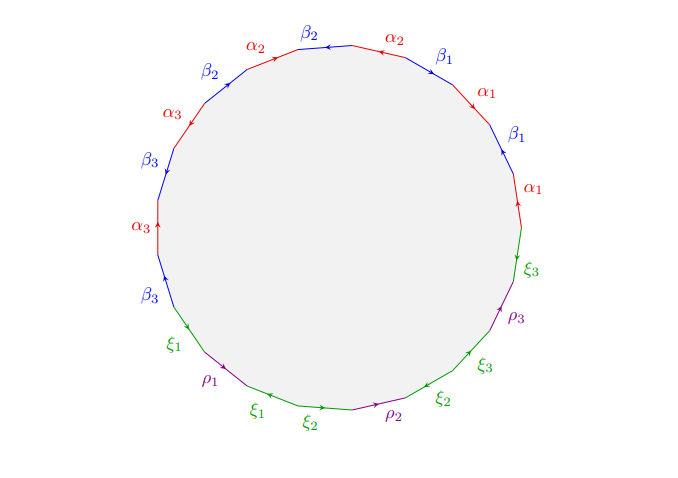
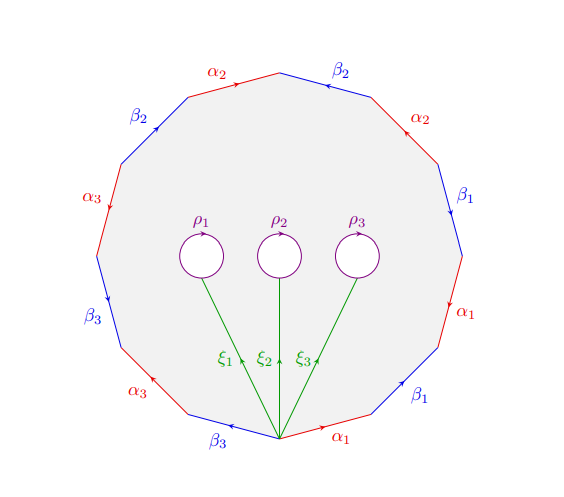
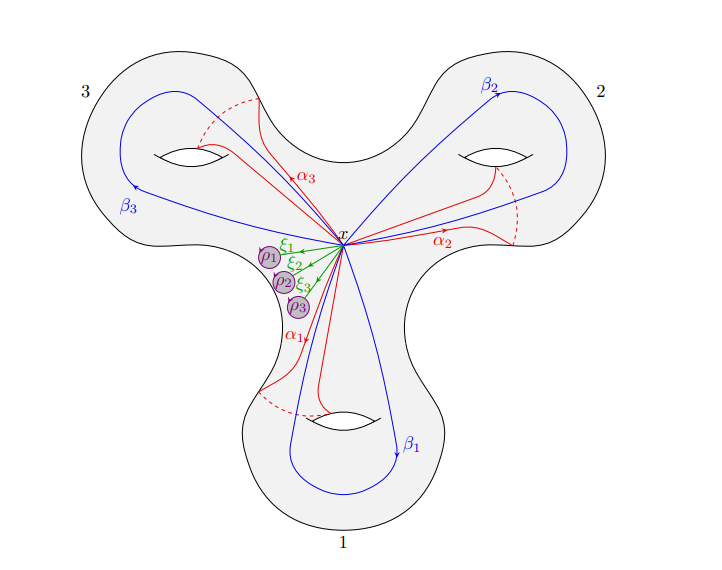
Every connected closed surface is homeomorphic to the quotient of a polygon whose edges are identified in pairs according to one of the words \(a_1a_1^{-1}\), \(a_1b_1a_1^{-1}b_1^{-1}\cdots a_gb_ga_g^{-1}b_g^{-1}\) (\(g\geq 1\)), or \(a_1a_1\cdots a_ka_k\) (\(k\geq 1\)) [@Mun00]. For compact surfaces with boundary, the orientable surface of genus \(g\) with \(b\) boundary circles is obtained from the word \(\alpha_1\beta_1\alpha_1^{-1}\beta_1^{-1}\cdots\alpha_g\beta_g\alpha_g^{-1}\beta_g^{-1}\,\xi_1\rho_1\xi_1^{-1}\cdots\xi_b\rho_b\xi_b^{-1}\), in which the edges \(\rho_j\) are left unidentified and become the boundary circles.
Classification of compact surfaces (Tag T-NBARV)
Let \(X\) be a compact connected surface and let \(b\) be the number of boundary components. Then exactly one of the following holds:
\(X\) is orientable and is homeomorphic to the connected sum of \(g\geq 0\) tori with the interiors of \(b\) disjoint discs removed;
\(X\) is nonorientable and is homeomorphic to the connected sum of \(k\geq 1\) copies of \(\RP^2\) with the interiors of \(b\) disjoint discs removed.
The Euler characteristic is \[ \chi(X)= \begin{cases} 2-2g-b & \text{if $X$ is orientable}, \\ 2-k-b & \text{if $X$ is nonorientable}. \end{cases} \]
Thus compact connected surfaces are classified up to homeomorphism by orientability, the number \(b\) of boundary components, and \(\chi(X)\); equivalently, by \((g,b)\) in the orientable case and \((k,b)\) in the nonorientable case. For closed surfaces (\(b=0\)), orientability and Euler characteristic alone determine the homeomorphism type [@Mun00]; [@Hat02].
Classification of closed surfaces (Tag FF-GBHJL)
Every connected closed surface is homeomorphic to exactly one of: the sphere \(S^2\); the connected sum \(\Sigma_g = \#_{i=1}^g T^2\) of \(g\geq 1\) tori; or the connected sum \(N_k = \#_{i=1}^k \RP^2\) of \(k\geq 1\) projective planes [@Mun00]; [@Hat02]. The surfaces \(\Sigma_g\) are orientable and the surfaces \(N_k\) are not.
Under connected sum, homeomorphism classes of connected closed surfaces form a commutative monoid with identity \(S^2\), generated by \(T = T^2\) and \(P = \RP^2\) subject to the relation \(T\# P \cong P\# P\# P\); the Klein bottle is \(K\cong P\# P\) [@Mun00].
Decomposing a Klein bottle (Tag PR-LIXWH)
The Klein bottle is a connected sum of two projective planes, \[ \KK \cong \RP^2 \# \RP^2 .\] Equivalently, \(\KK\) is the union of two Möbius bands glued along their boundary circles [@Hat02].
Rewriting a Klein bottle summand (Tag PR-BDH3V)
There is a homeomorphism \[ \RP^2 \# \KK \cong \RP^2 \# \TT^2 ,\] and both surfaces are homeomorphic to \(\RP^2\#\RP^2\#\RP^2\) [@Mun00].
Decomposing $\RP^2$ (Tag PR-GKRFP)
The real projective plane is obtained from a Möbius band \(\bbm\) and a closed disc \(D^2\) by identifying the boundary circle of \(\bbm\) with \(\partial D^2\) by a homeomorphism: \[ \RP^2 \cong \bbm \union_{\partial} D^2 .\]
Gluing two Möbius bands along their boundary circles gives the Klein bottle [@Hat02].
Euler characteristic of a finite CW complex (Tag D-QK5BM)
Let \(X\) be a finite CW complex with \(c_n\) cells of dimension \(n\). The Euler characteristic of \(X\) is \[ \chi(X)\coloneqq\sum_{n\geq0}(-1)^nc_n. \]
For a finite CW complex \(X\), \[ \chi(X)=\sum_{n\geq0}(-1)^n\rank H_n(X;\ZZ), \] where \(H_n(X;\ZZ)\) is singular homology [@Hat02]. Consequently \(\chi(X)\) does not depend on the CW structure, and finite CW complexes that are homotopy equivalent have the same Euler characteristic.
Euler characteristic in terms of genus (Tag FF-IEHB2)
Let \(g\geq 0\) and \(k\geq 1\). The closed orientable surface \(\Sigma_g\) of genus \(g\) and the closed nonorientable surface \(N_k\) of genus \(k\) have Euler characteristics \[ \chi(\Sigma_g) = 2-2g, \qquad \chi(N_k) = 2-k \] [@Hat02]. Removing the interiors of \(b\) disjoint closed discs from a closed surface lowers \(\chi\) by \(b\).
Euler characteristics of spheres, surfaces and the Klein bottle (Tag FF-W3AIU)
The Euler characteristics of the following spaces are \[ \chi(S^n) = 1 + (-1)^n \quad (n\geq 0),\qquad \chi(\Sigma_g) = 2-2g \quad (g\geq 0),\qquad \chi(\RP^2) = 1,\qquad \chi(K) = 0, \] where \(\Sigma_g\) is the closed orientable surface of genus \(g\) and \(K\) is the Klein bottle [@Hat02]. In particular \(\chi(S^1) = 0\), \(\chi(S^2) = 2\), \(\chi(\Sigma_1) = 0\), \(\chi(\Sigma_2) = -2\) and \(\chi(\Sigma_3) = -4\).
Euler characteristic of a connected sum of surfaces (Tag C-CT2NX)
Let \(A\) and \(B\) be closed surfaces, and let \(A \# B\) be their connected sum. Then the Euler characteristics satisfy \[ \chi(A \# B) = \chi(A) + \chi(B) - 2 .\]
Inclusion-exclusion for Euler characteristic (Tag PR-QV4U5)
Let \(X\) be a finite CW complex and \(U, V\subseteq X\) subcomplexes with \(X = U\cup V\). Then \[ \chi(X) = \chi(U) + \chi(V) - \chi (U\cap V) .\]
This follows by counting cells, since the Euler characteristic of a finite CW complex is the alternating sum of its numbers of cells [@Hat02].
Closed odd-dimensional manifolds have Euler characteristic zero (Tag PR-TU4G5)
Let \(M\) be a closed manifold of odd dimension. Then \(\chi(M) = 0\) [@Hat02].