For a space \(X\) and \(x_0\in X\), \(\pi_1(X,x_0)\) is the set of homotopy classes, relative to the endpoints, of loops at \(x_0\), with the group operation induced by concatenation. A path \(\gamma\) from \(x_0\) to \(x_1\) induces an isomorphism \(\pi_1(X,x_0)\to\pi_1(X,x_1)\), \([\alpha]\mapsto[\overline\gamma\cdot\alpha\cdot\gamma]\), which depends on \(\gamma\) only through its homotopy class; different paths give isomorphisms that differ by conjugation. A path-connected space is simply connected if its fundamental group is trivial, and convex subsets of \(\RR^n\) are simply connected through straight-line homotopies. The Seifert–van Kampen theorem: if \(X=U\cup V\) with \(U\) and \(V\) open, and \(U\), \(V\), and \(U\cap V\) path-connected and containing \(x_0\), then \(\pi_1(X,x_0)\cong\pi_1(U,x_0)*_{\pi_1(U\cap V,x_0)}\pi_1(V,x_0)\). The fundamental group of the wedge of \(n\) circles is the free group on \(n\) generators.
Path (Tag D-J6XOC)
Let \(X\) be a topological space and \(I\coloneqq[0,1]\). A path in \(X\) is a continuous map \(\gamma\colon I\to X\); it is a path from \(\gamma(0)\) to \(\gamma(1)\). A path \(\gamma\) is a loop if \(\gamma(0) = \gamma(1)\), and then it is a loop based at \(\gamma(0)\). For paths \(\gamma, \eta\colon I\to X\) with \(\gamma(1) = \eta(0)\), the concatenation \(\gamma\cdot\eta\colon I\to X\) is the path \[ (\gamma\cdot\eta)(s)\coloneqq \begin{cases} \gamma(2s) & 0\leq s\leq 1/2, \\ \eta(2s-1) & 1/2\leq s\leq 1. \end{cases} \]
See [@Hat02] and [@Mun00].
Fundamental group (Tag D-EBNUE)
Let \(X\) be a topological space and \(x_0\in X\), and let \(I = [0,1]\). The fundamental group \(\pi_1(X, x_0)\) is the set of classes of loops \(\gamma\colon I\to X\) based at \(x_0\) under homotopy rel endpoints, with multiplication \[ [\gamma][\eta]\coloneqq[\gamma\cdot\eta], \] where \(\gamma\cdot\eta\) is the concatenation of \(\gamma\) and \(\eta\).
The multiplication on \(\pi_1(X, x_0)\) is well defined and makes \(\pi_1(X, x_0)\) a group. Its identity is the class of the constant loop at \(x_0\), and \(\inverseof{[\gamma]} = [\bar\gamma]\), where \(\bar\gamma(s)\coloneqq\gamma(1-s)\).
Let \(h\colon I\to X\) be a path from \(x_0\) to \(x_1\), with reverse \(\bar h\). Then \(\beta_h\colon\pi_1(X, x_1)\to\pi_1(X, x_0)\), \(\beta_h[\gamma]\coloneqq[h\cdot\gamma\cdot\bar h]\), is a group isomorphism. It depends only on the homotopy class of \(h\) rel endpoints, and for a second path \(h'\) from \(x_0\) to \(x_1\), \(\beta_{h'} = c\circ\beta_h\), where \(c\) is conjugation by \([h'\cdot\bar h]\in\pi_1(X, x_0)\). In particular, if \(X\) is path connected, the groups \(\pi_1(X, x)\) for \(x\in X\) are all isomorphic.
See [@Hat02].
Simply connected space (Tag D-GFM35)
A topological space \(X\) is simply connected if \(X\) is path connected and the fundamental group \(\pi_1(X, x_0)\) is trivial for every \(x_0\in X\).
For a path connected space \(X\), the following are equivalent:
\(X\) is simply connected;
every continuous map \(\gamma\colon S^1\to X\) is homotopic to a constant map;
every continuous map \(\gamma\colon S^1\to X\) extends to a continuous map \(\hat\gamma\colon D^2\to X\), that is, \(\hat\gamma|_{S^1} = \gamma\);
any two paths \(p_1, p_2\colon[0,1]\to X\) with \(p_1(0) = p_2(0)\) and \(p_1(1) = p_2(1)\) are homotopic rel endpoints.
See [@Hat02].
$\pi_1$ detects simple connectivity (Tag PR-EWJMJ)
Let \(X\) be a path-connected space. Then \(X\) is simply connected if and only if \(\pi_1(X, x_0) = 1\) for some, equivalently every, basepoint \(x_0\in X\) [@Hat02].
Maps into a convex set are homotopic (Tag T-2YTCZ)
Let \(X\) be a topological space and \(C\subseteq\RR^n\) a convex subset. Any two continuous maps \(f, g\colon X\to C\) are homotopic, via the linear homotopy \(F(x,t) = (1-t)f(x) + t\,g(x)\), which lies in \(C\) by convexity. For \(X = [0,1]\) and paths with common endpoints, the linear homotopy is a homotopy rel endpoints [@Hat02].
Free product of groups (Tag D-JDDCP)
Let \((G_\alpha)_{\alpha\in A}\) be a family of groups. A reduced word is a finite sequence \(g_1g_2\cdots g_k\), \(k\geq 0\), in which each letter \(g_i\) lies in \(G_{\alpha_i}\sm\ts{1}\) for some \(\alpha_i\in A\) and \(\alpha_i\neq\alpha_{i+1}\) for \(1\leq i<k\). The free product \(\ast_{\alpha\in A} G_\alpha\) is the set of reduced words, with product given by concatenating two words and then reducing: adjacent letters from the same \(G_\alpha\) are replaced by their product in \(G_\alpha\), and letters equal to \(1\) are deleted, until the word is reduced.
The free product \(\ast_\alpha G_\alpha\) is a group whose identity is the empty word, and each \(G_\beta\) is a subgroup via one-letter words. For every group \(H\) and homomorphisms \(\varphi_\alpha\colon G_\alpha\to H\) there is a unique homomorphism \(\varphi\colon\ast_\alpha G_\alpha\to H\) restricting to \(\varphi_\alpha\) on each \(G_\alpha\), so \(\ast_\alpha G_\alpha\) is the coproduct of the \(G_\alpha\) in \(\Grp\).
For a set \(S\), the free group on \(S\) is isomorphic to \(\ast_{s\in S}\ZZ\).
See [@Hat02].
Free product with amalgamation (Tag D-WSFYS)
Let \(A\), \(B\), and \(C\) be groups, and let \(i\colon C\to A\) and \(j\colon C\to B\) be homomorphisms. The free product with amalgamation of \(A\) and \(B\) over \(C\) is \[ A \ast_C B \coloneqq \qty{A \ast B} / N, \] where \(A\ast B\) is the free product and \(N\) is the normal subgroup of \(A\ast B\) generated by \(\ts{ i(c) \inverseof{j(c)} \st c\in C }\).
Together with the homomorphisms \(A\to A\ast_C B\) and \(B\to A\ast_C B\) induced by the inclusions of \(A\) and \(B\) into \(A\ast B\), the group \(A\ast_C B\) is the pushout of \(A\xleftarrow{i} C\xrightarrow{j} B\) in \(\Grp\).
By van Kampen's theorem, if \(X = U_1\union U_2\) with \(U_1\), \(U_2\) and \(U_1\intersect U_2\) open and path-connected, then \(\pi_1(X)\) is the free product of \(\pi_1(U_1)\) and \(\pi_1(U_2)\) amalgamated over \(\pi_1(U_1\intersect U_2)\) [@Hat02].
[@Hat02].
Seifert--van Kampen theorem (Tag T-BTPU4)
Let \(X = U_{1} \union U_{2}\), where \(U_1\), \(U_2\) and \(U_1\intersect U_2\) are open, path-connected and nonempty, and let \(x_0 \in U_1\intersect U_2\). Let \(\iota_k\colon \pi_1(U_1\intersect U_2, x_0)\to\pi_1(U_k, x_0)\), \(k = 1, 2\), be induced by the inclusions. Then the inclusions \(U_1, U_2\injects X\) induce an isomorphism \[ \pi_{1}(U_1, x_0) \ast_{\pi_{1}(U_1 \intersect U_2, x_0)} \pi_{1}(U_2, x_0) \xrightarrow{\ \sim\ } \pi_{1}(X, x_0) \] onto \(\pi_1(X, x_0)\) from the free product with amalgamation, which is the pushout of \(\pi_1(U_1, x_0)\xleftarrow{\iota_1}\pi_1(U_1\intersect U_2, x_0)\xrightarrow{\iota_2}\pi_1(U_2, x_0)\) in the category of groups [@Hat02].
Let \(X = U_1\union U_2\), where \(U_1\), \(U_2\) and \(U_1\intersect U_2\) are open, path-connected and nonempty, let \(x_0\in U_1\intersect U_2\), and let \(\iota_k\colon \pi_1(U_1\intersect U_2, x_0)\to\pi_1(U_k, x_0)\), \(k = 1, 2\), be induced by the inclusions. Suppose \[ \pi_{1}(U_1, x_0) = \left\langle u_{1}, \ldots, u_{k} \suchthat \alpha_{1}, \ldots, \alpha_{l}\right\rangle, \qquad \pi_{1}(U_2, x_0) = \left\langle v_{1}, \ldots, v_{m} \suchthat \beta_{1}, \ldots, \beta_{n}\right\rangle, \] and that \(w_1, \ldots, w_p\) generate \(\pi_1(U_1\intersect U_2, x_0)\). Then \[ \pi_{1}(X, x_0) \cong \left\langle u_{1}, \ldots, u_{k}, v_{1}, \ldots, v_{m} \suchthat \alpha_{1}, \ldots, \alpha_{l},\ \beta_{1}, \ldots, \beta_{n},\ \iota_1(w_{1}) \iota_2(w_{1})^{-1}, \ldots, \iota_1(w_{p}) \iota_2(w_{p})^{-1} \right\rangle \] [@Hat02].
The hypothesis that \(U_1 \intersect U_2\) is path-connected is necessary: for \(S^1\) covered by two open arcs, the intersection has two components, both arcs are simply connected, and \(\pi_1(S^1)\cong\ZZ\).
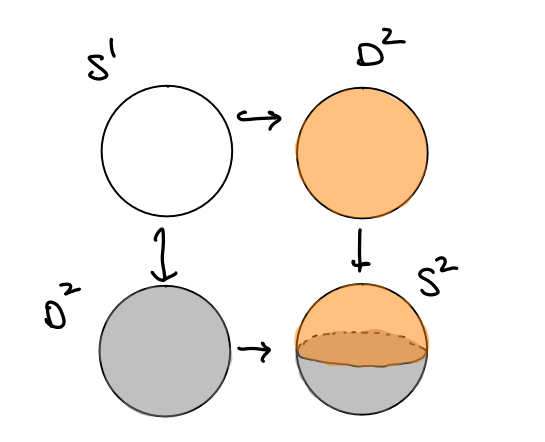
$\pi_1$ of a wedge sum (Tag PR-3APOT)
Let \((X, x_0)\) and \((Y, y_0)\) be path-connected pointed spaces such that \(x_0\) and \(y_0\) are deformation retracts of open neighborhoods in \(X\) and \(Y\) respectively. Then the inclusions induce an isomorphism \[ \pi_1(X)\ast\pi_1(Y)\xrightarrow{\ \sim\ }\pi_1(X \vee Y) \] [@Hat02].
$\pi_1$ of a product (Tag PR-OO3DH)
Let \(X\) and \(Y\) be path-connected spaces. Then the projections induce an isomorphism \[ \pi_1 (X \cross Y) \xrightarrow{\ \sim\ } \pi_1(X) \cross \pi_1(Y) \] [@Hat02].
Homotopy groups (Tag D-EUX36)
Let \(X\) be a topological space, \(x_0\in X\), and \(n\geq 1\), and let \(I^n = [0,1]^n\) with boundary \(\del I^n\). The \(n\)th homotopy group \(\pi_n(X, x_0)\) is the set of homotopy classes of maps \(f\colon(I^n, \del I^n)\to(X, x_0)\), where the homotopies \(f_t\) are required to satisfy \(f_t(\del I^n) = \ts{x_0}\) for all \(t\), with the operation \([f]+[g]\coloneqq[f+g]\) given by \[ (f+g)(s_1, s_2, \ldots, s_n)\coloneqq \begin{cases} f(2s_1, s_2, \ldots, s_n) & 0\leq s_1\leq 1/2, \\ g(2s_1-1, s_2, \ldots, s_n) & 1/2\leq s_1\leq 1. \end{cases} \]
For \(n\geq 1\) the operation on \(\pi_n(X, x_0)\) is well defined and makes \(\pi_n(X, x_0)\) a group, and \(\pi_1(X, x_0)\) is the fundamental group. For \(n\geq 2\) the group \(\pi_n(X, x_0)\) is abelian. Since \(I^n/\del I^n\cong S^n\), the set \(\pi_n(X, x_0)\) is in bijection with the set \([(S^n, s_0), (X, x_0)]\) of based homotopy classes of based maps \((S^n, s_0)\to(X, x_0)\).
See [@Hat02].