A space is compact if every open cover has a finite subcover. For continuous \(f\colon X\to Y\) with \(X\) compact, \(f(X)\) is compact; for \(Y=\RR\), \(f\) attains its maximum and minimum; and if \(Y\) is Hausdorff and \(f\) is bijective, \(f\) is a homeomorphism. Closed subsets of compact spaces are compact, and compact subsets of Hausdorff spaces are closed. The tube lemma: if \(Y\) is compact and \(N\) is an open subset of \(X\times Y\) containing \(\{x_0\}\times Y\), then \(N\) contains \(W\times Y\) for some neighbourhood \(W\) of \(x_0\). The tube lemma shows that a product of two compact spaces is compact, and Tychonoff’s theorem extends this to arbitrary products. A metric space is compact if and only if it is complete and totally bounded.
Cover of a space or subset (Tag D-AOJG3)
Let \(X\) be a set and \(\mathcal U = \ts{U_\alpha}_{\alpha\in I}\) a collection of subsets of \(X\). The collection \(\mathcal U\) is a cover of \(X\) if \(X = \Union_{\alpha\in I} U_\alpha\), and a cover of a subset \(A\subseteq X\) if \(A\subseteq \Union_{\alpha\in I} U_\alpha\). If \(X\) is a topological space and every \(U_\alpha\) is open, \(\mathcal U\) is an open cover.
Compact space (Tag D-EILKJ)
A topological space \((X, \tau)\) is compact if every open cover of \(X\) has a finite subcover: for every family \((U_j)_{j\in J}\) in \(\tau\) with \(X = \bigcup_{j\in J} U_j\), there is a finite subset \(J'\subseteq J\) with \(X = \bigcup_{j\in J'} U_j\).
Quasicompact (Tag D-MQSFD)
A topological space \(X\), not necessarily Hausdorff, is quasicompact if every open cover of \(X\) has a finite subcover. A quasicompact space is compact if it is also Hausdorff.
Requiring compact spaces to be Hausdorff is the convention of Bourbaki and of algebraic geometry, where the Zariski topology on the spectrum \(\Spec A\) of a commutative ring \(A\) is always quasicompact and is Hausdorff if and only if every prime ideal of \(A\) is maximal. In [@Mun00] a space is compact under the open-cover condition alone, so compact in that sense means quasicompact in the Bourbaki convention.
Locally compact space (Tag D-5EOQZ)
A topological space \(X\) is locally compact if every \(x\in X\) has a neighborhood \(U\) contained in a compact subset \(K\subseteq X\).
Every compact space \(X\) is locally compact, with \(U = K = X\). The converse fails: for \(n\geq 1\), \(\RR^n\) is locally compact, since each \(x\) lies in an open ball whose closure is compact, but \(\RR^n\) is not compact.
The following subspaces of Euclidean space are not locally compact:
\(\QQ\subseteq\RR\);
\(\ts{\mathbf 0} \union \ts{(x, y)\in\RR^2 \st x>0} \subseteq\RR^2\), in which the origin has no neighborhood contained in a compact subset.
Some authors also require a locally compact space to be Hausdorff. For Hausdorff \(X\) the condition above is equivalent to every point having a neighborhood whose closure is compact.
[@Mun00].
Paracompact space (Tag D-HQSEQ)
A topological space \(X\) is paracompact if every open cover of \(X\) has a locally finite open refinement that covers \(X\).
The relation \(\mcv\leq\mcu\) if \(\mcv\) refines \(\mcu\) is a preorder on the set of open covers of \(X\).
See [@Mun00].
Continuous images of compact, connected and separable spaces (Tag PR-ZCUXL)
Let \(f\colon X\to Y\) be continuous.
If \(X\) is compact, then \(f(X)\) is compact [@Mun00].
If \(X\) is connected, then \(f(X)\) is connected [@Mun00].
If \(D\subseteq X\) is dense, then \(f(D)\) is dense in \(f(X)\) with the subspace topology; in particular, if \(X\) is separable, then so is \(f(X)\), and if \(f\) is surjective, then \(f(D)\) is dense in \(Y\).
A continuous map need not be open or closed: the constant map \(\RR\to\RR\), \(x\mapsto 0\), sends the open set \(\RR\) to \(\ts{0}\), which is not open, and \(x\mapsto e^x\) sends the closed set \(\RR\) to \((0,\infty)\), which is not closed in \(\RR\).
Continuous image of compact is compact (Tag T-TJBYR)
Let \(f\colon X\to Y\) be continuous and \(K\subseteq X\) compact. Then \(f(K)\) is compact [@Mun00].
Closed subsets of compact spaces are compact (Tag T-UEXBK)
Let \(B\) be a compact space and \(A\subseteq B\) a closed subset. Then \(A\) is compact [@Mun00].
Extreme value theorem (Tag T-OPK3N)
Let \(f\colon X \to Y\) be continuous, where \(X\) is a nonempty compact space and \(Y\) is an ordered set in the order topology. Then there exist \(c, d\in X\) with \(f(c)\leq f(x)\leq f(d)\) for every \(x\in X\) [@Mun00].
A continuous bijection from a compact space to a Hausdorff space is a homeomorphism (Tag FT-M5BHD)
Let \(f\colon X\to Y\) be a continuous bijection. If \(X\) is compact and \(Y\) is Hausdorff, then \(f\) is a homeomorphism [@Mun00].
Closed subspaces of compact spaces are compact, continuous images of compact spaces are compact, and compact subspaces of Hausdorff spaces are closed [@Mun00]. Hence \(f\) is a closed map, so \(\inverseof{f}\) is continuous.
Maps from compact spaces to Hausdorff spaces (Tag T-N6PYS)
Let \(f\colon X\to Y\) be continuous, with \(X\) compact and \(Y\) Hausdorff. Then
\(f\) is a closed map [@Mun00];
if \(f\) is surjective, \(f\) is a quotient map [@Lee13];
if \(f\) is injective, \(f\) is a topological embedding [@Lee13];
if \(f\) is bijective, \(f\) is a homeomorphism [@Mun00].
The tube lemma (Tag T-G4GO4)
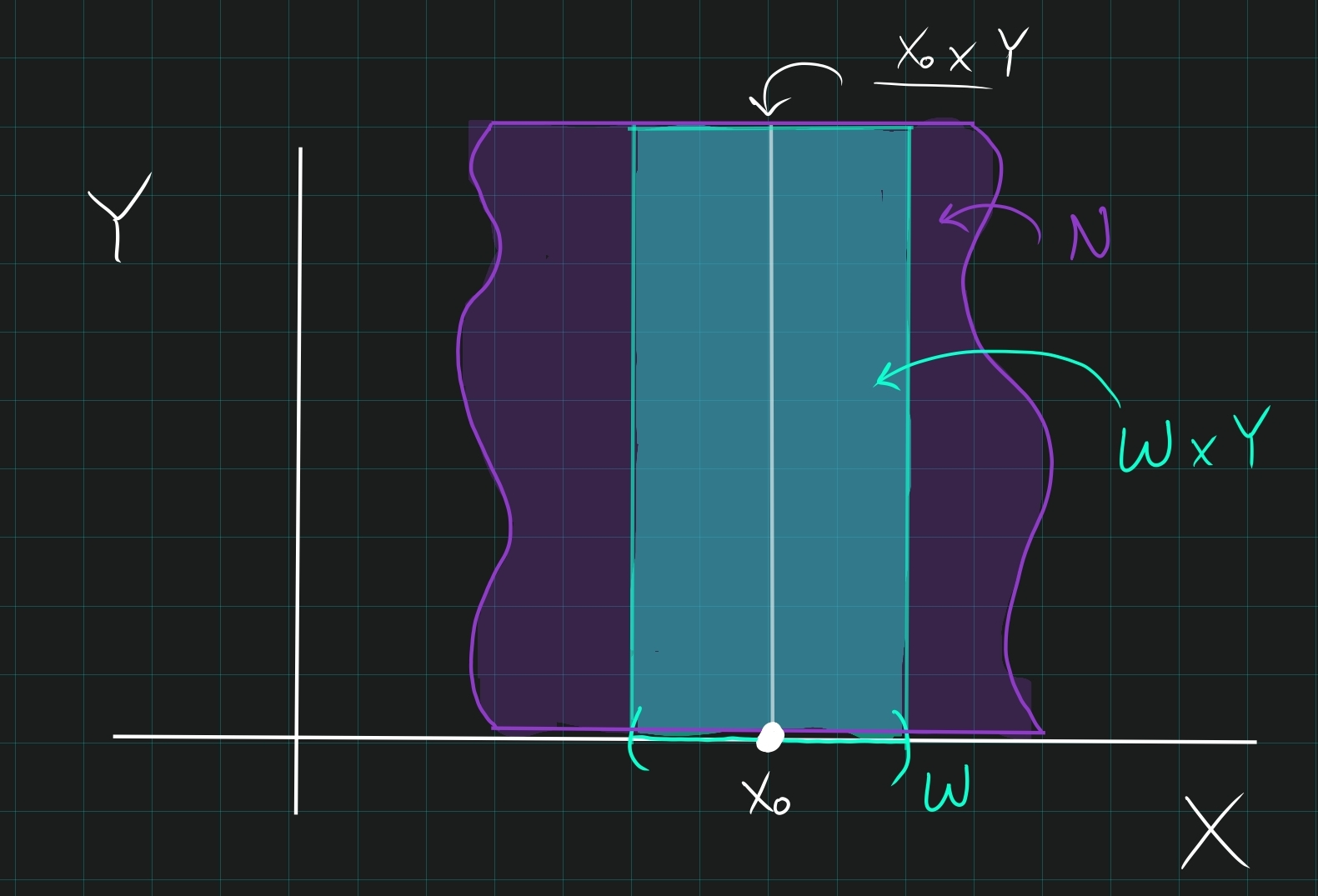
Let \(X, Y\) be topological spaces with \(Y\) compact, and let \(x_0\in X\). If \(N\subseteq X\cross Y\) is an open set containing the slice \(\theset{x_0} \cross Y\), then there is a neighborhood \(W\) of \(x_0\) in \(X\) with \(W\cross Y\subseteq N\) [@Mun00].
Compact if and only if complete and totally bounded (Tag T-HH3YP)
A metric space is compact if and only if it is complete and totally bounded [@Mun00].
Cantor's intersection theorem (Tag T-7DICT)
Let \(X\) be a compact space and let \(C_1 \supseteq C_2 \supseteq \cdots\) be a decreasing sequence of nonempty closed subsets of \(X\). Then \(\Intersect_n C_n \neq \emptyset\) [@Mun00].
If \(X\) is Hausdorff, it suffices that each \(C_n\) be nonempty and compact, since compact subsets of Hausdorff spaces are closed [@Mun00]. Without closedness the conclusion fails: in an infinite set \(\NN\) with the indiscrete topology every subset is compact, and \(C_n = \ts{n, n+1, \ldots}\) is a decreasing sequence of nonempty compact sets with empty intersection.